

217
Atmospheric Chemistry
Low levels of NO 2 are needed to prevent the formation of ClONO 2 . Reactions on ice have
been proposed to explain how the inert compound becomes active:
ClONO 2 + HCl → Cl 2 + HNO 3
(5.49)
ClONO 2 + H 2 O → HOCl + HNO 3
(5.50)
The unique meteorology of Antarctica results in a circulation of air in the stratosphere that
is different from the Northern Hemisphere. A stream of air called the polar vortex tends
to circle the South Pole in the winter. Air trapped in the vortex becomes very cold (–90°C)
and forms clouds even in very dry conditions. These clouds provide ice crystals that have
been shown by laboratory studies to cause molecules of HCl and ClONO 2 to react. The Cl 2
gas formed is released to the gas phase, whereas HNO 3 remains in the ice. The Cl 2 reacts
with light to produce 2Cl·, which further reacts with O 3 to produce more ClO. The total
reaction sequence is
ClONO 2 + HCl → Cl 2 + HNO 3
(5.51)
Cl 2 + hυ → 2Cl·
(5.52)
2Cl· + 2O 3 → 2ClO + 2O 2
(5.53)
ClO + NO 2 → ClONO 2
(5.54)
The net reaction is
HCl + 2O 3 + NO 2 → HNO 3 + 2O 2 + ClO
(5.55)
The HCl gets rid of NO 2 and forms ClO, which further removes O 3 . Although these reactions explain the formation of the ozone hole formed in Antarctica, further work is needed
Approximate Latitude
O
3 (ppm)
8
10
12
14
16
18
20
22
24
26
ClO (ppb)
0.0
0.2
0.4
0.6
0.8
1.0
1.2
ClO
O 3
63°S
72°S
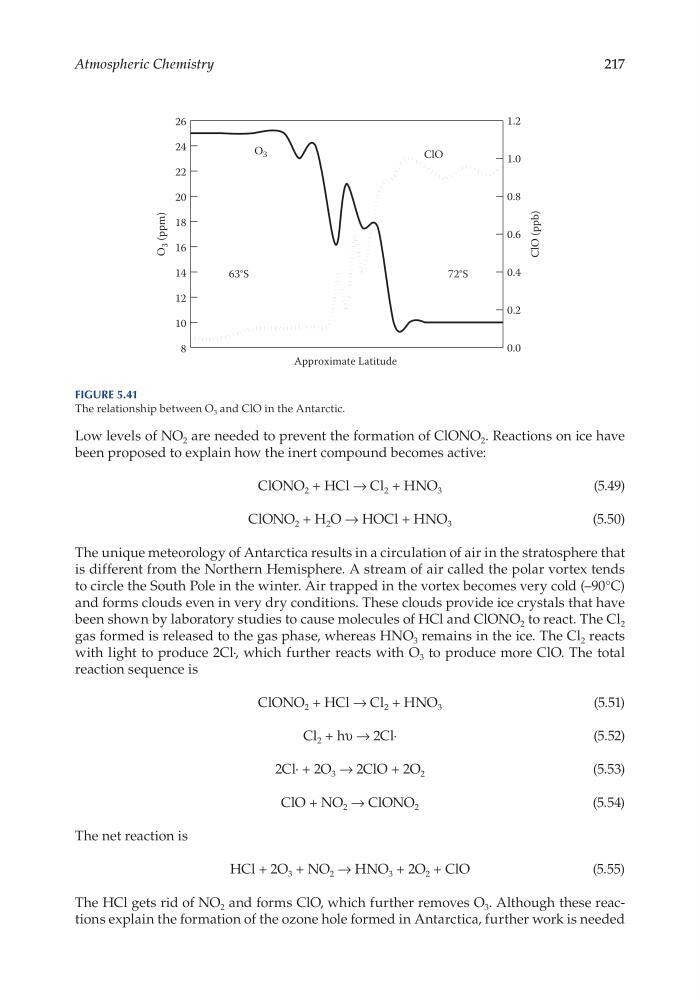
Figure 5.41
The relationship between O 3 and ClO in the Antarctic.
Atmospheric Chemistry
Low levels of NO 2 are needed to prevent the formation of ClONO 2 . Reactions on ice have
been proposed to explain how the inert compound becomes active:
ClONO 2 + HCl → Cl 2 + HNO 3
(5.49)
ClONO 2 + H 2 O → HOCl + HNO 3
(5.50)
The unique meteorology of Antarctica results in a circulation of air in the stratosphere that
is different from the Northern Hemisphere. A stream of air called the polar vortex tends
to circle the South Pole in the winter. Air trapped in the vortex becomes very cold (–90°C)
and forms clouds even in very dry conditions. These clouds provide ice crystals that have
been shown by laboratory studies to cause molecules of HCl and ClONO 2 to react. The Cl 2
gas formed is released to the gas phase, whereas HNO 3 remains in the ice. The Cl 2 reacts
with light to produce 2Cl·, which further reacts with O 3 to produce more ClO. The total
reaction sequence is
ClONO 2 + HCl → Cl 2 + HNO 3
(5.51)
Cl 2 + hυ → 2Cl·
(5.52)
2Cl· + 2O 3 → 2ClO + 2O 2
(5.53)
ClO + NO 2 → ClONO 2
(5.54)
The net reaction is
HCl + 2O 3 + NO 2 → HNO 3 + 2O 2 + ClO
(5.55)
The HCl gets rid of NO 2 and forms ClO, which further removes O 3 . Although these reactions explain the formation of the ozone hole formed in Antarctica, further work is needed
Approximate Latitude
O
3 (ppm)
8
10
12
14
16
18
20
22
24
26
ClO (ppb)
0.0
0.2
0.4
0.6
0.8
1.0
1.2
ClO
O 3
63°S
72°S
Figure 5.41
The relationship between O 3 and ClO in the Antarctic.