

188
Chemical Oceanography, 4th Edition
The hydrogen peroxide (H 2 O 2 ) is removed in rain. The chemistry of the methyperoxyl
radical (CH 3 O 2 ) is quite complicated, and not all of its reactions are known at present.
Mathematical models have been used to simulate these reactions, and the average OH·
concentration is about 2 to 20 × 10 5 radicals per cubic centimeter, with the highest levels
in the tropics. Model calculations predict that about 20% more OH· radicals should be
found in the Southern Hemisphere. This is caused by the higher CO concentrations in the
Northern Hemisphere. Direct measurements of OH· radicals in the atmosphere are difficult to make because of their low concentration and high reactivity. The largest loss of the
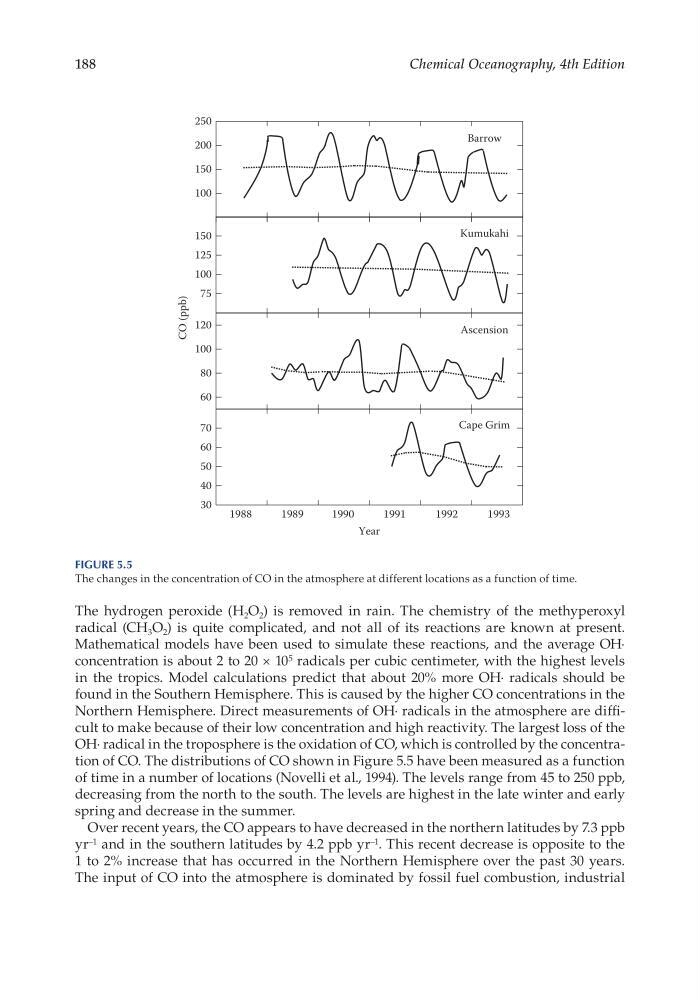
OH· radical in the troposphere is the oxidation of CO, which is controlled by the concentration of CO. The distributions of CO shown in Figure 5.5 have been measured as a function
of time in a number of locations (Novelli et al., 1994). The levels range from 45 to 250 ppb,
decreasing from the north to the south. The levels are highest in the late winter and early
spring and decrease in the summer.
Over recent years, the CO appears to have decreased in the northern latitudes by 7.3 ppb
yr –1 and in the southern latitudes by 4.2 ppb yr –1 . This recent decrease is opposite to the
1 to 2% increase that has occurred in the Northern Hemisphere over the past 30 years.
The input of CO into the atmosphere is dominated by fossil fuel combustion, industrial
100
150
200
250
CO (ppb)
75
100
125
150
60
80
100
120
Ascension
Kumukahi
Barrow
Year
30
40
50
60
70
Cape Grim
1988
1989
1990
1991
1992
1993
Figure 5.5
The changes in the concentration of CO in the atmosphere at different locations as a function of time.
Chemical Oceanography, 4th Edition
The hydrogen peroxide (H 2 O 2 ) is removed in rain. The chemistry of the methyperoxyl
radical (CH 3 O 2 ) is quite complicated, and not all of its reactions are known at present.
Mathematical models have been used to simulate these reactions, and the average OH·
concentration is about 2 to 20 × 10 5 radicals per cubic centimeter, with the highest levels
in the tropics. Model calculations predict that about 20% more OH· radicals should be
found in the Southern Hemisphere. This is caused by the higher CO concentrations in the
Northern Hemisphere. Direct measurements of OH· radicals in the atmosphere are difficult to make because of their low concentration and high reactivity. The largest loss of the
OH· radical in the troposphere is the oxidation of CO, which is controlled by the concentration of CO. The distributions of CO shown in Figure 5.5 have been measured as a function
of time in a number of locations (Novelli et al., 1994). The levels range from 45 to 250 ppb,
decreasing from the north to the south. The levels are highest in the late winter and early
spring and decrease in the summer.
Over recent years, the CO appears to have decreased in the northern latitudes by 7.3 ppb
yr –1 and in the southern latitudes by 4.2 ppb yr –1 . This recent decrease is opposite to the
1 to 2% increase that has occurred in the Northern Hemisphere over the past 30 years.
The input of CO into the atmosphere is dominated by fossil fuel combustion, industrial
100
150
200
250
CO (ppb)
75
100
125
150
60
80
100
120
Ascension
Kumukahi
Barrow
Year
30
40
50
60
70
Cape Grim
1988
1989
1990
1991
1992
1993
Figure 5.5
The changes in the concentration of CO in the atmosphere at different locations as a function of time.