

187
Atmospheric Chemistry
O( 1 D) + M → O( 3 P) + M
(5.10)
This ultimately reacts with O 2 to form O 3 , which also results in no net chemical change.
Occasionally, O( 1 D) collides with water to generate two hydroxyl radicals:
O( 1 D) + H 2 O → 2 OH·
(5.11)
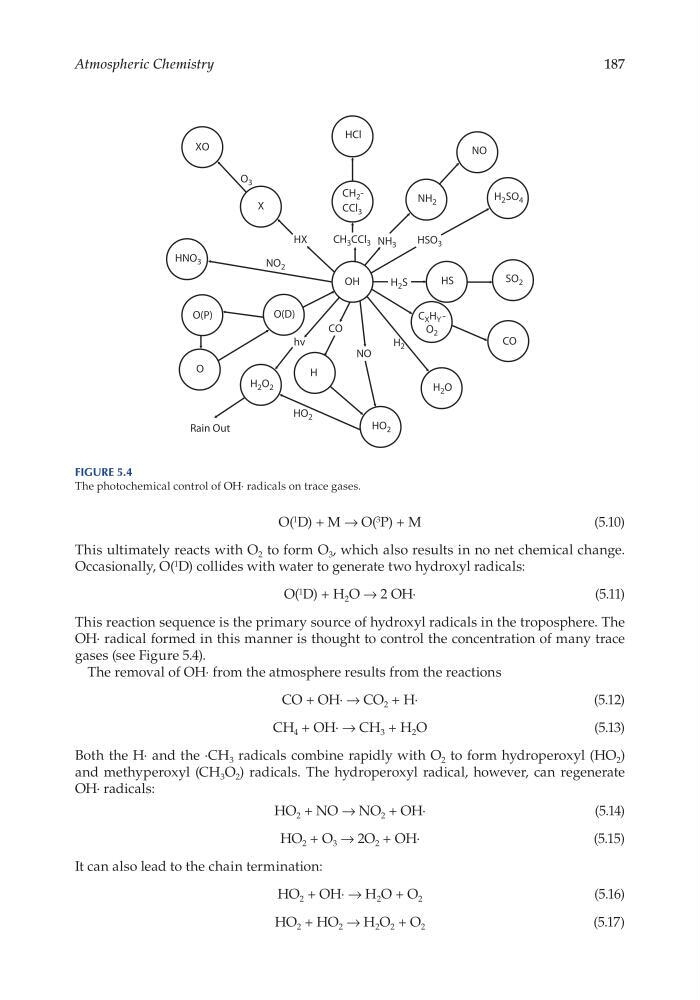
This reaction sequence is the primary source of hydroxyl radicals in the troposphere. The
OH· radical formed in this manner is thought to control the concentration of many trace
gases (see Figure 5.4).
The removal of OH· from the atmosphere results from the reactions
CO + OH· → CO 2 + H·
(5.12)
CH 4 + OH· → CH 3 + H 2 O
(5.13)
Both the H· and the ·CH 3 radicals combine rapidly with O 2 to form hydroperoxyl (HO 2 )
and methyperoxyl (CH 3 O 2 ) radicals. The hydroperoxyl radical, however, can regenerate
OH· radicals:
HO 2 + NO → NO 2 + OH·
(5.14)
HO 2 + O 3 → 2O 2 + OH·
(5.15)
It can also lead to the chain termination:
HO 2 + OH· → H 2 O + O 2
(5.16)
HO 2 + HO 2 → H 2 O 2 + O 2
(5.17)
HCl
XO
NO
O 3
CH 2 -
NH 2
H 2 SO 4
X
CCl 3
CH 3 CCl 3 NH 3
HSO 3
HNO 3
NO 2
OH
H 2 S
HS
SO 2
O(P)
O(D)
C X H Y -
O 2
CO
hv
H 2
CO
NO
O
H
H 2 O 2
H 2 O
HO 2
Rain Out
HO 2
HX
Figure 5.4
The photochemical control of OH· radicals on trace gases.
Atmospheric Chemistry
O( 1 D) + M → O( 3 P) + M
(5.10)
This ultimately reacts with O 2 to form O 3 , which also results in no net chemical change.
Occasionally, O( 1 D) collides with water to generate two hydroxyl radicals:
O( 1 D) + H 2 O → 2 OH·
(5.11)
This reaction sequence is the primary source of hydroxyl radicals in the troposphere. The
OH· radical formed in this manner is thought to control the concentration of many trace
gases (see Figure 5.4).
The removal of OH· from the atmosphere results from the reactions
CO + OH· → CO 2 + H·
(5.12)
CH 4 + OH· → CH 3 + H 2 O
(5.13)
Both the H· and the ·CH 3 radicals combine rapidly with O 2 to form hydroperoxyl (HO 2 )
and methyperoxyl (CH 3 O 2 ) radicals. The hydroperoxyl radical, however, can regenerate
OH· radicals:
HO 2 + NO → NO 2 + OH·
(5.14)
HO 2 + O 3 → 2O 2 + OH·
(5.15)
It can also lead to the chain termination:
HO 2 + OH· → H 2 O + O 2
(5.16)
HO 2 + HO 2 → H 2 O 2 + O 2
(5.17)
HCl
XO
NO
O 3
CH 2 -
NH 2
H 2 SO 4
X
CCl 3
CH 3 CCl 3 NH 3
HSO 3
HNO 3
NO 2
OH
H 2 S
HS
SO 2
O(P)
O(D)
C X H Y -
O 2
CO
hv
H 2
CO
NO
O
H
H 2 O 2
H 2 O
HO 2
Rain Out
HO 2
HX
Figure 5.4
The photochemical control of OH· radicals on trace gases.