

186
Chemical Oceanography, 4th Edition
cannot oxidize reduced gases in the troposphere. At one time, it was thought that O 3 and
H 2 O 2 were oxidizers in the troposphere. Now, the OH· radical is thought to be the oxidizer.
The production of OH· radicals is initiated by the photolysis of O 3 . Ozone is present in
the troposphere at concentrations from 10 to 100 ppb and has bond energy of 26 kcal mol –1 .
Solar photons with wavelengths between 315 and 1200 nm can dissociate O 3 and produce
an oxygen atom in its ground electronic state:
O 3 + hυ (1200 > λ > 315 nm) → O 2 + O( 3 P)
(5.7)
The O( 3 P) atom rapidly re- forms ozone by reaction with O 2 in a three- body reaction:
O( 3 P) + O 2 + M → O 3 + M
(5.8)
where M is N 2 or O 2 . This sequence results in no net chemical effect. When ozone reacts
with wavelengths shorter than 315 nm, an electronically excited oxygen atom is produced:
O 3 + hυ (λ < 315 nm) → O( 1 D) + O 2
(5.9)
The O( 1 D)-to- O( 3 P) transition is forbidden and results in a relatively long lifetime for O( 1 D)
of 100 s. The O( 1 D) most often collides with N 2 or O 2 (M):
Temperature (K)
0
100
200
300
400
500
Altitude (km)
0
20
40
60
80
100
120
140
10
10
10
11
10
12
10
13
Ozone Conc. (molecules per cc)
Troposphere
Stratosphere
Mesosphere
ermosphere
Temperature
Ozone
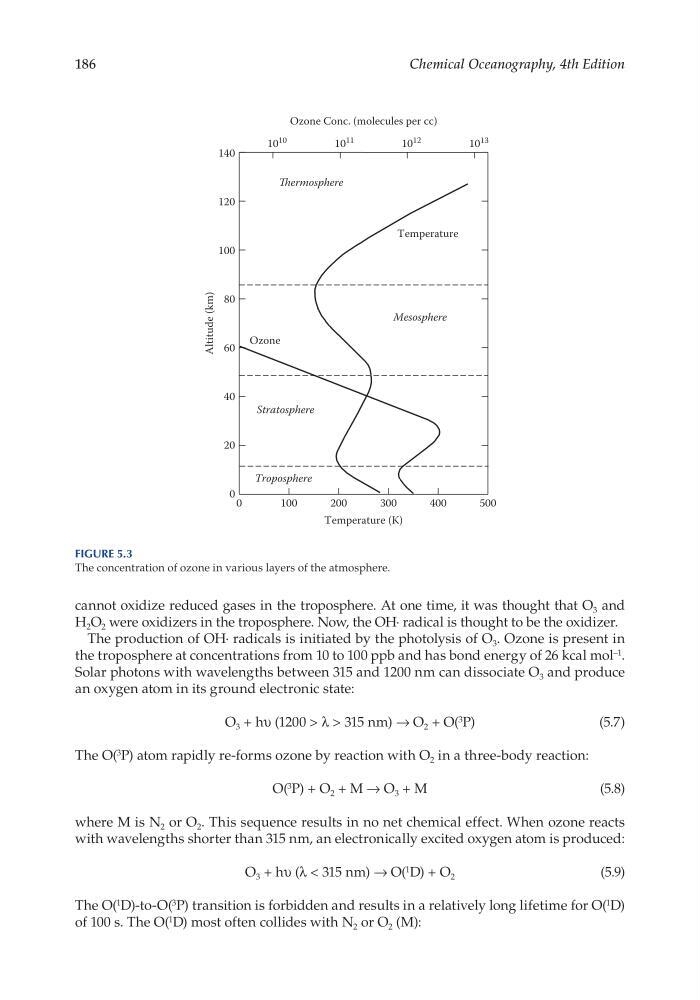
Figure 5.3
The concentration of ozone in various layers of the atmosphere.
Chemical Oceanography, 4th Edition
cannot oxidize reduced gases in the troposphere. At one time, it was thought that O 3 and
H 2 O 2 were oxidizers in the troposphere. Now, the OH· radical is thought to be the oxidizer.
The production of OH· radicals is initiated by the photolysis of O 3 . Ozone is present in
the troposphere at concentrations from 10 to 100 ppb and has bond energy of 26 kcal mol –1 .
Solar photons with wavelengths between 315 and 1200 nm can dissociate O 3 and produce
an oxygen atom in its ground electronic state:
O 3 + hυ (1200 > λ > 315 nm) → O 2 + O( 3 P)
(5.7)
The O( 3 P) atom rapidly re- forms ozone by reaction with O 2 in a three- body reaction:
O( 3 P) + O 2 + M → O 3 + M
(5.8)
where M is N 2 or O 2 . This sequence results in no net chemical effect. When ozone reacts
with wavelengths shorter than 315 nm, an electronically excited oxygen atom is produced:
O 3 + hυ (λ < 315 nm) → O( 1 D) + O 2
(5.9)
The O( 1 D)-to- O( 3 P) transition is forbidden and results in a relatively long lifetime for O( 1 D)
of 100 s. The O( 1 D) most often collides with N 2 or O 2 (M):
Temperature (K)
0
100
200
300
400
500
Altitude (km)
0
20
40
60
80
100
120
140
10
10
10
11
10
12
10
13
Ozone Conc. (molecules per cc)
Troposphere
Stratosphere
Mesosphere
ermosphere
Temperature
Ozone
Figure 5.3
The concentration of ozone in various layers of the atmosphere.