

185
Atmospheric Chemistry
This reaction is responsible for the absorption of light between 240 to 300 nm. The electronically excited oxygen O( 1 D) formed in the dissociation of O 3 is responsible for the formation of odd nitrogen radicals and odd hydrogen radicals:
N 2 O + O( 1 D) → 2 NO·
(5.4)
H 2 O + O( 1 D) → 2 OH·
(5.5)
More will be said about these reactions. The O 3 that is broken apart by photons forms oxygen atoms that quickly re- form O 3 by reactions with O 2 . This leads to a steady- state buildup
of O 3 . The O 3 dies off when it collides with an O atom, forming two oxygen molecules:
O 3 + O → 2 O 2
(5.6)
Other reactions that destroy O 3 in the stratosphere (such as reactions with atomic Cl) will
be discussed further. The maximum in the concentration of ozone in the stratosphere can
be attributed in the upper portion to the exponential decrease in O 2 and in the lower portion to the fall- off in the intensity of UV light as the solar light penetrates into the increasingly dense atmosphere.
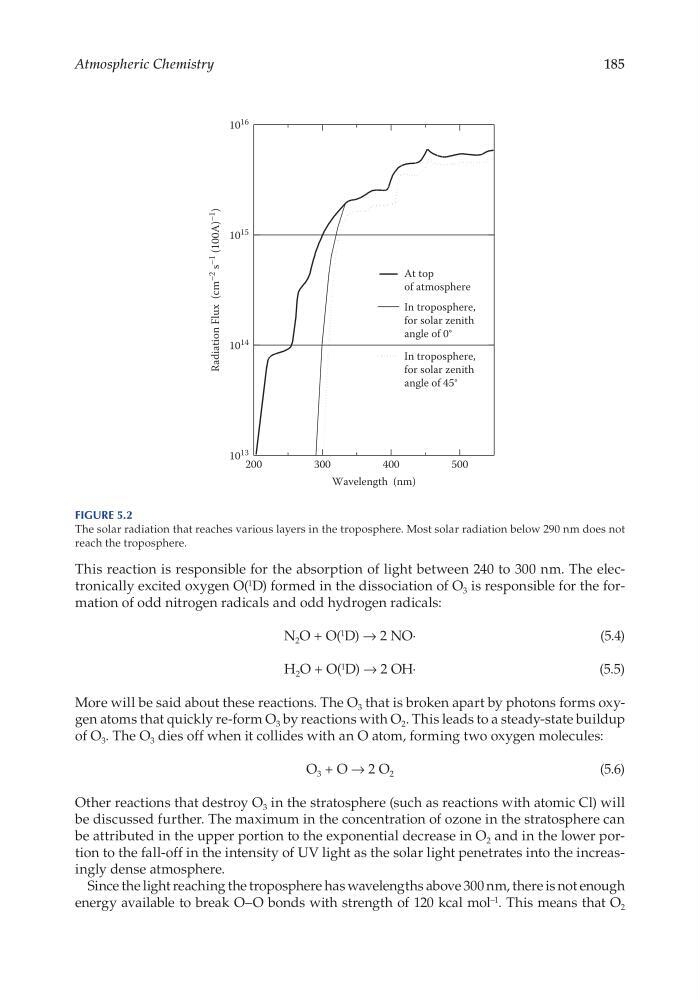
Since the light reaching the troposphere has wavelengths above 300 nm, there is not enough
energy available to break O–O bonds with strength of 120 kcal mol –1 . This means that O 2
Wavelength (nm)
200
300
400
500
10
13
10
14
10
15
10
16
Radiation Flux (cm
–2
s
–1
(100A)
–1
)
At top
of atmosphere
In troposphere,
for solar zenith
angle of 0°
In troposphere,
for solar zenith
angle of 45°
Figure 5.2
The solar radiation that reaches various layers in the troposphere. Most solar radiation below 290 nm does not
reach the troposphere.
Atmospheric Chemistry
This reaction is responsible for the absorption of light between 240 to 300 nm. The electronically excited oxygen O( 1 D) formed in the dissociation of O 3 is responsible for the formation of odd nitrogen radicals and odd hydrogen radicals:
N 2 O + O( 1 D) → 2 NO·
(5.4)
H 2 O + O( 1 D) → 2 OH·
(5.5)
More will be said about these reactions. The O 3 that is broken apart by photons forms oxygen atoms that quickly re- form O 3 by reactions with O 2 . This leads to a steady- state buildup
of O 3 . The O 3 dies off when it collides with an O atom, forming two oxygen molecules:
O 3 + O → 2 O 2
(5.6)
Other reactions that destroy O 3 in the stratosphere (such as reactions with atomic Cl) will
be discussed further. The maximum in the concentration of ozone in the stratosphere can
be attributed in the upper portion to the exponential decrease in O 2 and in the lower portion to the fall- off in the intensity of UV light as the solar light penetrates into the increasingly dense atmosphere.
Since the light reaching the troposphere has wavelengths above 300 nm, there is not enough
energy available to break O–O bonds with strength of 120 kcal mol –1 . This means that O 2
Wavelength (nm)
200
300
400
500
10
13
10
14
10
15
10
16
Radiation Flux (cm
–2
s
–1
(100A)
–1
)
At top
of atmosphere
In troposphere,
for solar zenith
angle of 0°
In troposphere,
for solar zenith
angle of 45°
Figure 5.2
The solar radiation that reaches various layers in the troposphere. Most solar radiation below 290 nm does not
reach the troposphere.