

184
Chemical Oceanography, 4th Edition
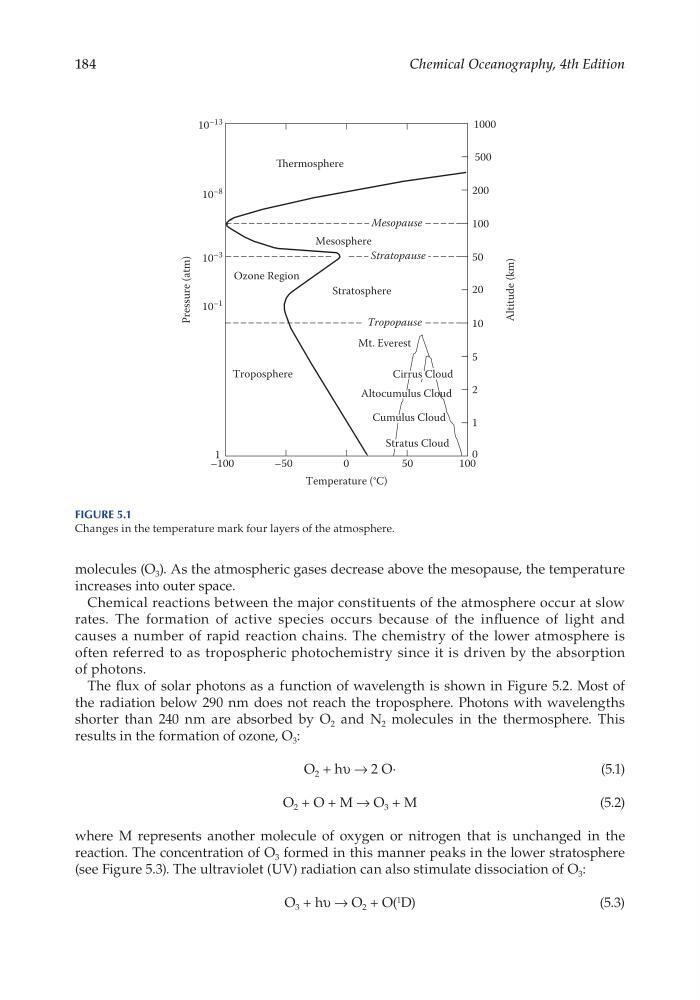
molecules (O 3 ). As the atmospheric gases decrease above the mesopause, the temperature
increases into outer space.
Chemical reactions between the major constituents of the atmosphere occur at slow
rates. The formation of active species occurs because of the influence of light and
causes a number of rapid reaction chains. The chemistry of the lower atmosphere is
often referred to as tropospheric photochemistry since it is driven by the absorption
of photons.
The flux of solar photons as a function of wavelength is shown in Figure 5.2. Most of
the radiation below 290 nm does not reach the troposphere. Photons with wavelengths
shorter than 240 nm are absorbed by O 2 and N 2 molecules in the thermosphere. This
results in the formation of ozone, O 3 :
O 2 + hυ → 2 O·
(5.1)
O 2 + O + M → O 3 + M
(5.2)
where M represents another molecule of oxygen or nitrogen that is unchanged in the
reaction. The concentration of O 3 formed in this manner peaks in the lower stratosphere
(see Figure 5.3). The ultraviolet (UV) radiation can also stimulate dissociation of O 3 :
O 3 + hυ → O 2 + O( 1 D)
(5.3)
Temperature (°C)
–100
–50
0
50
100
500
200
100
50
20
10
5
2
1
1000
Mesopause
Stratopause
ermosphere
Mesosphere
Stratosphere
Troposphere
Ozone Region
Tropopause
Mt. Everest
Cirrus Cloud
Altocumulus Cloud
Cumulus Cloud
Stratus Cloud
Altitude (km)
Pressure (atm)
10
–13
10
–3
10
–8
10
–1
1
0
Figure 5.1
Changes in the temperature mark four layers of the atmosphere.
Chemical Oceanography, 4th Edition
molecules (O 3 ). As the atmospheric gases decrease above the mesopause, the temperature
increases into outer space.
Chemical reactions between the major constituents of the atmosphere occur at slow
rates. The formation of active species occurs because of the influence of light and
causes a number of rapid reaction chains. The chemistry of the lower atmosphere is
often referred to as tropospheric photochemistry since it is driven by the absorption
of photons.
The flux of solar photons as a function of wavelength is shown in Figure 5.2. Most of
the radiation below 290 nm does not reach the troposphere. Photons with wavelengths
shorter than 240 nm are absorbed by O 2 and N 2 molecules in the thermosphere. This
results in the formation of ozone, O 3 :
O 2 + hυ → 2 O·
(5.1)
O 2 + O + M → O 3 + M
(5.2)
where M represents another molecule of oxygen or nitrogen that is unchanged in the
reaction. The concentration of O 3 formed in this manner peaks in the lower stratosphere
(see Figure 5.3). The ultraviolet (UV) radiation can also stimulate dissociation of O 3 :
O 3 + hυ → O 2 + O( 1 D)
(5.3)
Temperature (°C)
–100
–50
0
50
100
500
200
100
50
20
10
5
2
1
1000
Mesopause
Stratopause
ermosphere
Mesosphere
Stratosphere
Troposphere
Ozone Region
Tropopause
Mt. Everest
Cirrus Cloud
Altocumulus Cloud
Cumulus Cloud
Stratus Cloud
Altitude (km)
Pressure (atm)
10
–13
10
–3
10
–8
10
–1
1
0
Figure 5.1
Changes in the temperature mark four layers of the atmosphere.