

176
Chemical Oceanography, 4th Edition
progress has been made in interpreting and modeling the physical–chemical properties
of mixed electrolyte solutions. These models have been used to estimate the properties of
seawater using known properties for sea salts. This is done by using the apparent molal
properties ϕ of the solution. The apparent molal property is related to the change that
occurs when a salt is added to water. The apparent molal property is defined by
ϕ = Δρ/ n = (P – P 0 )/n
(4.92)
where n is the number of moles of salt added, P is the property of the solution, and P o is the
property of water. The major reason the apparent molal property is useful is the fact that it
is nearly additive for a mixture. The additivity, called Young’s rule, is given by
ϕ = ΣN i ϕ i
(4.93)
where N i = n i / nT is the mole fraction of electrolyte i in the mixture, and ϕ i is the molal
property of i at the ionic strength of the mixture. In terms of the ionic components of a
mixed electrolyte solution, the equation becomes
ϕ = Σ M Σ X E M E X ϕ(MX)
(4.94)
where E M and E X are the equivalent fractions of cations M and anions X, and ϕ(MX) is the
apparent property of electrolyte MX at the ionic strength of the mixture. For the major
components of seawater, this sum can be made three ways:
Lake Tanganyika
K
+
Mg
2+
Ca
2+
SO 4
2 –
CO 3
2–
Cl
–
HCO 3
–
Na
+
Dead Sea
Br
–
Cl
–
K
+
Mg
2+
Ca
2+
Na
+
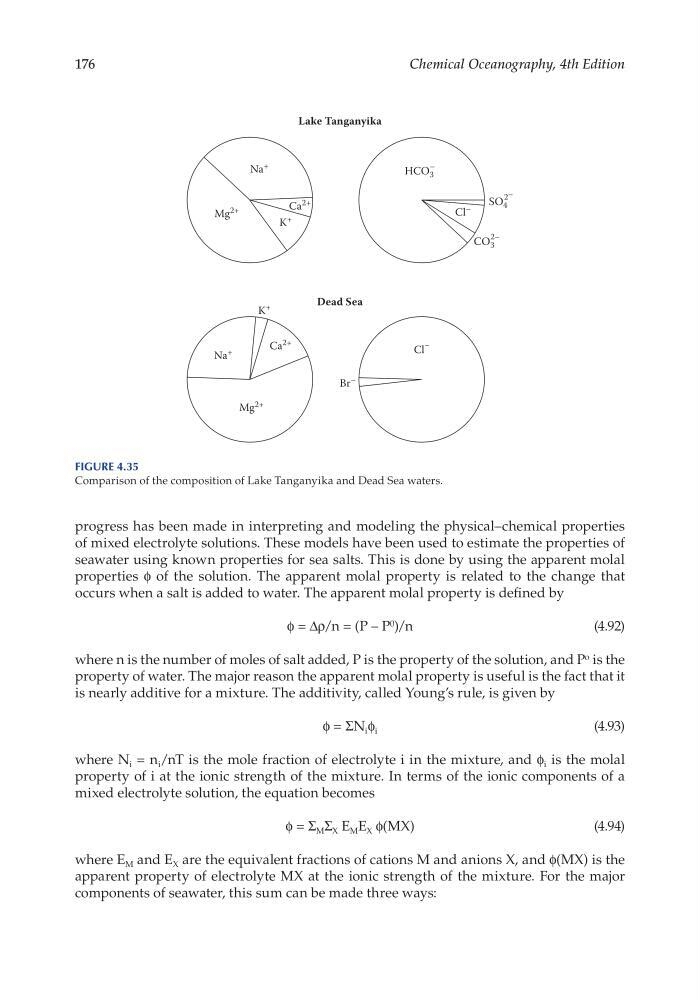
Figure 4.35
Comparison of the composition of Lake Tanganyika and Dead Sea waters.
Chemical Oceanography, 4th Edition
progress has been made in interpreting and modeling the physical–chemical properties
of mixed electrolyte solutions. These models have been used to estimate the properties of
seawater using known properties for sea salts. This is done by using the apparent molal
properties ϕ of the solution. The apparent molal property is related to the change that
occurs when a salt is added to water. The apparent molal property is defined by
ϕ = Δρ/ n = (P – P 0 )/n
(4.92)
where n is the number of moles of salt added, P is the property of the solution, and P o is the
property of water. The major reason the apparent molal property is useful is the fact that it
is nearly additive for a mixture. The additivity, called Young’s rule, is given by
ϕ = ΣN i ϕ i
(4.93)
where N i = n i / nT is the mole fraction of electrolyte i in the mixture, and ϕ i is the molal
property of i at the ionic strength of the mixture. In terms of the ionic components of a
mixed electrolyte solution, the equation becomes
ϕ = Σ M Σ X E M E X ϕ(MX)
(4.94)
where E M and E X are the equivalent fractions of cations M and anions X, and ϕ(MX) is the
apparent property of electrolyte MX at the ionic strength of the mixture. For the major
components of seawater, this sum can be made three ways:
Lake Tanganyika
K
+
Mg
2+
Ca
2+
SO 4
2 –
CO 3
2–
Cl
–
HCO 3
–
Na
+
Dead Sea
Br
–
Cl
–
K
+
Mg
2+
Ca
2+
Na
+
Figure 4.35
Comparison of the composition of Lake Tanganyika and Dead Sea waters.