

175
Ionic Interactions
natural waters. The stability constants and the activity coefficients of free ions are determined using the Pitzer equations. The strong interactions of metals with anions such as
OH – , CO 3
2– , and so on are accounted for by the ion- pairing model.
Honig and Nicholls (1995) have shown that there has been a major revival in the use of
electrostatics for studying the interactions of charged ions and polar molecules in aqueous
solutions. This has been accomplished by the development of numerical and computational methods that can be used to quickly solve the Poisson– Boltzmann equation, which
describes the electrostatic interactions of charged molecules in a continuous dielectric
medium (similar to the Born and Debye–Hückel models). These methods have been used
to examine the electrostatic interactions of complex molecules (proteins) with different
charge distributions. The graphic representation of the results can be used to examine the
surface charge of proteins and nucleic acids involved in binding metals and polar solutes.
These methods may prove useful in examining the interactions of metals with model colloids and organic ligands in natural waters.
4.6 Physical Properties of Seawater
Knowledge of ionic interactions in seawater can also affect the physical properties of ocean
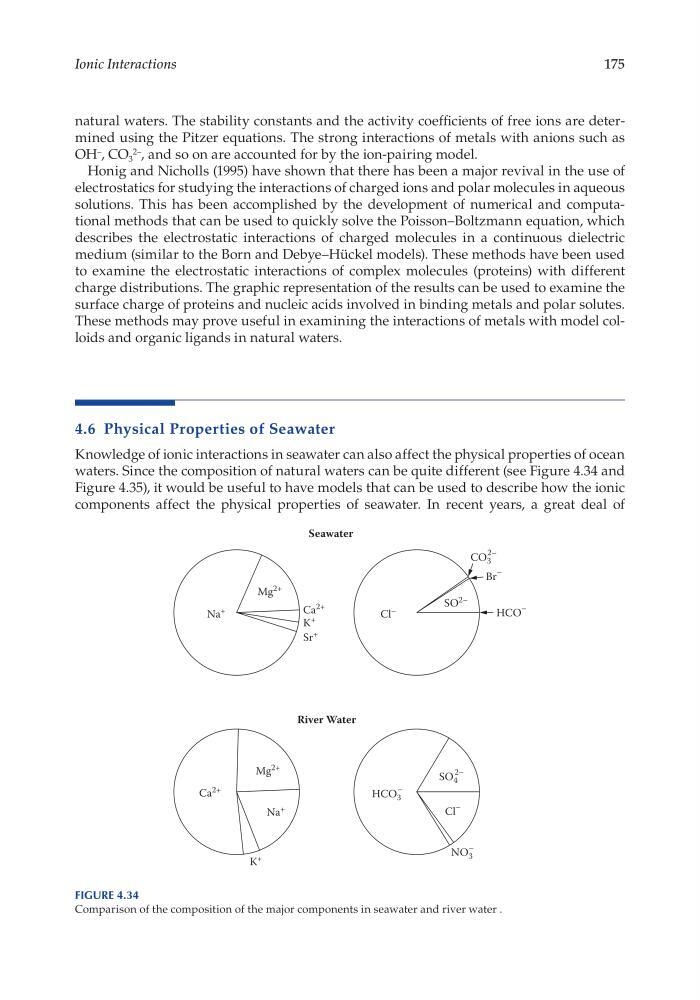
waters. Since the composition of natural waters can be quite different (see Figure 4.34 and
Figure 4.35), it would be useful to have models that can be used to describe how the ionic
components affect the physical properties of seawater. In recent years, a great deal of
Mg
2+
Mg
2+
Ca
2+
K
+
Seawater
River Water
Ca
2+
Cl
–
SO
2–
CO 3
2–
HCO 3
–
SO 4
2–
NO 3
–
Cl
–
Br
–
HCO
–
K
+
Sr
+
Na
+
Na
+
Figure 4.34
Comparison of the composition of the major components in seawater and river water .
Ionic Interactions
natural waters. The stability constants and the activity coefficients of free ions are determined using the Pitzer equations. The strong interactions of metals with anions such as
OH – , CO 3
2– , and so on are accounted for by the ion- pairing model.
Honig and Nicholls (1995) have shown that there has been a major revival in the use of
electrostatics for studying the interactions of charged ions and polar molecules in aqueous
solutions. This has been accomplished by the development of numerical and computational methods that can be used to quickly solve the Poisson– Boltzmann equation, which
describes the electrostatic interactions of charged molecules in a continuous dielectric
medium (similar to the Born and Debye–Hückel models). These methods have been used
to examine the electrostatic interactions of complex molecules (proteins) with different
charge distributions. The graphic representation of the results can be used to examine the
surface charge of proteins and nucleic acids involved in binding metals and polar solutes.
These methods may prove useful in examining the interactions of metals with model colloids and organic ligands in natural waters.
4.6 Physical Properties of Seawater
Knowledge of ionic interactions in seawater can also affect the physical properties of ocean
waters. Since the composition of natural waters can be quite different (see Figure 4.34 and
Figure 4.35), it would be useful to have models that can be used to describe how the ionic
components affect the physical properties of seawater. In recent years, a great deal of
Mg
2+
Mg
2+
Ca
2+
K
+
Seawater
River Water
Ca
2+
Cl
–
SO
2–
CO 3
2–
HCO 3
–
SO 4
2–
NO 3
–
Cl
–
Br
–
HCO
–
K
+
Sr
+
Na
+
Na
+
Figure 4.34
Comparison of the composition of the major components in seawater and river water .