

171
Ionic Interactions
interactions of all the components (plus–minus–plus, plus–minus–minus, and minus–
plus–plus). Pitzer has given some general equations that can be used to estimate the
activity coefficient of ions that account for all the ionic interactions that occur in a mixedelectrolyte solution. In their simplest form, they are
lnγ M = Z M
2 fγ + 2Σ a m a (B Ma + EC Ma ) + Z M
2Σ
cΣa m c m a B ca + Z MΣcΣa m c m a C ca
(4.76)
lnγ X = Z X
2 fγ + 2Σ c m c (B cX + EC cX ) + Z X
2Σ
cΣa m c m a B ca + Z XΣcΣa m c m a C ca
(4.77)
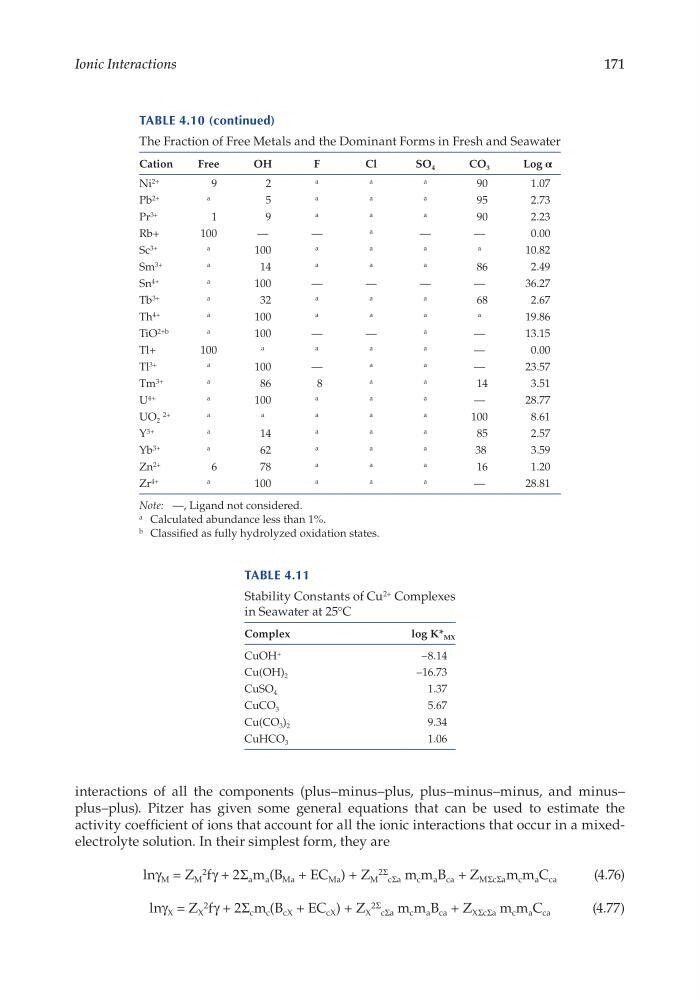
Table 4.10 (continued)
The Fraction of Free Metals and the Dominant Forms in Fresh and Seawater
Cation
Free
OH
F
Cl
SO 4
CO 3
Log α
Ni 2+
9
2
a
a
a
90
1.07
Pb 2+
a
5
a
a
a
95
2.73
Pr 3+
1
9
a
a
a
90
2.23
Rb+
100
—
—
a
—
—
0.00
Sc 3+
a
100
a
a
a
a
10.82
Sm 3+
a
14
a
a
a
86
2.49
Sn 4+
a
100
—
—
—
—
36.27
Tb 3+
a
32
a
a
a
68
2.67
Th 4+
a
100
a
a
a
a
19.86
TiO 2+b
a
100
—
—
a
—
13.15
Tl+
100
a
a
a
a
—
0.00
Tl 3+
a
100
—
a
a
—
23.57
Tm 3+
a
86
8
a
a
14
3.51
U 4+
a
100
a
a
a
—
28.77
UO 2
2+
a
a
a
a
a
100
8.61
Y 3+
a
14
a
a
a
85
2.57
Yb 3+
a
62
a
a
a
38
3.59
Zn 2+
6
78
a
a
a
16
1.20
Zr 4+
a
100
a
a
a
—
28.81
Note: —, Ligand not considered.
a Calculated abundance less than 1%.
b Classified as fully hydrolyzed oxidation states.
Table 4.11
Stability Constants of Cu 2+ Complexes
in Seawater at 25°C
Complex
log K* MX
CuOH +
−8.14
Cu(OH) 2
–16.73
CuSO 4
1.37
CuCO 3
5.67
Cu(CO 3 ) 2
9.34
CuHCO 3
1.06
Ionic Interactions
interactions of all the components (plus–minus–plus, plus–minus–minus, and minus–
plus–plus). Pitzer has given some general equations that can be used to estimate the
activity coefficient of ions that account for all the ionic interactions that occur in a mixedelectrolyte solution. In their simplest form, they are
lnγ M = Z M
2 fγ + 2Σ a m a (B Ma + EC Ma ) + Z M
2Σ
cΣa m c m a B ca + Z MΣcΣa m c m a C ca
(4.76)
lnγ X = Z X
2 fγ + 2Σ c m c (B cX + EC cX ) + Z X
2Σ
cΣa m c m a B ca + Z XΣcΣa m c m a C ca
(4.77)
Table 4.10 (continued)
The Fraction of Free Metals and the Dominant Forms in Fresh and Seawater
Cation
Free
OH
F
Cl
SO 4
CO 3
Log α
Ni 2+
9
2
a
a
a
90
1.07
Pb 2+
a
5
a
a
a
95
2.73
Pr 3+
1
9
a
a
a
90
2.23
Rb+
100
—
—
a
—
—
0.00
Sc 3+
a
100
a
a
a
a
10.82
Sm 3+
a
14
a
a
a
86
2.49
Sn 4+
a
100
—
—
—
—
36.27
Tb 3+
a
32
a
a
a
68
2.67
Th 4+
a
100
a
a
a
a
19.86
TiO 2+b
a
100
—
—
a
—
13.15
Tl+
100
a
a
a
a
—
0.00
Tl 3+
a
100
—
a
a
—
23.57
Tm 3+
a
86
8
a
a
14
3.51
U 4+
a
100
a
a
a
—
28.77
UO 2
2+
a
a
a
a
a
100
8.61
Y 3+
a
14
a
a
a
85
2.57
Yb 3+
a
62
a
a
a
38
3.59
Zn 2+
6
78
a
a
a
16
1.20
Zr 4+
a
100
a
a
a
—
28.81
Note: —, Ligand not considered.
a Calculated abundance less than 1%.
b Classified as fully hydrolyzed oxidation states.
Table 4.11
Stability Constants of Cu 2+ Complexes
in Seawater at 25°C
Complex
log K* MX
CuOH +
−8.14
Cu(OH) 2
–16.73
CuSO 4
1.37
CuCO 3
5.67
Cu(CO 3 ) 2
9.34
CuHCO 3
1.06