

172
Chemical Oceanography, 4th Edition
where Z i is the charge on the ion; a and c are anions and cations of the media, respectively;
m i is the molalities, E = 1/2Σ m i Z i is the equivalent molality, and fγ is a Debye–Hückel term:
f γ = –0.392[I 1/2 /(1 + 1.2I 1/2 ) + (2/1.2) (1 + 1.2I 1/2 )]
(4.78)
and the interaction terms B MX , B MX
1 , and C MX are given for 1-1 electrolytes by
B
I
I exp I
MX
MX
MX
=
+
− +
−
β
β
0
1 2
1 2
1 2
1 1 2
2
(
)[ (
)
(
)
/
/
/
(4.79)
B
I
I
I exp I
MX
MX
=
− + +
+
−
(
) [
(
)
(
)
/
/
/
β
1 2 2
1 2
2
1 2
1 1 2
2
] ]
(4.80)
C MX = C ϕ /(2|Z M Z X | 1/2 )
(4.81)
Values of β 0 , β 1 , and C ϕ for various electrolytes are tabulated elsewhere (Pitzer, 1991).
Although the equations may appear to be quite complicated, they are easy to use if the
calculations are made on a personal computer. These equations account for all the binary
interactions. To account for triplet interactions, it is necessary to consider two more terms:
CuCO 3
Cu(CO 3 ) 2
2–
Cu
2+
CuOH
+
CuSO 4
Cu(OH) 2
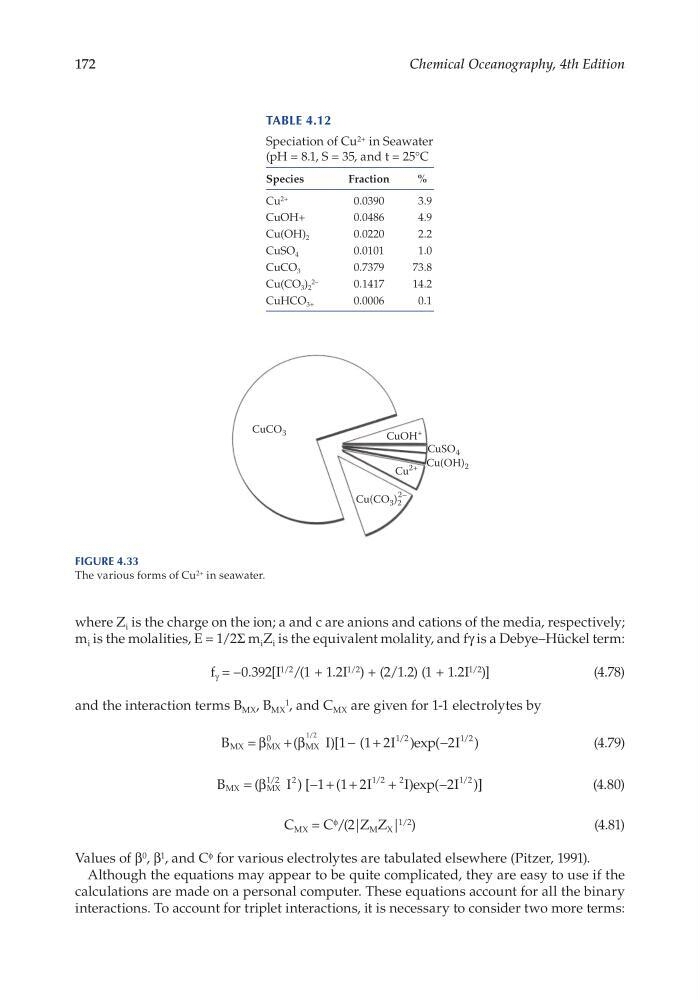
Figure 4.33
The various forms of Cu 2+ in seawater.
Table 4.12
Speciation of Cu 2+ in Seawater
(pH = 8.1, S = 35, and t = 25°C
Species
Fraction
%
Cu 2+
0.0390
3.9
CuOH+
0.0486
4.9
Cu(OH) 2
0.0220
2.2
CuSO 4
0.0101
1.0
CuCO 3
0.7379
73.8
Cu(CO 3 ) 2
2–
0.1417
14.2
CuHCO 3+
0.0006
0.1
Chemical Oceanography, 4th Edition
where Z i is the charge on the ion; a and c are anions and cations of the media, respectively;
m i is the molalities, E = 1/2Σ m i Z i is the equivalent molality, and fγ is a Debye–Hückel term:
f γ = –0.392[I 1/2 /(1 + 1.2I 1/2 ) + (2/1.2) (1 + 1.2I 1/2 )]
(4.78)
and the interaction terms B MX , B MX
1 , and C MX are given for 1-1 electrolytes by
B
I
I exp I
MX
MX
MX
=
+
− +
−
β
β
0
1 2
1 2
1 2
1 1 2
2
(
)[ (
)
(
)
/
/
/
(4.79)
B
I
I
I exp I
MX
MX
=
− + +
+
−
(
) [
(
)
(
)
/
/
/
β
1 2 2
1 2
2
1 2
1 1 2
2
] ]
(4.80)
C MX = C ϕ /(2|Z M Z X | 1/2 )
(4.81)
Values of β 0 , β 1 , and C ϕ for various electrolytes are tabulated elsewhere (Pitzer, 1991).
Although the equations may appear to be quite complicated, they are easy to use if the
calculations are made on a personal computer. These equations account for all the binary
interactions. To account for triplet interactions, it is necessary to consider two more terms:
CuCO 3
Cu(CO 3 ) 2
2–
Cu
2+
CuOH
+
CuSO 4
Cu(OH) 2
Figure 4.33
The various forms of Cu 2+ in seawater.
Table 4.12
Speciation of Cu 2+ in Seawater
(pH = 8.1, S = 35, and t = 25°C
Species
Fraction
%
Cu 2+
0.0390
3.9
CuOH+
0.0486
4.9
Cu(OH) 2
0.0220
2.2
CuSO 4
0.0101
1.0
CuCO 3
0.7379
73.8
Cu(CO 3 ) 2
2–
0.1417
14.2
CuHCO 3+
0.0006
0.1