

160
Chemical Oceanography, 4th Edition
The pH can affect the metals directly by hydrolysis equilibrium:
M 2+ + H 2 O = M(OH) + + H +
(4.56)
and by affecting the form of the ligands:
HCO 3
– = H + + CO 3
2–
(4.57)
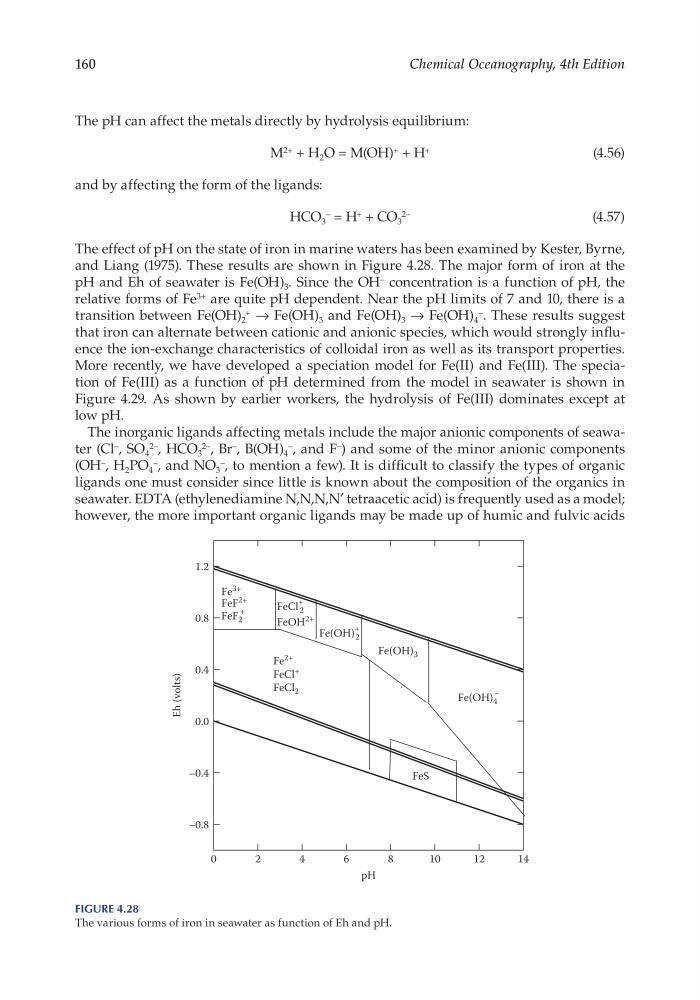
The effect of pH on the state of iron in marine waters has been examined by Kester, Byrne,
and Liang (1975). These results are shown in Figure 4.28. The major form of iron at the
pH and Eh of seawater is Fe(OH) 3 . Since the OH – concentration is a function of pH, the
relative forms of Fe 3+ are quite pH dependent. Near the pH limits of 7 and 10, there is a
transition between Fe(OH) 2
+ → Fe(OH) 3 and Fe(OH) 3 → Fe(OH) 4
– . These results suggest
that iron can alternate between cationic and anionic species, which would strongly influence the ion- exchange characteristics of colloidal iron as well as its transport properties.
More recently, we have developed a speciation model for Fe(II) and Fe(III). The speciation of Fe(III) as a function of pH determined from the model in seawater is shown in
Figure 4.29. As shown by earlier workers, the hydrolysis of Fe(III) dominates except at
low pH.
The inorganic ligands affecting metals include the major anionic components of seawater (Cl – , SO 4
2– , HCO 3
2– , Br – , B(OH) 4
– , and F – ) and some of the minor anionic components
(OH – , H 2 PO 4
– , and NO 3
– , to mention a few). It is difficult to classify the types of organic
ligands one must consider since little is known about the composition of the organics in
seawater. EDTA (ethylenediamine N,N,N,N′ tetraacetic acid) is frequently used as a model;
however, the more important organic ligands may be made up of humic and fulvic acids
pH
0
2
4
6
8
10
12
14
Eh (volts)
–0.8
–0.4
0.0
0.4
0.8
1.2
Fe
3+
FeF
2+
FeF 2
+
FeS
Fe(OH) 4
–
Fe(OH) 3
Fe(OH)
+
2
FeCl
+
2
FeOH
2+
Fe
2+
FeCl
+
FeCl 2
Figure 4.28
The various forms of iron in seawater as function of Eh and pH.
Chemical Oceanography, 4th Edition
The pH can affect the metals directly by hydrolysis equilibrium:
M 2+ + H 2 O = M(OH) + + H +
(4.56)
and by affecting the form of the ligands:
HCO 3
– = H + + CO 3
2–
(4.57)
The effect of pH on the state of iron in marine waters has been examined by Kester, Byrne,
and Liang (1975). These results are shown in Figure 4.28. The major form of iron at the
pH and Eh of seawater is Fe(OH) 3 . Since the OH – concentration is a function of pH, the
relative forms of Fe 3+ are quite pH dependent. Near the pH limits of 7 and 10, there is a
transition between Fe(OH) 2
+ → Fe(OH) 3 and Fe(OH) 3 → Fe(OH) 4
– . These results suggest
that iron can alternate between cationic and anionic species, which would strongly influence the ion- exchange characteristics of colloidal iron as well as its transport properties.
More recently, we have developed a speciation model for Fe(II) and Fe(III). The speciation of Fe(III) as a function of pH determined from the model in seawater is shown in
Figure 4.29. As shown by earlier workers, the hydrolysis of Fe(III) dominates except at
low pH.
The inorganic ligands affecting metals include the major anionic components of seawater (Cl – , SO 4
2– , HCO 3
2– , Br – , B(OH) 4
– , and F – ) and some of the minor anionic components
(OH – , H 2 PO 4
– , and NO 3
– , to mention a few). It is difficult to classify the types of organic
ligands one must consider since little is known about the composition of the organics in
seawater. EDTA (ethylenediamine N,N,N,N′ tetraacetic acid) is frequently used as a model;
however, the more important organic ligands may be made up of humic and fulvic acids
pH
0
2
4
6
8
10
12
14
Eh (volts)
–0.8
–0.4
0.0
0.4
0.8
1.2
Fe
3+
FeF
2+
FeF 2
+
FeS
Fe(OH) 4
–
Fe(OH) 3
Fe(OH)
+
2
FeCl
+
2
FeOH
2+
Fe
2+
FeCl
+
FeCl 2
Figure 4.28
The various forms of iron in seawater as function of Eh and pH.