

161
Ionic Interactions
and their derivatives. For the present, it is not possible to consider these organic ligands,
although we realize they may be of great importance. It should be pointed out that all the
model calculations made by using various organic ligands indicate that organic ligands
have little effect on the speciation of most trace metals (i.e., compared to the major inorganic ligands).
We now examine the use of the ion- pairing model and the specific interaction model
to estimate the total activity coefficient of the major ions of seawater. Owing to the large
amount of thermodynamic data available for the major sea salts, it is possible to apply both
methods. As we will see, for the minor or trace metals, we can use at present only the ionpairing methods.
4.5.1 ion- Pairing Model
The speciation forms in which various metals can exist are shown in Figure 4.30. Most
models confine the speciation to the dissolved species. To examine the colloidal forms of
metals, one must use filters of various sizes or use such techniques as dialysis to separate
the various forms. Some of the methods used to determine individual species include
1. Physical separation based on size
2. Equilibrium distributions using adsorption, ion exchange, redox equilibria, and
so on
3. Potentiometric methods using ion- selective electrodes
4. Electrode kinetics such as polarography
5. Detection of structure using optical methods
6. Bioassay techniques by which metals may act as a catalyst or inhibitor
pH
0
2
4
6
8
10
12
% Total Fe(III)
0.1
1
10
100
Fe(OH) 2
+
Fe(OH) 3
FeF
2+
FeSO 4
+
FeOH
2+
Fe(OH) 4
–
FeCl
2+
Fe
3+
Fe(SO 4 ) 2
–
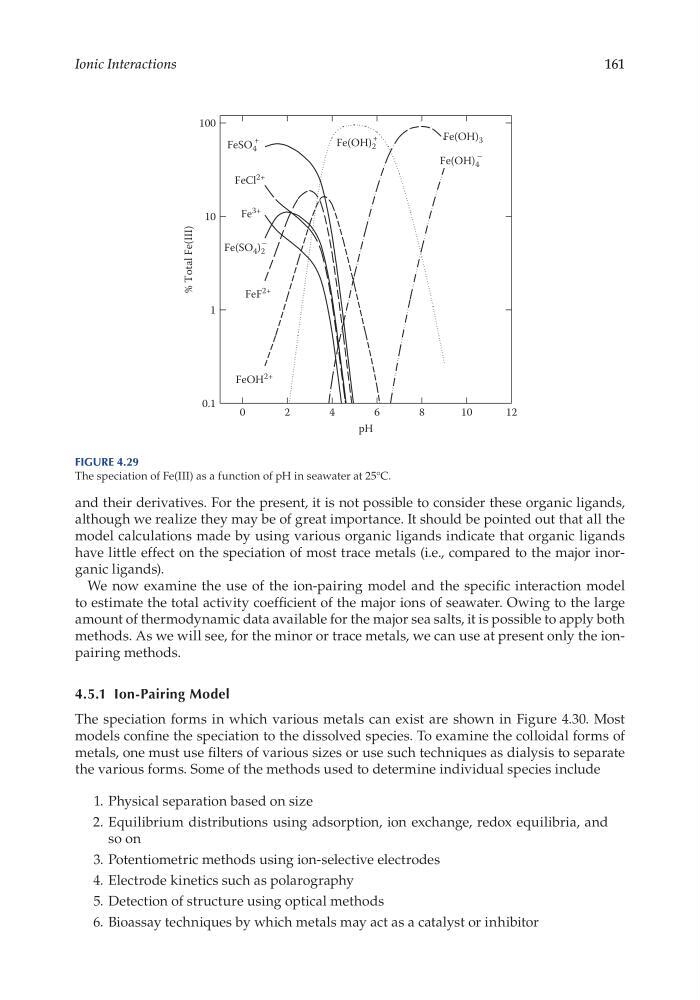
Figure 4.29
The speciation of Fe(III) as a function of pH in seawater at 25°C.
Ionic Interactions
and their derivatives. For the present, it is not possible to consider these organic ligands,
although we realize they may be of great importance. It should be pointed out that all the
model calculations made by using various organic ligands indicate that organic ligands
have little effect on the speciation of most trace metals (i.e., compared to the major inorganic ligands).
We now examine the use of the ion- pairing model and the specific interaction model
to estimate the total activity coefficient of the major ions of seawater. Owing to the large
amount of thermodynamic data available for the major sea salts, it is possible to apply both
methods. As we will see, for the minor or trace metals, we can use at present only the ionpairing methods.
4.5.1 ion- Pairing Model
The speciation forms in which various metals can exist are shown in Figure 4.30. Most
models confine the speciation to the dissolved species. To examine the colloidal forms of
metals, one must use filters of various sizes or use such techniques as dialysis to separate
the various forms. Some of the methods used to determine individual species include
1. Physical separation based on size
2. Equilibrium distributions using adsorption, ion exchange, redox equilibria, and
so on
3. Potentiometric methods using ion- selective electrodes
4. Electrode kinetics such as polarography
5. Detection of structure using optical methods
6. Bioassay techniques by which metals may act as a catalyst or inhibitor
pH
0
2
4
6
8
10
12
% Total Fe(III)
0.1
1
10
100
Fe(OH) 2
+
Fe(OH) 3
FeF
2+
FeSO 4
+
FeOH
2+
Fe(OH) 4
–
FeCl
2+
Fe
3+
Fe(SO 4 ) 2
–
Figure 4.29
The speciation of Fe(III) as a function of pH in seawater at 25°C.