

159
Ionic Interactions
Using Equation 4.45, the oxidation state can be determined from
Eh = Eh 0 + (2.3RT/ nF) log[a Fe (III)/a Fe (II)]
(4.54)
Using Eh 0 = 0.771 V at 25°C, we obtain a Fe (III)/a Fe (II) = 2.43 × 10 –18 when Eh = –0.27 V. It
should be pointed out that these ratios are at infinite dilution and do not include the effects
of complex formation (which usually stabilizes a system against reduction). To determine
the concentration ratios at higher ionic strengths, one must estimate the stoichiometric
activity coefficients of the ions:
[Fe 3+ ] T /[Fe 2 ] T = [a Fe (III)/a Fe (II)]γ T (Fe 2+ )/γ T (Fe 3+ )
(4.55)
Kester et al. (1975) have also examined the ion pairing of Fe 3+ and Fe 2+ in seawater,
which can be used to estimate the activity coefficient ratio. Although redox calculations
are quite simple, some of the problems inherent in these calculations are as follows:
1. Equilibrium is not reached (i.e., the process is kinetically controlled).
2. Biological activity may change the oxidation state.
3. Photochemical processes may control the state.
4. Other important species may be neglected (e.g., organic complexes).
5. Unreliable analytical and thermodynamic data are available for the actual system.
pH
0
2
4
6
8
10
12
14
Eh (volts)
–0.8
–0.4
0.0
0.4
0.8
1.2
Stability Band for Eh Controlled
by O 2 (0.5 to 300 µM)
Stability Band for Eh controlled by
Dissolved H 2 S (1 to 1000 µM)
Alkaline
Corrosion
Pits
Acidic
Corrosion
Pits
Ground
Waters
Anoxic
Waters
Oceanic
Waters
Pore
Waters
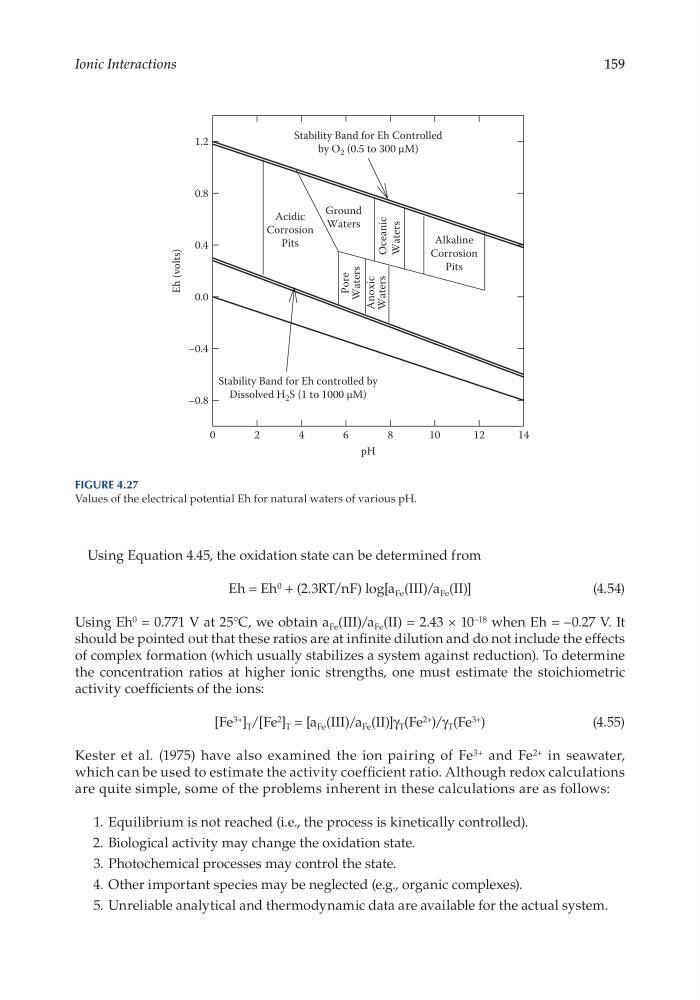
Figure 4.27
Values of the electrical potential Eh for natural waters of various pH.
Ionic Interactions
Using Equation 4.45, the oxidation state can be determined from
Eh = Eh 0 + (2.3RT/ nF) log[a Fe (III)/a Fe (II)]
(4.54)
Using Eh 0 = 0.771 V at 25°C, we obtain a Fe (III)/a Fe (II) = 2.43 × 10 –18 when Eh = –0.27 V. It
should be pointed out that these ratios are at infinite dilution and do not include the effects
of complex formation (which usually stabilizes a system against reduction). To determine
the concentration ratios at higher ionic strengths, one must estimate the stoichiometric
activity coefficients of the ions:
[Fe 3+ ] T /[Fe 2 ] T = [a Fe (III)/a Fe (II)]γ T (Fe 2+ )/γ T (Fe 3+ )
(4.55)
Kester et al. (1975) have also examined the ion pairing of Fe 3+ and Fe 2+ in seawater,
which can be used to estimate the activity coefficient ratio. Although redox calculations
are quite simple, some of the problems inherent in these calculations are as follows:
1. Equilibrium is not reached (i.e., the process is kinetically controlled).
2. Biological activity may change the oxidation state.
3. Photochemical processes may control the state.
4. Other important species may be neglected (e.g., organic complexes).
5. Unreliable analytical and thermodynamic data are available for the actual system.
pH
0
2
4
6
8
10
12
14
Eh (volts)
–0.8
–0.4
0.0
0.4
0.8
1.2
Stability Band for Eh Controlled
by O 2 (0.5 to 300 µM)
Stability Band for Eh controlled by
Dissolved H 2 S (1 to 1000 µM)
Alkaline
Corrosion
Pits
Acidic
Corrosion
Pits
Ground
Waters
Anoxic
Waters
Oceanic
Waters
Pore
Waters
Figure 4.27
Values of the electrical potential Eh for natural waters of various pH.