

149
Ionic Interactions
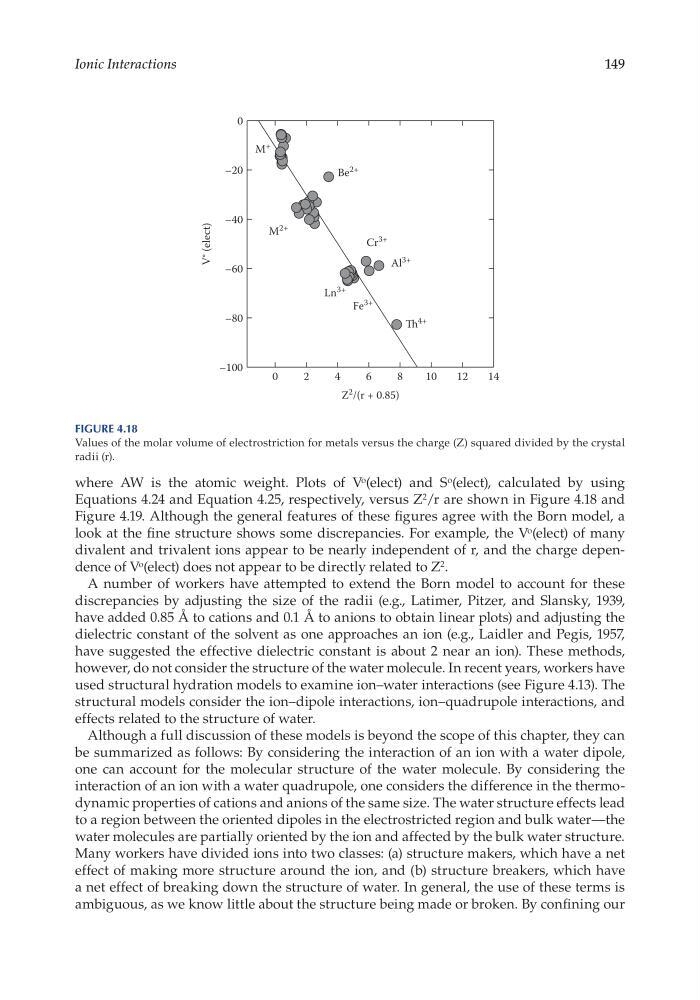
where AW is the atomic weight. Plots of V o (elect) and S o (elect), calculated by using
Equations 4.24 and Equation 4.25, respectively, versus Z 2 /r are shown in Figure 4.18 and
Figure 4.19. Although the general features of these figures agree with the Born model, a
look at the fine structure shows some discrepancies. For example, the V o (elect) of many
divalent and trivalent ions appear to be nearly independent of r, and the charge dependence of V o (elect) does not appear to be directly related to Z 2 .
A number of workers have attempted to extend the Born model to account for these
discrepancies by adjusting the size of the radii (e.g., Latimer, Pitzer, and Slansky, 1939,
have added 0.85 Å to cations and 0.1 Å to anions to obtain linear plots) and adjusting the
dielectric constant of the solvent as one approaches an ion (e.g., Laidler and Pegis, 1957,
have suggested the effective dielectric constant is about 2 near an ion). These methods,
however, do not consider the structure of the water molecule. In recent years, workers have
used structural hydration models to examine ion–water interactions (see Figure 4.13). The
structural models consider the ion–dipole interactions, ion–quadrupole interactions, and
effects related to the structure of water.
Although a full discussion of these models is beyond the scope of this chapter, they can
be summarized as follows: By considering the interaction of an ion with a water dipole,
one can account for the molecular structure of the water molecule. By considering the
interaction of an ion with a water quadrupole, one considers the difference in the thermodynamic properties of cations and anions of the same size. The water structure effects lead
to a region between the oriented dipoles in the electrostricted region and bulk water—the
water molecules are partially oriented by the ion and affected by the bulk water structure.
Many workers have divided ions into two classes: (a) structure makers, which have a net
effect of making more structure around the ion, and (b) structure breakers, which have
a net effect of breaking down the structure of water. In general, the use of these terms is
ambiguous, as we know little about the structure being made or broken. By confining our
Z 2 /(r + 0.85)
0
2
4
6
8
10
12
14
V° (elect)
–100
–80
–60
–40
–20
0
Be 2+
Al 3+
Fe 3+
Cr 3+
Ln
3+
M 2+
M +
4+
Figure 4.18
Values of the molar volume of electrostriction for metals versus the charge (Z) squared divided by the crystal
radii (r).
Ionic Interactions
where AW is the atomic weight. Plots of V o (elect) and S o (elect), calculated by using
Equations 4.24 and Equation 4.25, respectively, versus Z 2 /r are shown in Figure 4.18 and
Figure 4.19. Although the general features of these figures agree with the Born model, a
look at the fine structure shows some discrepancies. For example, the V o (elect) of many
divalent and trivalent ions appear to be nearly independent of r, and the charge dependence of V o (elect) does not appear to be directly related to Z 2 .
A number of workers have attempted to extend the Born model to account for these
discrepancies by adjusting the size of the radii (e.g., Latimer, Pitzer, and Slansky, 1939,
have added 0.85 Å to cations and 0.1 Å to anions to obtain linear plots) and adjusting the
dielectric constant of the solvent as one approaches an ion (e.g., Laidler and Pegis, 1957,
have suggested the effective dielectric constant is about 2 near an ion). These methods,
however, do not consider the structure of the water molecule. In recent years, workers have
used structural hydration models to examine ion–water interactions (see Figure 4.13). The
structural models consider the ion–dipole interactions, ion–quadrupole interactions, and
effects related to the structure of water.
Although a full discussion of these models is beyond the scope of this chapter, they can
be summarized as follows: By considering the interaction of an ion with a water dipole,
one can account for the molecular structure of the water molecule. By considering the
interaction of an ion with a water quadrupole, one considers the difference in the thermodynamic properties of cations and anions of the same size. The water structure effects lead
to a region between the oriented dipoles in the electrostricted region and bulk water—the
water molecules are partially oriented by the ion and affected by the bulk water structure.
Many workers have divided ions into two classes: (a) structure makers, which have a net
effect of making more structure around the ion, and (b) structure breakers, which have
a net effect of breaking down the structure of water. In general, the use of these terms is
ambiguous, as we know little about the structure being made or broken. By confining our
Z 2 /(r + 0.85)
0
2
4
6
8
10
12
14
V° (elect)
–100
–80
–60
–40
–20
0
Be 2+
Al 3+
Fe 3+
Cr 3+
Ln
3+
M 2+
M +
4+
Figure 4.18
Values of the molar volume of electrostriction for metals versus the charge (Z) squared divided by the crystal
radii (r).