

150
Chemical Oceanography, 4th Edition
arguments to hydration effects [V o (elect)], it is possible to discuss ion–water interactions
using Equation 4.24 or its equivalent for other thermodynamic properties.
If we use a hydration model for ion–water interactions, the V o (elect) can be related to the
number of water molecules affected by the ion (i.e., the hydration number h),
V o (elect) = V o (ion) – V o (int) = h (V o
E – V o
B )
(4.27)
where V o
E is the molal volume of water in the electrostricted region, and V o
B is the molal
volume of water in the bulk phase (18.0 cm 3 mol –1 ). Due to the difficulties of determining V o (int), it is not possible to unambiguously solve this equation. By differentiating
Equation 4.24 with respect to pressure, we get the partial molal compressibility:
K o (ion) = K o (int) + K o (elect)
(4.28)
If we assume K o (int) = 0, we can combine this equation with the differential of Equation 4.27
(assuming h and V o
E are not functions of pressure) and get
K o (ion) – K o (elect) = -∂V o (elect)/∂P = h(∂V o
B /∂P) = –hV o
B β o
B
(4.29)
where β o
B = –(1/V o
B )(∂V o
B /∂P) is the compressibility of bulk water (45.25 × 10 –6 bar –1 at 25°C).
By rearrangement of Equation 4.28, we get for the hydration number
h = –K o (ion)/V o
B β o
B
(4.30)
Hydration numbers for some cations and anions calculated from Equation 4.30 are given
in Table 4.4. By examining V o (elect) and K o (ion) = K o (elect) for various ions, it is possible to
calculate (V o
E − V o
B ). Combining equations, we have
V o (elect) = –[(V o
E – V o
B )/V o
B β o
B ] K o (elect) = –k K o (elect)
(4.31)
Z
2 /(r + 0.85)
0
1
2
3
4
5
6
7
S° (elect)
–120
–100
–80
–60
–40
–20
0
20
40
M
2+
M
+
Al
3+
Fe
3+
Gd
3+
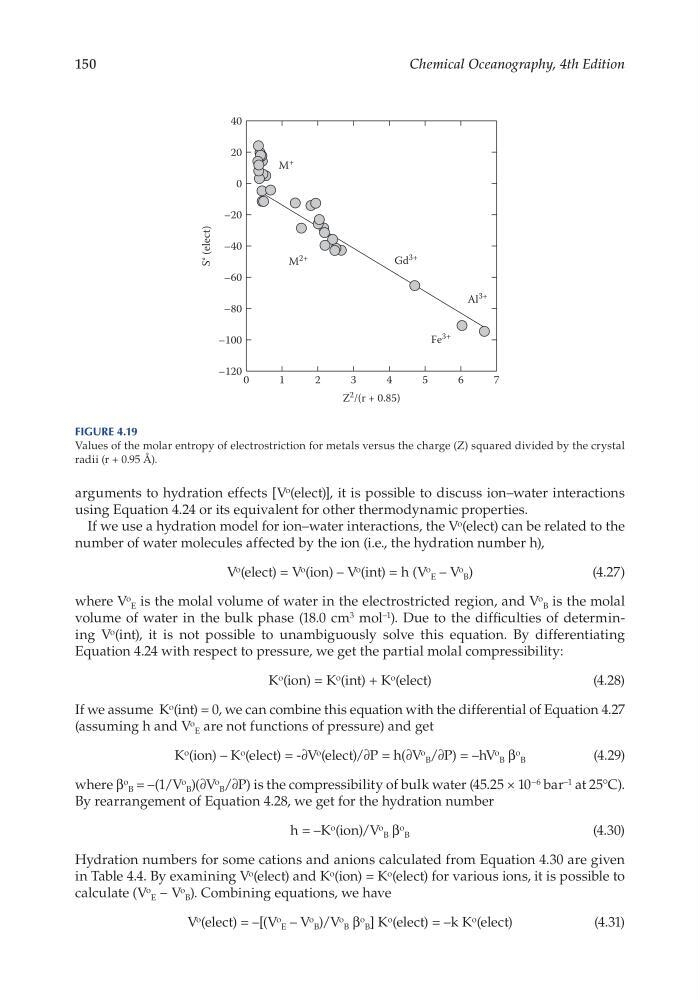
Figure 4.19
Values of the molar entropy of electrostriction for metals versus the charge (Z) squared divided by the crystal
radii (r + 0.95 Å).
Chemical Oceanography, 4th Edition
arguments to hydration effects [V o (elect)], it is possible to discuss ion–water interactions
using Equation 4.24 or its equivalent for other thermodynamic properties.
If we use a hydration model for ion–water interactions, the V o (elect) can be related to the
number of water molecules affected by the ion (i.e., the hydration number h),
V o (elect) = V o (ion) – V o (int) = h (V o
E – V o
B )
(4.27)
where V o
E is the molal volume of water in the electrostricted region, and V o
B is the molal
volume of water in the bulk phase (18.0 cm 3 mol –1 ). Due to the difficulties of determining V o (int), it is not possible to unambiguously solve this equation. By differentiating
Equation 4.24 with respect to pressure, we get the partial molal compressibility:
K o (ion) = K o (int) + K o (elect)
(4.28)
If we assume K o (int) = 0, we can combine this equation with the differential of Equation 4.27
(assuming h and V o
E are not functions of pressure) and get
K o (ion) – K o (elect) = -∂V o (elect)/∂P = h(∂V o
B /∂P) = –hV o
B β o
B
(4.29)
where β o
B = –(1/V o
B )(∂V o
B /∂P) is the compressibility of bulk water (45.25 × 10 –6 bar –1 at 25°C).
By rearrangement of Equation 4.28, we get for the hydration number
h = –K o (ion)/V o
B β o
B
(4.30)
Hydration numbers for some cations and anions calculated from Equation 4.30 are given
in Table 4.4. By examining V o (elect) and K o (ion) = K o (elect) for various ions, it is possible to
calculate (V o
E − V o
B ). Combining equations, we have
V o (elect) = –[(V o
E – V o
B )/V o
B β o
B ] K o (elect) = –k K o (elect)
(4.31)
Z
2 /(r + 0.85)
0
1
2
3
4
5
6
7
S° (elect)
–120
–100
–80
–60
–40
–20
0
20
40
M
2+
M
+
Al
3+
Fe
3+
Gd
3+
Figure 4.19
Values of the molar entropy of electrostriction for metals versus the charge (Z) squared divided by the crystal
radii (r + 0.95 Å).