

148
Chemical Oceanography, 4th Edition
K elect
NZ e Dr
lnD P T
lnD P
o (
) (
) (
)
(
=
∂
∂
− ∂
∂
2 2
2
2
/
/
/ ) )
.
T
Z r
2
4 2
8 31 10
= −
×
−
/
(4.21)
Similar differentiation of the solution component of Equation 4.16 with respect to temperature yields the electrostatic partial molal entropy (–∂G o /∂T = S o ) and heat capacity
–∂(S o /∂T)/∂T = ∂H o /∂T = C o
P .
S o (elect) = (NZ 2 e 2 /2Dr)(∂lnD/∂T) P = –9/65Z 2 /r
(4.22)
C elect
NZ eT
Dr
lnD T
lnD
P
o
P
(
) (
) (
) (
=
∂
∂
− ∂
2
2
2
2
2
/
/
/ /
/
∂
= −
T
Z r
P
)
.
2
2
12 96
(4.23)
The partial molal properties of ions in solution contain a minimum of two terms, an intrinsic contribution and an electrical contribution. For example, for the partial molal volume
of an ion, we have
V o (ion) = V o (int) + V o (elect)
(4.24)
where the intrinsic partial molal volume V o (int) is equal to the size of the ion, V o (cryst) =
(4πN/3)r 3 = 2.52 r 3 (when r is expressed in Å units) plus the packing effects, and the electrostriction partial molal volume V o (elect) is the decrease in volume caused by ion–water
interactions. Thus, to plot the various partial molal properties versus Z 2 /r, one must estimate the intrinsic term. For V(int), one can use the semiempirical values from
V o (int) = 4.48 r 3
(4.25)
while for S o (int), one can use
S o (int) = 3/2 ln[AW]
(4.26)
–∆H°h (kcal mol
–1
)
380
400
420
440
460
480
500
520
540
Ca
Mn
Fe
Co
Ni
Cu
Zn
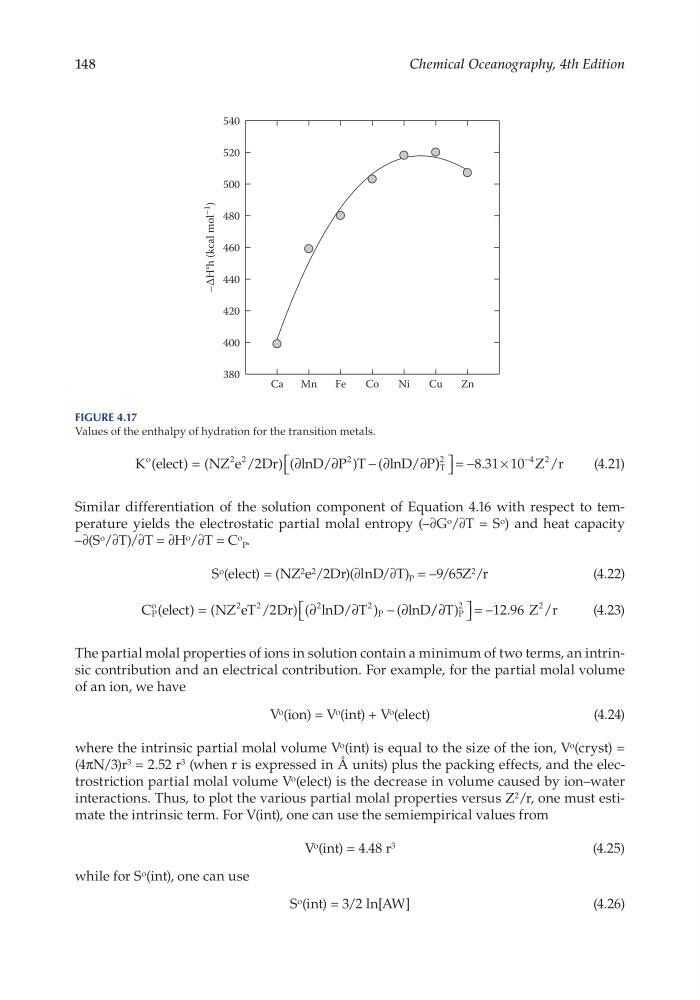
Figure 4.17
Values of the enthalpy of hydration for the transition metals.
Chemical Oceanography, 4th Edition
K elect
NZ e Dr
lnD P T
lnD P
o (
) (
) (
)
(
=
∂
∂
− ∂
∂
2 2
2
2
/
/
/ ) )
.
T
Z r
2
4 2
8 31 10
= −
×
−
/
(4.21)
Similar differentiation of the solution component of Equation 4.16 with respect to temperature yields the electrostatic partial molal entropy (–∂G o /∂T = S o ) and heat capacity
–∂(S o /∂T)/∂T = ∂H o /∂T = C o
P .
S o (elect) = (NZ 2 e 2 /2Dr)(∂lnD/∂T) P = –9/65Z 2 /r
(4.22)
C elect
NZ eT
Dr
lnD T
lnD
P
o
P
(
) (
) (
) (
=
∂
∂
− ∂
2
2
2
2
2
/
/
/ /
/
∂
= −
T
Z r
P
)
.
2
2
12 96
(4.23)
The partial molal properties of ions in solution contain a minimum of two terms, an intrinsic contribution and an electrical contribution. For example, for the partial molal volume
of an ion, we have
V o (ion) = V o (int) + V o (elect)
(4.24)
where the intrinsic partial molal volume V o (int) is equal to the size of the ion, V o (cryst) =
(4πN/3)r 3 = 2.52 r 3 (when r is expressed in Å units) plus the packing effects, and the electrostriction partial molal volume V o (elect) is the decrease in volume caused by ion–water
interactions. Thus, to plot the various partial molal properties versus Z 2 /r, one must estimate the intrinsic term. For V(int), one can use the semiempirical values from
V o (int) = 4.48 r 3
(4.25)
while for S o (int), one can use
S o (int) = 3/2 ln[AW]
(4.26)
–∆H°h (kcal mol
–1
)
380
400
420
440
460
480
500
520
540
Ca
Mn
Fe
Co
Ni
Cu
Zn
Figure 4.17
Values of the enthalpy of hydration for the transition metals.