

147
Ionic Interactions
By further differentiation of Equation 4.16 through Equation 4.18, it is possible to obtain
information about the size and structure of the hydration sphere. From the pressure dependence of ΔG h
o , one obtains the volume change (electrostriction):
V o (elect) = (–NZ 2 e 2 /2Dr)(∂lnD/∂P) T = –4.175 Z 2 /r
(4.19)
Further differentiation of Equation 4.19 with respect to T and P gives the electrostriction
partial molal expansibility (E o = ∂V o /∂T) and compressibility (K o = –∂V o /∂P).
E o (elect) = (–NZ 2 e 2 /2Dr)[(∂lnD/∂P) – (∂lnD/∂T) × (∂lnD/∂P) T ] = –2.74 × 10 –2 Z 2 /r (4.20)
Z
2 /r
0
4
8
12
16
20
0
200
400
600
800
1000
1200
Al
3+
Fe
3+
Sc
3+
Y
3+
M
2+
M
+
Z
2 /(r + 0.85)
0
2
4
6
8
–∆H (kcal mol
–1
)
–∆H (kcal mol –1
)
0
200
400
600
800
1000
1200
M
+
M
2+
Y
3+
Sc
3+
Fe
3+
Al
3+
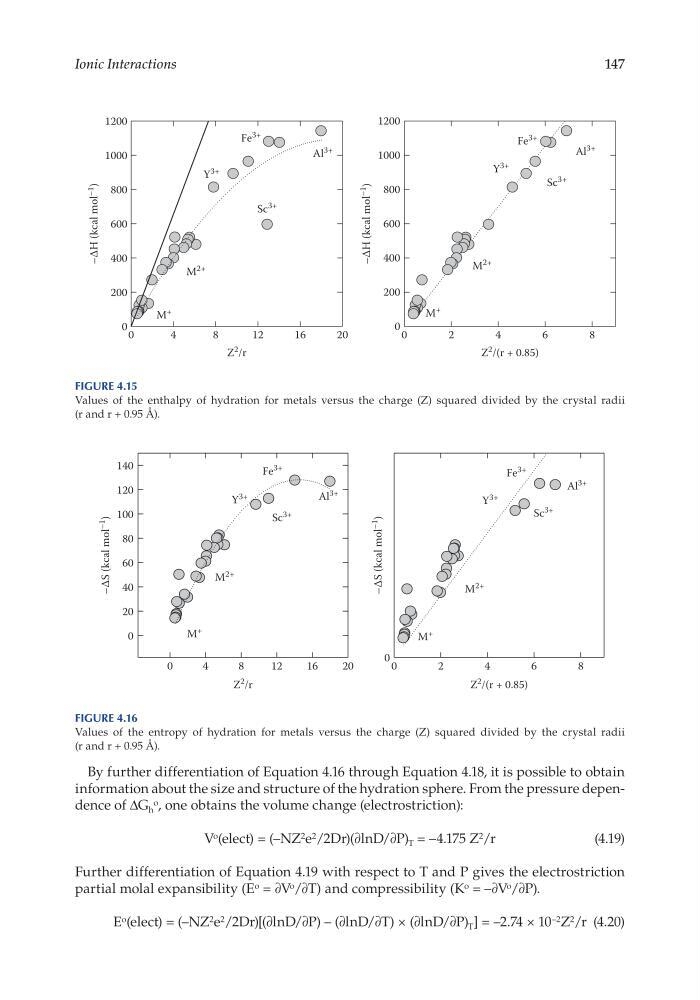
Figure 4.15
Values of the enthalpy of hydration for metals versus the charge (Z) squared divided by the crystal radii
(r and r + 0.95 Å).
Z
2 /r
Z
2 /(r + 0.85)
0
4
8
12
16
20
–∆S (kcal mol
–1
)
–∆S (kcal mol –1
)
0
20
40
60
80
100
120
140
Al
3+
Fe
3+
Sc
3+
Y
3+
M
2+
M
+
0
2
4
6
8
0
M
+
M 2+
Y
3+
Sc
3+
Fe
3+
Al
3+
Figure 4.16
Values of the entropy of hydration for metals versus the charge (Z) squared divided by the crystal radii
(r and r + 0.95 Å).
Ionic Interactions
By further differentiation of Equation 4.16 through Equation 4.18, it is possible to obtain
information about the size and structure of the hydration sphere. From the pressure dependence of ΔG h
o , one obtains the volume change (electrostriction):
V o (elect) = (–NZ 2 e 2 /2Dr)(∂lnD/∂P) T = –4.175 Z 2 /r
(4.19)
Further differentiation of Equation 4.19 with respect to T and P gives the electrostriction
partial molal expansibility (E o = ∂V o /∂T) and compressibility (K o = –∂V o /∂P).
E o (elect) = (–NZ 2 e 2 /2Dr)[(∂lnD/∂P) – (∂lnD/∂T) × (∂lnD/∂P) T ] = –2.74 × 10 –2 Z 2 /r (4.20)
Z
2 /r
0
4
8
12
16
20
0
200
400
600
800
1000
1200
Al
3+
Fe
3+
Sc
3+
Y
3+
M
2+
M
+
Z
2 /(r + 0.85)
0
2
4
6
8
–∆H (kcal mol
–1
)
–∆H (kcal mol –1
)
0
200
400
600
800
1000
1200
M
+
M
2+
Y
3+
Sc
3+
Fe
3+
Al
3+
Figure 4.15
Values of the enthalpy of hydration for metals versus the charge (Z) squared divided by the crystal radii
(r and r + 0.95 Å).
Z
2 /r
Z
2 /(r + 0.85)
0
4
8
12
16
20
–∆S (kcal mol
–1
)
–∆S (kcal mol –1
)
0
20
40
60
80
100
120
140
Al
3+
Fe
3+
Sc
3+
Y
3+
M
2+
M
+
0
2
4
6
8
0
M
+
M 2+
Y
3+
Sc
3+
Fe
3+
Al
3+
Figure 4.16
Values of the entropy of hydration for metals versus the charge (Z) squared divided by the crystal radii
(r and r + 0.95 Å).