

142
Chemical Oceanography, 4th Edition
Since we are interested in the transfer of ions (M + ) rather than electrolytes (MX), it is necessary to make some nonthermodynamic assumptions concerning the differences between
the properties of cations and anions. The details of such methods are discussed elsewhere
(Millero, 1977). Once the selection is made for the absolute thermodynamic quantity of
one ion (usually the proton), the values for the other ions can be easily determined by the
additivity principle:
ΔH h
o (MX) = ΔH h
o (M + ) + ΔH h
o (X – )
(4.3)
Values of ΔG h
o , ΔH h
o , and ΔS h
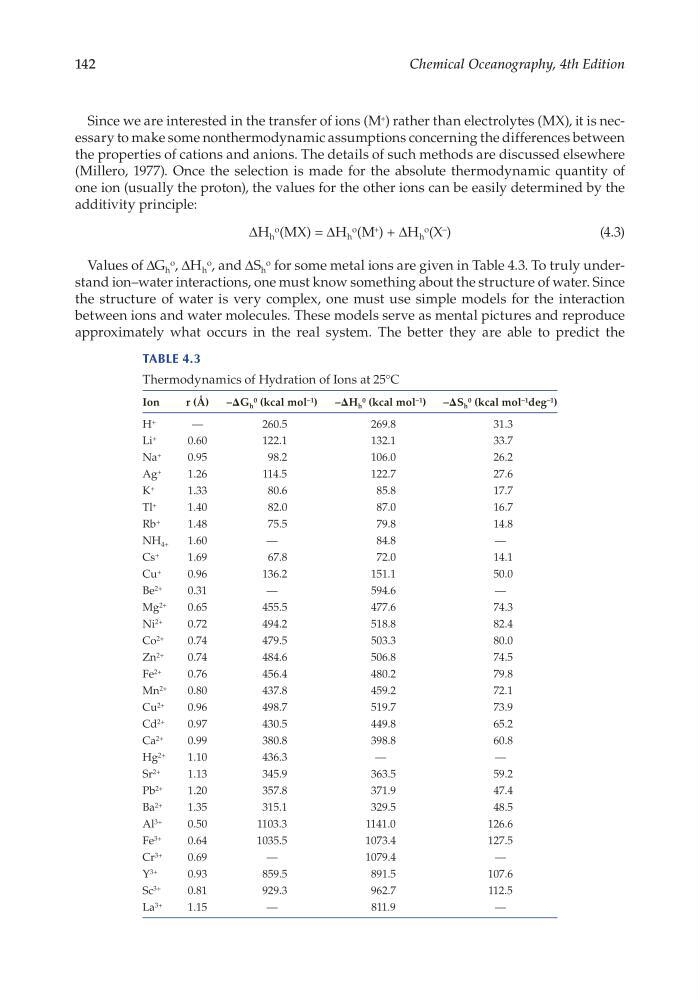
o for some metal ions are given in Table 4.3. To truly understand ion–water interactions, one must know something about the structure of water. Since
the structure of water is very complex, one must use simple models for the interaction
between ions and water molecules. These models serve as mental pictures and reproduce
approximately what occurs in the real system. The better they are able to predict the
Table 4.3
Thermodynamics of Hydration of Ions at 25°C
Ion
r (Å)
–ΔG h
0 (kcal mol –1 )
–ΔH h
0 (kcal mol –1 )
–ΔS h
0 (kcal mol –1 deg –1 )
H +
—
260.5
269.8
31.3
Li +
0.60
122.1
132.1
33.7
Na +
0.95
98.2
106.0
26.2
Ag +
1.26
114.5
122.7
27.6
K +
1.33
80.6
85.8
17.7
Tl +
1.40
82.0
87.0
16.7
Rb +
1.48
75.5
79.8
14.8
NH 4+
1.60
—
84.8
—
Cs +
1.69
67.8
72.0
14.1
Cu +
0.96
136.2
151.1
50.0
Be 2+
0.31
—
594.6
—
Mg 2+
0.65
455.5
477.6
74.3
Ni 2+
0.72
494.2
518.8
82.4
Co 2+
0.74
479.5
503.3
80.0
Zn 2+
0.74
484.6
506.8
74.5
Fe 2+
0.76
456.4
480.2
79.8
Mn 2+
0.80
437.8
459.2
72.1
Cu 2+
0.96
498.7
519.7
73.9
Cd 2+
0.97
430.5
449.8
65.2
Ca 2+
0.99
380.8
398.8
60.8
Hg 2+
1.10
436.3
—
—
Sr 2+
1.13
345.9
363.5
59.2
Pb 2+
1.20
357.8
371.9
47.4
Ba 2+
1.35
315.1
329.5
48.5
Al 3+
0.50
1103.3
1141.0
126.6
Fe 3+
0.64
1035.5
1073.4
127.5
Cr 3+
0.69
—
1079.4
—
Y 3+
0.93
859.5
891.5
107.6
Sc 3+
0.81
929.3
962.7
112.5
La 3+
1.15
—
811.9
—
Chemical Oceanography, 4th Edition
Since we are interested in the transfer of ions (M + ) rather than electrolytes (MX), it is necessary to make some nonthermodynamic assumptions concerning the differences between
the properties of cations and anions. The details of such methods are discussed elsewhere
(Millero, 1977). Once the selection is made for the absolute thermodynamic quantity of
one ion (usually the proton), the values for the other ions can be easily determined by the
additivity principle:
ΔH h
o (MX) = ΔH h
o (M + ) + ΔH h
o (X – )
(4.3)
Values of ΔG h
o , ΔH h
o , and ΔS h
o for some metal ions are given in Table 4.3. To truly understand ion–water interactions, one must know something about the structure of water. Since
the structure of water is very complex, one must use simple models for the interaction
between ions and water molecules. These models serve as mental pictures and reproduce
approximately what occurs in the real system. The better they are able to predict the
Table 4.3
Thermodynamics of Hydration of Ions at 25°C
Ion
r (Å)
–ΔG h
0 (kcal mol –1 )
–ΔH h
0 (kcal mol –1 )
–ΔS h
0 (kcal mol –1 deg –1 )
H +
—
260.5
269.8
31.3
Li +
0.60
122.1
132.1
33.7
Na +
0.95
98.2
106.0
26.2
Ag +
1.26
114.5
122.7
27.6
K +
1.33
80.6
85.8
17.7
Tl +
1.40
82.0
87.0
16.7
Rb +
1.48
75.5
79.8
14.8
NH 4+
1.60
—
84.8
—
Cs +
1.69
67.8
72.0
14.1
Cu +
0.96
136.2
151.1
50.0
Be 2+
0.31
—
594.6
—
Mg 2+
0.65
455.5
477.6
74.3
Ni 2+
0.72
494.2
518.8
82.4
Co 2+
0.74
479.5
503.3
80.0
Zn 2+
0.74
484.6
506.8
74.5
Fe 2+
0.76
456.4
480.2
79.8
Mn 2+
0.80
437.8
459.2
72.1
Cu 2+
0.96
498.7
519.7
73.9
Cd 2+
0.97
430.5
449.8
65.2
Ca 2+
0.99
380.8
398.8
60.8
Hg 2+
1.10
436.3
—
—
Sr 2+
1.13
345.9
363.5
59.2
Pb 2+
1.20
357.8
371.9
47.4
Ba 2+
1.35
315.1
329.5
48.5
Al 3+
0.50
1103.3
1141.0
126.6
Fe 3+
0.64
1035.5
1073.4
127.5
Cr 3+
0.69
—
1079.4
—
Y 3+
0.93
859.5
891.5
107.6
Sc 3+
0.81
929.3
962.7
112.5
La 3+
1.15
—
811.9
—