

143
Ionic Interactions
experimental properties of the real system, the better they serve as aids to understanding
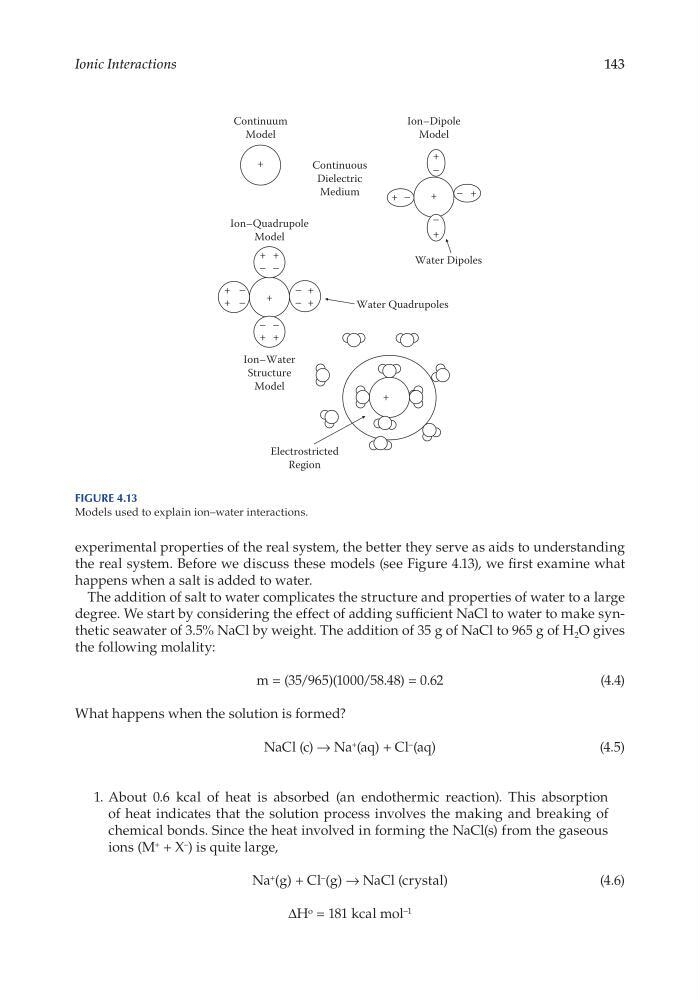
the real system. Before we discuss these models (see Figure 4.13), we first examine what
happens when a salt is added to water.
The addition of salt to water complicates the structure and properties of water to a large
degree. We start by considering the effect of adding sufficient NaCl to water to make synthetic seawater of 3.5% NaCl by weight. The addition of 35 g of NaCl to 965 g of H 2 O gives
the following molality:
m = (35/965)(1000/58.48) = 0.62
(4.4)
What happens when the solution is formed?
NaCl (c) → Na + (aq) + Cl – (aq)
(4.5)
1. About 0.6 kcal of heat is absorbed (an endothermic reaction). This absorption
of heat indicates that the solution process involves the making and breaking of
chemical bonds. Since the heat involved in forming the NaCl(s) from the gaseous
ions (M + + X – ) is quite large,
Na + (g) + Cl – (g) → NaCl (crystal)
(4.6)
ΔH o = 181 kcal mol –1
+
+
+
–
+
–
+
–
+
–
+
+
+
+
–
–
–
–
–
+
–
+
–
+
–
Continuum
Model
Ion–Dipole
Model
+
Continuous
Dielectric
Medium
Ion–Quadrupole
Model
Water Dipoles
+
Water Quadrupoles
Ion–Water
Structure
Model
+
Electrostricted
Region
Figure 4.13
Models used to explain ion–water interactions.
Ionic Interactions
experimental properties of the real system, the better they serve as aids to understanding
the real system. Before we discuss these models (see Figure 4.13), we first examine what
happens when a salt is added to water.
The addition of salt to water complicates the structure and properties of water to a large
degree. We start by considering the effect of adding sufficient NaCl to water to make synthetic seawater of 3.5% NaCl by weight. The addition of 35 g of NaCl to 965 g of H 2 O gives
the following molality:
m = (35/965)(1000/58.48) = 0.62
(4.4)
What happens when the solution is formed?
NaCl (c) → Na + (aq) + Cl – (aq)
(4.5)
1. About 0.6 kcal of heat is absorbed (an endothermic reaction). This absorption
of heat indicates that the solution process involves the making and breaking of
chemical bonds. Since the heat involved in forming the NaCl(s) from the gaseous
ions (M + + X – ) is quite large,
Na + (g) + Cl – (g) → NaCl (crystal)
(4.6)
ΔH o = 181 kcal mol –1
+
+
+
–
+
–
+
–
+
–
+
+
+
+
–
–
–
–
–
+
–
+
–
+
–
Continuum
Model
Ion–Dipole
Model
+
Continuous
Dielectric
Medium
Ion–Quadrupole
Model
Water Dipoles
+
Water Quadrupoles
Ion–Water
Structure
Model
+
Electrostricted
Region
Figure 4.13
Models used to explain ion–water interactions.