

141
Ionic Interactions
4.4 Ion–Water Interactions
To understand the behavior of ions in seawater, it is important to be able to understand the
interactions of ions with water molecules. To study these ion–water interactions, one must
study the thermodynamic and transport properties of electrolytes at infinite dilution. In
practice, it is not possible to make direct measurements at infinite dilution; thus, the infinite
dilution thermodynamic properties are extrapolated from experimental results at finite
low concentrations (with the aid of the Debye–Hückel equations for long- range ion–ion
interactions). Since one normally studies the ion–water interactions in solution where no
ion–ion interactions occur, it is necessary to select an initial state devoid of ion–ion interactions. The initial state normally selected is that of ions in a vacuum at an infinitely low pressure (i.e., the ideal gas). One considers then the changes in properties such as free energy
ΔG h
o , enthalpy ΔH h
o , and entropy ΔS h
o for the process denoted by Equation 4.1 (called,
respectively, the hydration free energies, enthalpies, and entropies). The methods used to
calculate these thermodynamic hydration functions are discussed elsewhere (Robinson
and Stokes, 1959). The methods used to calculate the ΔH h
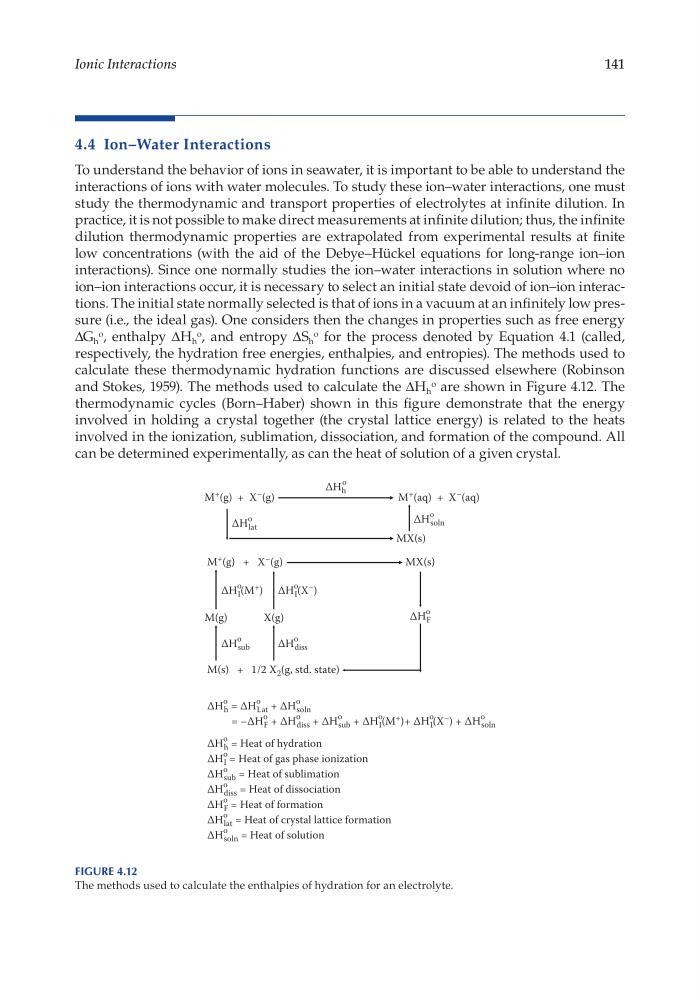
o are shown in Figure 4.12. The
thermodynamic cycles (Born–Haber) shown in this figure demonstrate that the energy
involved in holding a crystal together (the crystal lattice energy) is related to the heats
involved in the ionization, sublimation, dissociation, and formation of the compound. All
can be determined experimentally, as can the heat of solution of a given crystal.
∆H h
o
∆H
o
lat
∆H
o
I (M
+ )
∆H
o
sub
∆H
o
I (X
– )
∆H
o
diss
∆H
o
soln
M
+ (g) + X
– (g)
M
+ (aq) + X
– (aq)
MX(s)
M + (g) + X
– (g)
MX(s)
M(g)
X(g)
∆H
o
F
M(s) + 1/2 X 2 (g, std. state)
∆H
o
h = ∆H
o
Lat + ∆H
o
soln
= –∆H
o
F + ∆H
o
diss + ∆H
o
sub + ∆H
o
I (M
+ )+ ∆H
o
I (X
– ) + ∆H
o
soln
∆H
o
h = Heat of hydration
∆H
o
I = Heat of gas phase ionization
∆H
o
sub = Heat of sublimation
∆H
o
diss = Heat of dissociation
∆H
o
F = Heat of formation
∆H
o
lat = Heat of crystal lattice formation
∆H
o
soln = Heat of solution
Figure 4.12
The methods used to calculate the enthalpies of hydration for an electrolyte.
Ionic Interactions
4.4 Ion–Water Interactions
To understand the behavior of ions in seawater, it is important to be able to understand the
interactions of ions with water molecules. To study these ion–water interactions, one must
study the thermodynamic and transport properties of electrolytes at infinite dilution. In
practice, it is not possible to make direct measurements at infinite dilution; thus, the infinite
dilution thermodynamic properties are extrapolated from experimental results at finite
low concentrations (with the aid of the Debye–Hückel equations for long- range ion–ion
interactions). Since one normally studies the ion–water interactions in solution where no
ion–ion interactions occur, it is necessary to select an initial state devoid of ion–ion interactions. The initial state normally selected is that of ions in a vacuum at an infinitely low pressure (i.e., the ideal gas). One considers then the changes in properties such as free energy
ΔG h
o , enthalpy ΔH h
o , and entropy ΔS h
o for the process denoted by Equation 4.1 (called,
respectively, the hydration free energies, enthalpies, and entropies). The methods used to
calculate these thermodynamic hydration functions are discussed elsewhere (Robinson
and Stokes, 1959). The methods used to calculate the ΔH h
o are shown in Figure 4.12. The
thermodynamic cycles (Born–Haber) shown in this figure demonstrate that the energy
involved in holding a crystal together (the crystal lattice energy) is related to the heats
involved in the ionization, sublimation, dissociation, and formation of the compound. All
can be determined experimentally, as can the heat of solution of a given crystal.
∆H h
o
∆H
o
lat
∆H
o
I (M
+ )
∆H
o
sub
∆H
o
I (X
– )
∆H
o
diss
∆H
o
soln
M
+ (g) + X
– (g)
M
+ (aq) + X
– (aq)
MX(s)
M + (g) + X
– (g)
MX(s)
M(g)
X(g)
∆H
o
F
M(s) + 1/2 X 2 (g, std. state)
∆H
o
h = ∆H
o
Lat + ∆H
o
soln
= –∆H
o
F + ∆H
o
diss + ∆H
o
sub + ∆H
o
I (M
+ )+ ∆H
o
I (X
– ) + ∆H
o
soln
∆H
o
h = Heat of hydration
∆H
o
I = Heat of gas phase ionization
∆H
o
sub = Heat of sublimation
∆H
o
diss = Heat of dissociation
∆H
o
F = Heat of formation
∆H
o
lat = Heat of crystal lattice formation
∆H
o
soln = Heat of solution
Figure 4.12
The methods used to calculate the enthalpies of hydration for an electrolyte.