

139
Ionic Interactions
4.3.2.4 Significant Structure Theory and Eucken’s Polymer Model
The bulky species is ice- like (not necessarily like ice I). The dense species is not necessarily
a monomer but may be another ice- like species of higher density. Eyring, Ree, and Hirai
(1958) used significant structure theory—a specific element exists with fluidized vacancies
in addition to the individual monomers. Others have extended this treatment by recognizing that the amount of free monomeric water is small. Thus, the significant structures are
cage- like clusters with 16 molecules (density of ice I) within equilibrium in an ice III–like
structure. Fluidized vacancies are produced during melting (contraction occurs from the
packing of single H 2 O molecules into voids of ice I–like clusters). This model has been used
to successfully predict the minimum at 4°C in density, the vapor pressure, and the specific
heat (combined with Eyring’s rate theory, this model has been used to calculate the pressure dependence of relative viscosity of H 2 O).
Eucken (1949) treated water as a mixture of distinctly associated species of dimers, tetramers, and octamers. Although this method is probably not correct, Wicke (1966) has suggested that dimers may exist near the critical point. Eucken’s theory is interesting in that
it is able to estimate thermodynamic properties that agree with the experimental results;
however, the model is not correct. It is thus important to note that the fact that a model is
able to calculate accurate properties of water does not prove the model is correct. A more
critical test of a water theory is its ability to predict correctly, even if only quantitatively,
a large variety of widely different properties of water. One of the major difficulties of the
mixture models that assume the dense species is monomeric water is in explaining how
mere van der Waals forces can provide enough attraction for the single water molecule
to avoid escaping into the vapor state. The water molecules in a clathrate cage must also
possess some unique properties. It is difficult to see how H 2 O molecules with their large
dipole moment can exist in a clathrate cage with strong interactions. Experimental studies
have not proved that H 2 O molecules reside in clathrate cages.
It is important to understand that when we think of the structure of a liquid, it is necessary to consider the timescale used to measure that structure. Depending on the experimental techniques used (see Figure 4.11), one will take a picture that is related to the
shutter speed of the camera. Thermodynamic measurements see an average structure.
Temperature (°C)
–100
–50
0
50
100
Pressure (kbar)
0
5
10
15
20
25
VIII
VII
Liquid
VI
V
I
II
III
IV
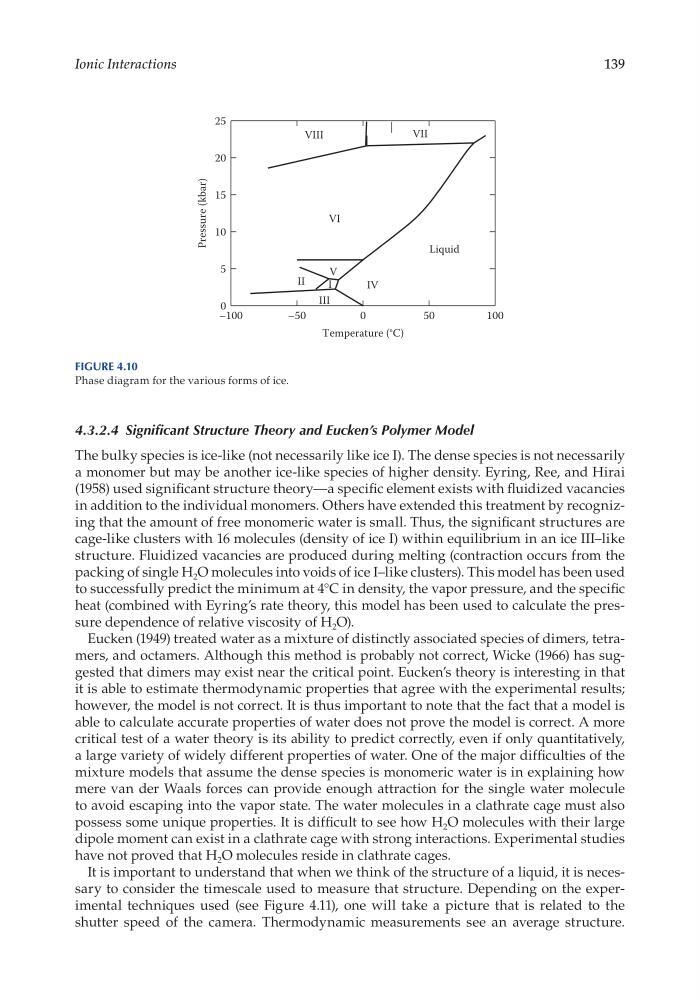
Figure 4.10
Phase diagram for the various forms of ice.
Ionic Interactions
4.3.2.4 Significant Structure Theory and Eucken’s Polymer Model
The bulky species is ice- like (not necessarily like ice I). The dense species is not necessarily
a monomer but may be another ice- like species of higher density. Eyring, Ree, and Hirai
(1958) used significant structure theory—a specific element exists with fluidized vacancies
in addition to the individual monomers. Others have extended this treatment by recognizing that the amount of free monomeric water is small. Thus, the significant structures are
cage- like clusters with 16 molecules (density of ice I) within equilibrium in an ice III–like
structure. Fluidized vacancies are produced during melting (contraction occurs from the
packing of single H 2 O molecules into voids of ice I–like clusters). This model has been used
to successfully predict the minimum at 4°C in density, the vapor pressure, and the specific
heat (combined with Eyring’s rate theory, this model has been used to calculate the pressure dependence of relative viscosity of H 2 O).
Eucken (1949) treated water as a mixture of distinctly associated species of dimers, tetramers, and octamers. Although this method is probably not correct, Wicke (1966) has suggested that dimers may exist near the critical point. Eucken’s theory is interesting in that
it is able to estimate thermodynamic properties that agree with the experimental results;
however, the model is not correct. It is thus important to note that the fact that a model is
able to calculate accurate properties of water does not prove the model is correct. A more
critical test of a water theory is its ability to predict correctly, even if only quantitatively,
a large variety of widely different properties of water. One of the major difficulties of the
mixture models that assume the dense species is monomeric water is in explaining how
mere van der Waals forces can provide enough attraction for the single water molecule
to avoid escaping into the vapor state. The water molecules in a clathrate cage must also
possess some unique properties. It is difficult to see how H 2 O molecules with their large
dipole moment can exist in a clathrate cage with strong interactions. Experimental studies
have not proved that H 2 O molecules reside in clathrate cages.
It is important to understand that when we think of the structure of a liquid, it is necessary to consider the timescale used to measure that structure. Depending on the experimental techniques used (see Figure 4.11), one will take a picture that is related to the
shutter speed of the camera. Thermodynamic measurements see an average structure.
Temperature (°C)
–100
–50
0
50
100
Pressure (kbar)
0
5
10
15
20
25
VIII
VII
Liquid
VI
V
I
II
III
IV
Figure 4.10
Phase diagram for the various forms of ice.