

137
Ionic Interactions
reproduce the x- ray data, many adjustable parameters were used; thus, there has been
criticism of this model. Davis and Litovitz (1965) suggested a model involving puckered
hexagonal rings similar to the ice rings formed in the basal plane of ice. Density variations
are accounted for by assuming two rings exist: an open- packed, ice- like ring and a closedpacked ring structure.
4.3.2.2 Cluster Theories
Stewart (1931) was the first to suggest the existence of clusters based on his x- ray work.
The clusters contained 10,000 water molecules. Nemethy and Scheraga (1962) built on
the Frank and Wen (1957) concept of flickering clusters using statistical thermodynamics. They have used this model to calculate the thermodynamic properties of H 2 O. The
authors considered unbonded water molecules and water molecules with 1, 2, 3, and 4 H
bonds per molecule. The average cluster varies from 91 to 25 molecules from 0 to 70°C. At
25°C, the cluster size is about 50 molecules. Monomeric molecules range from fractions of
0.24 to 0.29 from 0 to 70°C (i.e., 24% of the bonds are broken at 0°C on melting). Others have
made similar calculations by assigning energy bands instead of levels for different states
of the H bonding. Only three species are considered: free H 2 O, one OH group bonded, and
two OH groups bonded molecules. They have been able to calculate the thermodynamic
properties with great accuracy using these models and formulated models using clusters
of H 2 O molecules of 100 to 700 molecules.
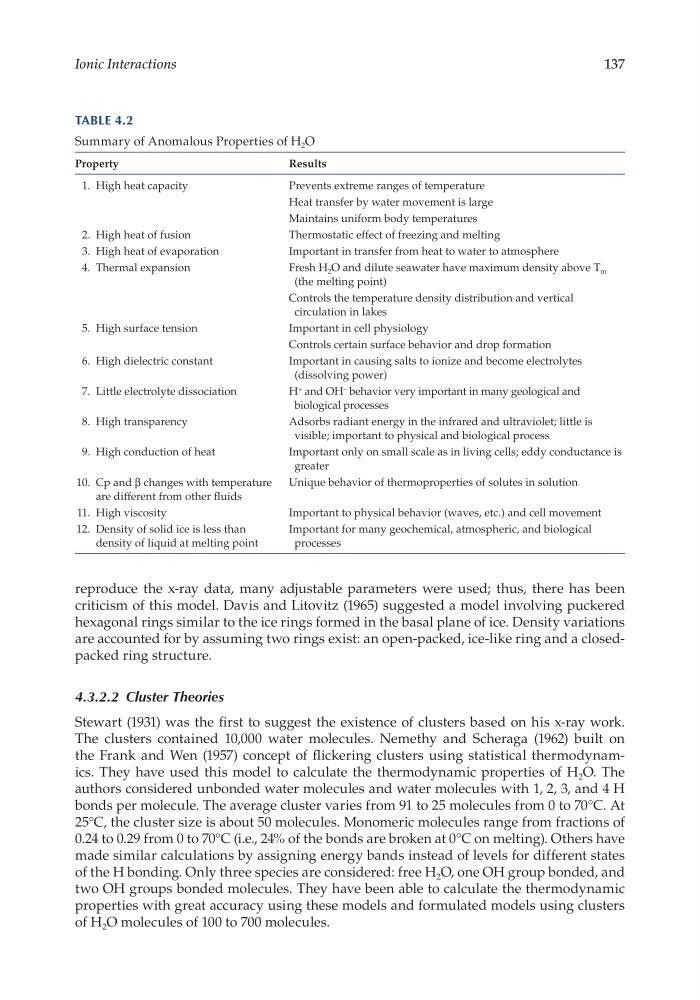
Table 4.2
Summary of Anomalous Properties of H 2 O
Property
Results
1. High heat capacity
Prevents extreme ranges of temperature
Heat transfer by water movement is large
Maintains uniform body temperatures
2. High heat of fusion
Thermostatic effect of freezing and melting
3. High heat of evaporation
Important in transfer from heat to water to atmosphere
4. Thermal expansion
Fresh H 2 O and dilute seawater have maximum density above T m
(the melting point)
Controls the temperature density distribution and vertical
circulation in lakes
5. High surface tension
Important in cell physiology
Controls certain surface behavior and drop formation
6. High dielectric constant
Important in causing salts to ionize and become electrolytes
(dissolving power)
7. Little electrolyte dissociation
H + and OH – behavior very important in many geological and
biological processes
8. High transparency
Adsorbs radiant energy in the infrared and ultraviolet; little is
visible; important to physical and biological process
9. High conduction of heat
Important only on small scale as in living cells; eddy conductance is
greater
10. Cp and β changes with temperature
are different from other fluids
Unique behavior of thermoproperties of solutes in solution
11. High viscosity
Important to physical behavior (waves, etc.) and cell movement
12. Density of solid ice is less than
density of liquid at melting point
Important for many geochemical, atmospheric, and biological
processes
Ionic Interactions
reproduce the x- ray data, many adjustable parameters were used; thus, there has been
criticism of this model. Davis and Litovitz (1965) suggested a model involving puckered
hexagonal rings similar to the ice rings formed in the basal plane of ice. Density variations
are accounted for by assuming two rings exist: an open- packed, ice- like ring and a closedpacked ring structure.
4.3.2.2 Cluster Theories
Stewart (1931) was the first to suggest the existence of clusters based on his x- ray work.
The clusters contained 10,000 water molecules. Nemethy and Scheraga (1962) built on
the Frank and Wen (1957) concept of flickering clusters using statistical thermodynamics. They have used this model to calculate the thermodynamic properties of H 2 O. The
authors considered unbonded water molecules and water molecules with 1, 2, 3, and 4 H
bonds per molecule. The average cluster varies from 91 to 25 molecules from 0 to 70°C. At
25°C, the cluster size is about 50 molecules. Monomeric molecules range from fractions of
0.24 to 0.29 from 0 to 70°C (i.e., 24% of the bonds are broken at 0°C on melting). Others have
made similar calculations by assigning energy bands instead of levels for different states
of the H bonding. Only three species are considered: free H 2 O, one OH group bonded, and
two OH groups bonded molecules. They have been able to calculate the thermodynamic
properties with great accuracy using these models and formulated models using clusters
of H 2 O molecules of 100 to 700 molecules.
Table 4.2
Summary of Anomalous Properties of H 2 O
Property
Results
1. High heat capacity
Prevents extreme ranges of temperature
Heat transfer by water movement is large
Maintains uniform body temperatures
2. High heat of fusion
Thermostatic effect of freezing and melting
3. High heat of evaporation
Important in transfer from heat to water to atmosphere
4. Thermal expansion
Fresh H 2 O and dilute seawater have maximum density above T m
(the melting point)
Controls the temperature density distribution and vertical
circulation in lakes
5. High surface tension
Important in cell physiology
Controls certain surface behavior and drop formation
6. High dielectric constant
Important in causing salts to ionize and become electrolytes
(dissolving power)
7. Little electrolyte dissociation
H + and OH – behavior very important in many geological and
biological processes
8. High transparency
Adsorbs radiant energy in the infrared and ultraviolet; little is
visible; important to physical and biological process
9. High conduction of heat
Important only on small scale as in living cells; eddy conductance is
greater
10. Cp and β changes with temperature
are different from other fluids
Unique behavior of thermoproperties of solutes in solution
11. High viscosity
Important to physical behavior (waves, etc.) and cell movement
12. Density of solid ice is less than
density of liquid at melting point
Important for many geochemical, atmospheric, and biological
processes