

136
Chemical Oceanography, 4th Edition
1. Broken- down ice lattice models: ice- like units in equilibrium with monomers
2. Cluster models: H- bonded clusters in equilibrium with monomers
3. Clathrate models: clathrate- like cages in equilibrium with monomers
4. Significant structure model or Eucken’s polymer model: bulky species that are
not necessarily a monomer
In each case, at least two different species of water exist—a bulky species representing some type of structured units and a dense species such as a monomer. A sketch of a
popular mixture model called the flickering cluster model is shown in Figure 4.8. Water
monomers are thought to be in a dynamic equilibrium with large clusters of hydrogenbonded waters.
4.3.2.1 Ice- Like Models
Rowland (1880) was the first to suggest equilibrium between ice I and monomer. Samoilov
(1965) proposed a model in which the monomeric H 2 O molecules are “tucked away” in the
interstitial spaces of an ice- like lattice (Figure 4.9). Since ice has 13 known crystal phases
(Ball, 1999) and a number of amorphous forms (Guthrie et al., 2003), some workers have
assumed that the structured form is ice- like. Tammann (1895), for example, suggested that
there should be as many types of structures in liquid water as there are types of ice (e.g., ice
I, II, etc.; Figure 4.10). The very careful x- ray diffraction study of Danford and Levy (1962)
was found to be in good agreement with a broken- down ice structure model. They suggested that the monomeric water molecules occupy positions in the interstices of the ice.
(This is similar to the Samoilov model.) Although the model has been used to successfully
Pressure (kg cm
–3 )
0
500
1000
1500
2000
2500
Relative Visocity (η/η°)
0.90
0.92
0.94
0.96
0.98
1.00
1.02
1.04
2.25°C
4.009°C
20.36°C
30°C
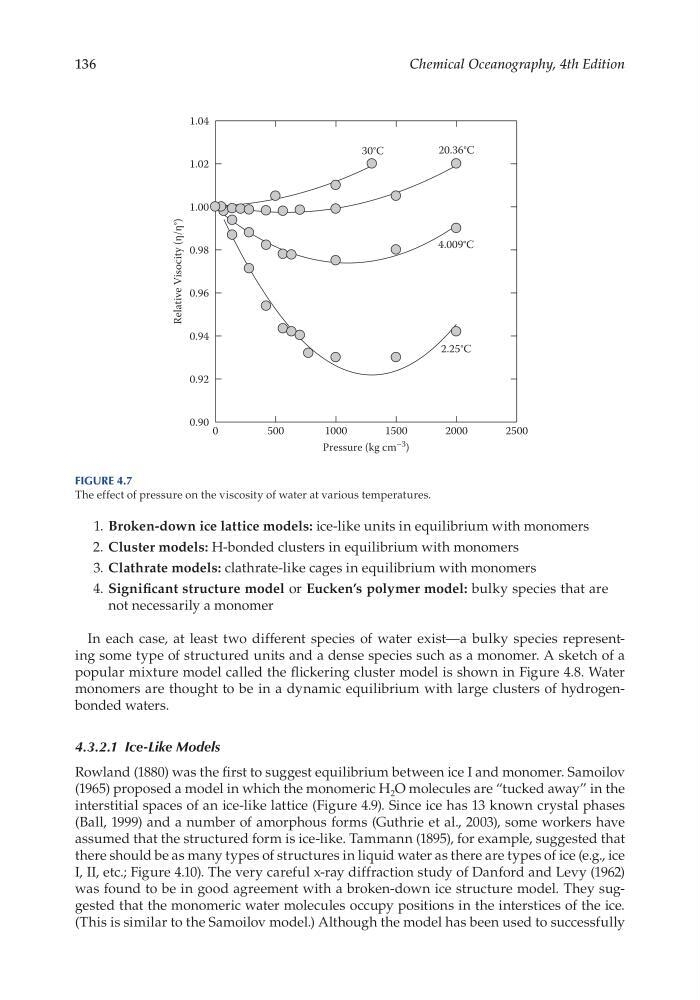
Figure 4.7
The effect of pressure on the viscosity of water at various temperatures.
Chemical Oceanography, 4th Edition
1. Broken- down ice lattice models: ice- like units in equilibrium with monomers
2. Cluster models: H- bonded clusters in equilibrium with monomers
3. Clathrate models: clathrate- like cages in equilibrium with monomers
4. Significant structure model or Eucken’s polymer model: bulky species that are
not necessarily a monomer
In each case, at least two different species of water exist—a bulky species representing some type of structured units and a dense species such as a monomer. A sketch of a
popular mixture model called the flickering cluster model is shown in Figure 4.8. Water
monomers are thought to be in a dynamic equilibrium with large clusters of hydrogenbonded waters.
4.3.2.1 Ice- Like Models
Rowland (1880) was the first to suggest equilibrium between ice I and monomer. Samoilov
(1965) proposed a model in which the monomeric H 2 O molecules are “tucked away” in the
interstitial spaces of an ice- like lattice (Figure 4.9). Since ice has 13 known crystal phases
(Ball, 1999) and a number of amorphous forms (Guthrie et al., 2003), some workers have
assumed that the structured form is ice- like. Tammann (1895), for example, suggested that
there should be as many types of structures in liquid water as there are types of ice (e.g., ice
I, II, etc.; Figure 4.10). The very careful x- ray diffraction study of Danford and Levy (1962)
was found to be in good agreement with a broken- down ice structure model. They suggested that the monomeric water molecules occupy positions in the interstices of the ice.
(This is similar to the Samoilov model.) Although the model has been used to successfully
Pressure (kg cm
–3 )
0
500
1000
1500
2000
2500
Relative Visocity (η/η°)
0.90
0.92
0.94
0.96
0.98
1.00
1.02
1.04
2.25°C
4.009°C
20.36°C
30°C
Figure 4.7
The effect of pressure on the viscosity of water at various temperatures.