

133
Ionic Interactions
temperature. Although the inflections do not occur at the same temperature, they appear
to be due to changes in the structure of the liquid. For example, the specific volumes indicate that from 0 to 4°C some ice- like structure may be broken down, and at temperatures
above 4°C, the volume increases with increasing temperature, like other fluids. The effect
of pressure on the viscosity of water (Figure 4.7) also appears to be unique at temperatures
below 30°C. One would expect that the application of pressure to a fluid would increase
with an increase in pressure. Water below 30°C shows a decrease as the pressure is first
applied. This may be due to the pressure initially breaking down some open structure of
water at the lower temperatures. These so- called anomalies of water can have an effect on
the properties of natural waters (Table 4.2). For example, the high heat capacity of water
prevents extreme ranges in the temperature in coastal regions.
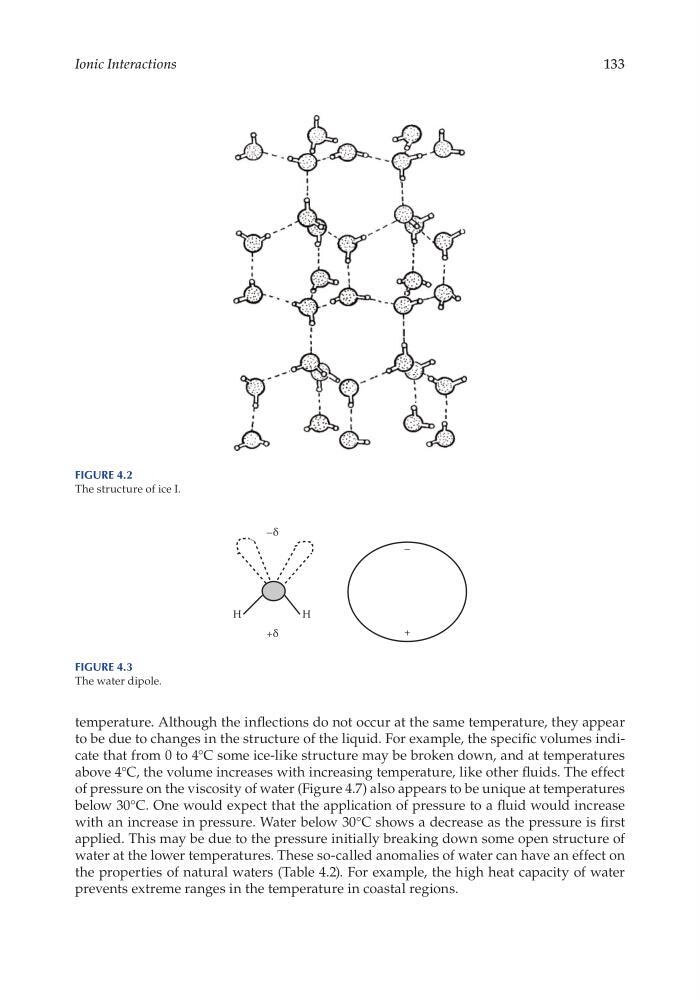
Figure 4.2
The structure of ice I.
–
H
H
+
+δ
–δ
Figure 4.3
The water dipole.
Ionic Interactions
temperature. Although the inflections do not occur at the same temperature, they appear
to be due to changes in the structure of the liquid. For example, the specific volumes indicate that from 0 to 4°C some ice- like structure may be broken down, and at temperatures
above 4°C, the volume increases with increasing temperature, like other fluids. The effect
of pressure on the viscosity of water (Figure 4.7) also appears to be unique at temperatures
below 30°C. One would expect that the application of pressure to a fluid would increase
with an increase in pressure. Water below 30°C shows a decrease as the pressure is first
applied. This may be due to the pressure initially breaking down some open structure of
water at the lower temperatures. These so- called anomalies of water can have an effect on
the properties of natural waters (Table 4.2). For example, the high heat capacity of water
prevents extreme ranges in the temperature in coastal regions.
Figure 4.2
The structure of ice I.
–
H
H
+
+δ
–δ
Figure 4.3
The water dipole.