

132
Chemical Oceanography, 4th Edition
also due to its high dielectric constant. Only a few inorganic components have higher
dielectric constants: D (NH 3 ) = 23, D (HF) = 85, D (HCN) = 95, D (SO 2 ) = 140. The hydrating
properties of water are well known; however, the causes are not clearly known.
The unique bond angle and ability to form hydrogen bonds results in long- range order
in water (and ice) that is unique compared to most other liquids. Each water molecule
has the opportunity to combine with up to four other water molecules through hydrogen
bonds (see Figure 4.2). All of these unique properties of water can be traced to the structure of the individual water molecules and how they interact with one another. One might
expect the atoms in water to be at a bond angle of 180°, but they actually form a bond angle
of 105°. As a result of the intermolecular forces in the water molecule not being completely
balanced (105° bond angle), the water molecule has an electric dipole. The separation of the
negative charge on the unpaired electrons and the positive charge on the protons results
in a dipole moment of 1.84D (D = Debye; 1 D is equivalent to the separation of two point
charges of opposite sign at a distance of 1 Å, 10 –8 cm). This is shown in Figure 4.3. Since
there are actually two points of negative and two points of positive charge separation on a
water molecule, one has a quadrupole moment. This is shown in Figure 4.4. This quadrupole moment results from dipole–dipole interactions, which are the electrical analogy to
moments of inertia.
The dipole–dipole interaction of two water molecules causes hydrogen bonding in
water. A given water molecule has the ability to form four hydrogen bonds (see Figure 4.5).
The energies involved in hydrogen bonding are in general much larger than most dipole–
dipole interactions; thus, they should be classified separately. The ΔH for the formation
of a hydrogen bond is small (~1 to 10 kcal mol –1 ) compared to most compounds that form
chemical bonds of 100 kcal mol –1 . The hydrogen bond is not completely electrostatic in
nature. It has some covalent character because of the sharing of the unpaired electrons
on the oxygen of one water molecule with protons of another. This hydrogen bonding
in water causes many of its physical and chemical properties to be different. The effects
of temperature and pressure on many of the properties of water are unique compared
to other liquids. The effects of temperature (Figure 4.6) on the specific volume, sound
speed, compressibility, and specific heat all show a maximum or minimum at a given
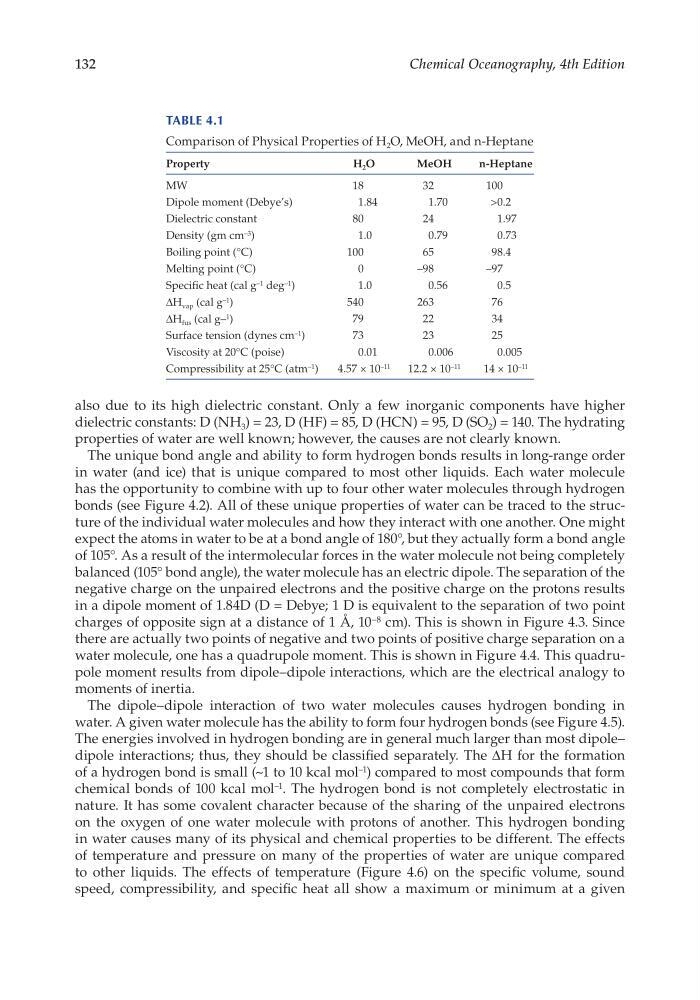
Table 4.1
Comparison of Physical Properties of H 2 O, MeOH, and n- Heptane
Property
H 2 O
MeOH
n- Heptane
MW
18
32
100
Dipole moment (Debye’s)
1.84
1.70
>0.2
Dielectric constant
80
24
1.97
Density (gm cm –3 )
1.0
0.79
0.73
Boiling point (°C)
100
65
98.4
Melting point (°C)
0
–98
–97
Specific heat (cal g –1 deg –1 )
1.0
0.56
0.5
ΔH vap (cal g –1 )
540
263
76
ΔH fus (cal g– 1 )
79
22
34
Surface tension (dynes cm –1 )
73
23
25
Viscosity at 20°C (poise)
0.01
0.006
0.005
Compressibility at 25°C (atm –1 )
4.57 × 10 –11
12.2 × 10 –11
14 × 10 –11
Chemical Oceanography, 4th Edition
also due to its high dielectric constant. Only a few inorganic components have higher
dielectric constants: D (NH 3 ) = 23, D (HF) = 85, D (HCN) = 95, D (SO 2 ) = 140. The hydrating
properties of water are well known; however, the causes are not clearly known.
The unique bond angle and ability to form hydrogen bonds results in long- range order
in water (and ice) that is unique compared to most other liquids. Each water molecule
has the opportunity to combine with up to four other water molecules through hydrogen
bonds (see Figure 4.2). All of these unique properties of water can be traced to the structure of the individual water molecules and how they interact with one another. One might
expect the atoms in water to be at a bond angle of 180°, but they actually form a bond angle
of 105°. As a result of the intermolecular forces in the water molecule not being completely
balanced (105° bond angle), the water molecule has an electric dipole. The separation of the
negative charge on the unpaired electrons and the positive charge on the protons results
in a dipole moment of 1.84D (D = Debye; 1 D is equivalent to the separation of two point
charges of opposite sign at a distance of 1 Å, 10 –8 cm). This is shown in Figure 4.3. Since
there are actually two points of negative and two points of positive charge separation on a
water molecule, one has a quadrupole moment. This is shown in Figure 4.4. This quadrupole moment results from dipole–dipole interactions, which are the electrical analogy to
moments of inertia.
The dipole–dipole interaction of two water molecules causes hydrogen bonding in
water. A given water molecule has the ability to form four hydrogen bonds (see Figure 4.5).
The energies involved in hydrogen bonding are in general much larger than most dipole–
dipole interactions; thus, they should be classified separately. The ΔH for the formation
of a hydrogen bond is small (~1 to 10 kcal mol –1 ) compared to most compounds that form
chemical bonds of 100 kcal mol –1 . The hydrogen bond is not completely electrostatic in
nature. It has some covalent character because of the sharing of the unpaired electrons
on the oxygen of one water molecule with protons of another. This hydrogen bonding
in water causes many of its physical and chemical properties to be different. The effects
of temperature and pressure on many of the properties of water are unique compared
to other liquids. The effects of temperature (Figure 4.6) on the specific volume, sound
speed, compressibility, and specific heat all show a maximum or minimum at a given
Table 4.1
Comparison of Physical Properties of H 2 O, MeOH, and n- Heptane
Property
H 2 O
MeOH
n- Heptane
MW
18
32
100
Dipole moment (Debye’s)
1.84
1.70
>0.2
Dielectric constant
80
24
1.97
Density (gm cm –3 )
1.0
0.79
0.73
Boiling point (°C)
100
65
98.4
Melting point (°C)
0
–98
–97
Specific heat (cal g –1 deg –1 )
1.0
0.56
0.5
ΔH vap (cal g –1 )
540
263
76
ΔH fus (cal g– 1 )
79
22
34
Surface tension (dynes cm –1 )
73
23
25
Viscosity at 20°C (poise)
0.01
0.006
0.005
Compressibility at 25°C (atm –1 )
4.57 × 10 –11
12.2 × 10 –11
14 × 10 –11