

131
Ionic Interactions
nature of water and its interactions in natural waters. As chemical oceanography becomes
a less- descriptive science and moves to one that attempts to probe the chemical processes
occurring in the oceans, this approach will become more popular. One must keep in mind
that the ultimate aim of a marine chemist is to obtain a molecular- level understanding of
the chemical processes that occur in the marine environment. To do this, one eventually
must understand the role water plays in these molecular interactions. With this in mind,
we discuss some of the unique properties of water and its structure in this section.
The unique position of water compared to other similar compounds in nature can be of
great importance in various meteorological, oceanographic, geochemical, and biochemical
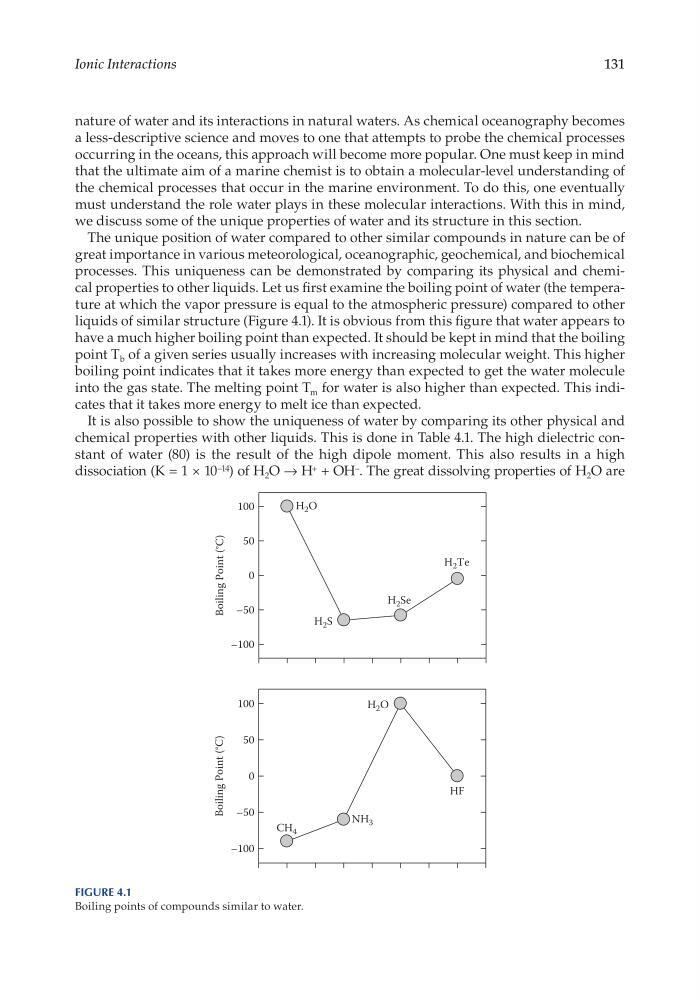
processes. This uniqueness can be demonstrated by comparing its physical and chemical properties to other liquids. Let us first examine the boiling point of water (the temperature at which the vapor pressure is equal to the atmospheric pressure) compared to other
liquids of similar structure (Figure 4.1). It is obvious from this figure that water appears to
have a much higher boiling point than expected. It should be kept in mind that the boiling
point T b of a given series usually increases with increasing molecular weight. This higher
boiling point indicates that it takes more energy than expected to get the water molecule
into the gas state. The melting point T m for water is also higher than expected. This indicates that it takes more energy to melt ice than expected.
It is also possible to show the uniqueness of water by comparing its other physical and
chemical properties with other liquids. This is done in Table 4.1. The high dielectric constant of water (80) is the result of the high dipole moment. This also results in a high
dissociation (K = 1 × 10 –14 ) of H 2 O → H + + OH – . The great dissolving properties of H 2 O are
Boiling Point (°C)
–100
–50
0
50
100
H 2 O
H 2 S
H 2 Se
H 2 Te
Boiling Point (°C)
–100
–50
0
50
100
CH 4
NH 3
H 2 O
HF
Figure 4.1
Boiling points of compounds similar to water.
Ionic Interactions
nature of water and its interactions in natural waters. As chemical oceanography becomes
a less- descriptive science and moves to one that attempts to probe the chemical processes
occurring in the oceans, this approach will become more popular. One must keep in mind
that the ultimate aim of a marine chemist is to obtain a molecular- level understanding of
the chemical processes that occur in the marine environment. To do this, one eventually
must understand the role water plays in these molecular interactions. With this in mind,
we discuss some of the unique properties of water and its structure in this section.
The unique position of water compared to other similar compounds in nature can be of
great importance in various meteorological, oceanographic, geochemical, and biochemical
processes. This uniqueness can be demonstrated by comparing its physical and chemical properties to other liquids. Let us first examine the boiling point of water (the temperature at which the vapor pressure is equal to the atmospheric pressure) compared to other
liquids of similar structure (Figure 4.1). It is obvious from this figure that water appears to
have a much higher boiling point than expected. It should be kept in mind that the boiling
point T b of a given series usually increases with increasing molecular weight. This higher
boiling point indicates that it takes more energy than expected to get the water molecule
into the gas state. The melting point T m for water is also higher than expected. This indicates that it takes more energy to melt ice than expected.
It is also possible to show the uniqueness of water by comparing its other physical and
chemical properties with other liquids. This is done in Table 4.1. The high dielectric constant of water (80) is the result of the high dipole moment. This also results in a high
dissociation (K = 1 × 10 –14 ) of H 2 O → H + + OH – . The great dissolving properties of H 2 O are
Boiling Point (°C)
–100
–50
0
50
100
H 2 O
H 2 S
H 2 Se
H 2 Te
Boiling Point (°C)
–100
–50
0
50
100
CH 4
NH 3
H 2 O
HF
Figure 4.1
Boiling points of compounds similar to water.