

113
Minor Elements in Seawater
bulk transport of materials to the deep sea. These particles have been studied by catching
them in sediment traps or by using large- volume pumping systems. This cycling of C, N, P,
and S as well as trace metals was studied in a large multi- institutional study called the Joint
Global Ocean Flux Study (JGOFS). Surface trace metals have been recently studied as part
of the Climate Variability and Predictability (CLIVAR) study. The recent results for Fe and
Al (Landing, Personal Communication) in the Atlantic off the coast of Africa are shown in
Figure 3.31. The Al is high in the surface waters from the input of African dust and removed
in deeper waters. The Fe is taken out of the surface water apparently by plankton and put
back into the deeper waters by the breakdown of the plankton by bacteria or zooplankton.
GEOTRACERS will measure a number of trace metals along a number of cruise tracks
from the surface to deep waters. This program will yield a large amount of information on
the biogeochemistry of the world oceans.
3.5 Geochemical Balance of Elements
There is a continual interaction between the oceans and the land. The water from the
oceans evaporates, comes down as rain, and attacks the rocks and soil. The rivers of the
world carry the weathered products (dissolved and suspended) to the oceans. Sediments
are formed on continental shelves, and fine particles are carried throughout the oceans. A
number of geochemists have been concerned with geochemical processes with an interest
in the evolution of seawater, sedimentary cycling, and the controls of the composition of
Pb, pmol kg
–1
0
20
40
60
80
100 120 140 160 180 200
Depth, m
0
100
200
300
400
500
600
700
800
900
1000
2012
1993
1984
1979
1989
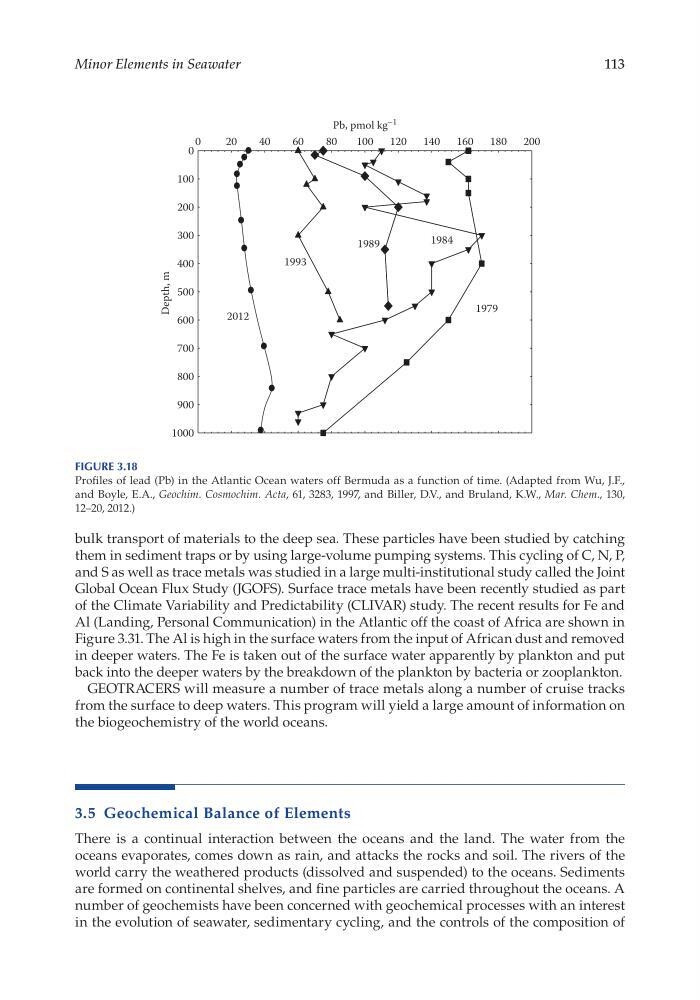
Figure 3.18
Profiles of lead (Pb) in the Atlantic Ocean waters off Bermuda as a function of time. (Adapted from Wu, J.F.,
and Boyle, E.A., Geochim. Cosmochim. Acta, 61, 3283, 1997, and Biller, D.V., and Bruland, K.W., Mar. Chem., 130,
12–20, 2012.)
Minor Elements in Seawater
bulk transport of materials to the deep sea. These particles have been studied by catching
them in sediment traps or by using large- volume pumping systems. This cycling of C, N, P,
and S as well as trace metals was studied in a large multi- institutional study called the Joint
Global Ocean Flux Study (JGOFS). Surface trace metals have been recently studied as part
of the Climate Variability and Predictability (CLIVAR) study. The recent results for Fe and
Al (Landing, Personal Communication) in the Atlantic off the coast of Africa are shown in
Figure 3.31. The Al is high in the surface waters from the input of African dust and removed
in deeper waters. The Fe is taken out of the surface water apparently by plankton and put
back into the deeper waters by the breakdown of the plankton by bacteria or zooplankton.
GEOTRACERS will measure a number of trace metals along a number of cruise tracks
from the surface to deep waters. This program will yield a large amount of information on
the biogeochemistry of the world oceans.
3.5 Geochemical Balance of Elements
There is a continual interaction between the oceans and the land. The water from the
oceans evaporates, comes down as rain, and attacks the rocks and soil. The rivers of the
world carry the weathered products (dissolved and suspended) to the oceans. Sediments
are formed on continental shelves, and fine particles are carried throughout the oceans. A
number of geochemists have been concerned with geochemical processes with an interest
in the evolution of seawater, sedimentary cycling, and the controls of the composition of
Pb, pmol kg
–1
0
20
40
60
80
100 120 140 160 180 200
Depth, m
0
100
200
300
400
500
600
700
800
900
1000
2012
1993
1984
1979
1989
Figure 3.18
Profiles of lead (Pb) in the Atlantic Ocean waters off Bermuda as a function of time. (Adapted from Wu, J.F.,
and Boyle, E.A., Geochim. Cosmochim. Acta, 61, 3283, 1997, and Biller, D.V., and Bruland, K.W., Mar. Chem., 130,
12–20, 2012.)