

114
Chemical Oceanography, 4th Edition
the oceans. By comparing the present composition of dissolved ions in the oceans (moles
per square centimeter of the surface of the earth) with the amount delivered, attempts
have been made to prepare a geochemical balance. Sillén (1967) tabulated the amounts of
some of the major components of seawater delivered by rivers over the past 100 million
years. These estimates are compared to the amounts in the present oceans in Table 3.11.
Most of the elements show an excess amount added over this period of time. The Na + and
Cl – delivered to the oceans is mostly sea spray that is washed back to the oceans. The other
ions, however, are the result of weathering of rocks and soils. In addition to the dissolved
materials, 300 to 600 kg cm –3 of solid material have been delivered to the oceans in the past
100 million years. These solids are mostly clay minerals that can participate in ion- exchange
reactions with the components of seawater and go through phase transformations.
Some geochemists have attempted to develop a geochemical balance between the material added to the rivers and the amount delivered to the sediments. These attempts were
started in 1993 by Goldsmith. He considered that the reaction
Igneous rocks + Volatiles → Seawater + Sediments + Air
(3.8)
controls the composition of rocks and seawater and attempted to balance the reaction. He
concluded that 600 g of rock would lead to 600 g of sediments. More recent attempts have
been made by Garrels and Mackenzie (1971). The steady- state model for the circulation of
elements in the sedimentary cycle is shown in Figure 3.32. The fluxes are in units of 10 14 g
yr –1 . Unlike the earlier model of Goldsmith, recent work has the weathering reaction going
Pb, pmol kg
–1
0
10
20
30
40
50
60
70
80
Depth, m
0
1000
2000
3000
4000
5000
Atlantic
Pacific
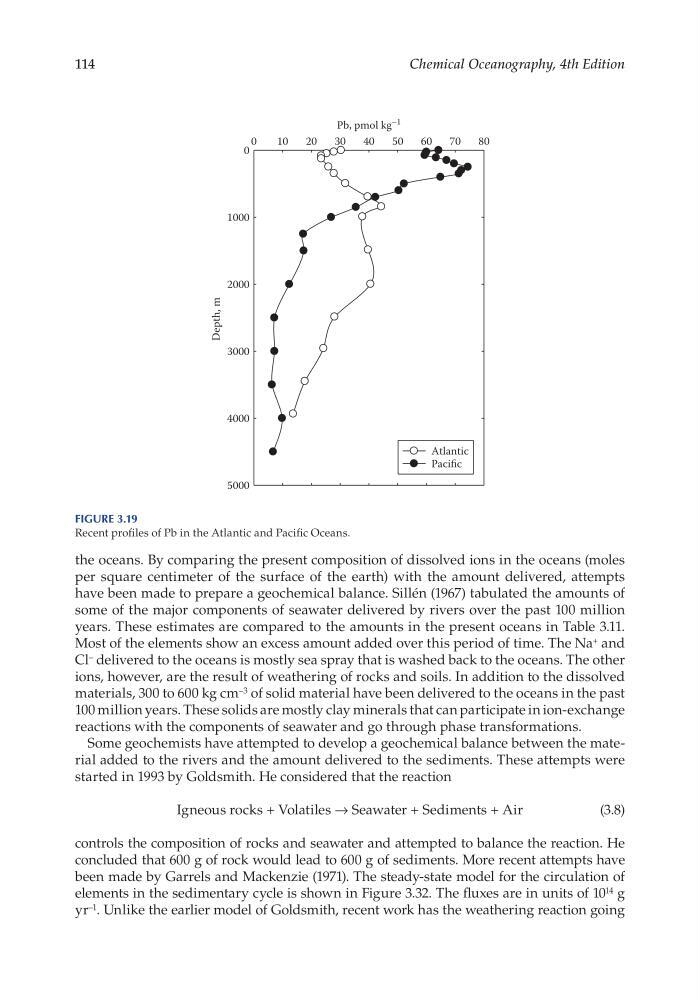
Figure 3.19
Recent profiles of Pb in the Atlantic and Pacific Oceans.
Chemical Oceanography, 4th Edition
the oceans. By comparing the present composition of dissolved ions in the oceans (moles
per square centimeter of the surface of the earth) with the amount delivered, attempts
have been made to prepare a geochemical balance. Sillén (1967) tabulated the amounts of
some of the major components of seawater delivered by rivers over the past 100 million
years. These estimates are compared to the amounts in the present oceans in Table 3.11.
Most of the elements show an excess amount added over this period of time. The Na + and
Cl – delivered to the oceans is mostly sea spray that is washed back to the oceans. The other
ions, however, are the result of weathering of rocks and soils. In addition to the dissolved
materials, 300 to 600 kg cm –3 of solid material have been delivered to the oceans in the past
100 million years. These solids are mostly clay minerals that can participate in ion- exchange
reactions with the components of seawater and go through phase transformations.
Some geochemists have attempted to develop a geochemical balance between the material added to the rivers and the amount delivered to the sediments. These attempts were
started in 1993 by Goldsmith. He considered that the reaction
Igneous rocks + Volatiles → Seawater + Sediments + Air
(3.8)
controls the composition of rocks and seawater and attempted to balance the reaction. He
concluded that 600 g of rock would lead to 600 g of sediments. More recent attempts have
been made by Garrels and Mackenzie (1971). The steady- state model for the circulation of
elements in the sedimentary cycle is shown in Figure 3.32. The fluxes are in units of 10 14 g
yr –1 . Unlike the earlier model of Goldsmith, recent work has the weathering reaction going
Pb, pmol kg
–1
0
10
20
30
40
50
60
70
80
Depth, m
0
1000
2000
3000
4000
5000
Atlantic
Pacific
Figure 3.19
Recent profiles of Pb in the Atlantic and Pacific Oceans.