

112
Chemical Oceanography, 4th Edition
was similar and proportional to the hydrolysis constants of the metals (see Figure 3.28)
and to the residence times (Figure 3.29). These results suggest that the scavenging of metals in the oceans may be the result of ionic interactions with surface groups on living and
dead organic matter in the oceans. Fisher also showed (see Figure 3.30) that the toxicity of
metals to plankton was related to hydrolysis constants.
The above discussion is not meant to rule out nonbiological transport since it is well
known that many metals can be coprecipitated by SiO 2 and CaCO 3 or adsorbed on minerals in ocean waters. In an oxidizing environment, for example, many metals (Fe 2+ , Cu 2+ ,
Ni 2+ , Co 2+ , etc.) are concentrated on Mn nodules. In a reducing environment, a number
of metals are coprecipitated or adsorbed by pyrite (FeS 2 ). The oxidation of Fe 2+ and Mn 2+
results in the formation of solids that can adsorb many metals. In summary, each metal
may be influenced by biological or nonbiological processes. Future studies are needed to
elucidate that these processes actually are responsible for the distribution of many of the
elements present in the oceans.
Although most minor elements that enter the oceans eventually are removed to the sediments, many are recycled. The removal process is related to the interactions of elements
with particles (Whitfield and Turner, 1987). The production, sinking, and decomposition of
particulate matter are thus important in controlling the recycling of metals. Phytoplankton
are the primary producers of particles in the surface oceans. These plants are grazed on by
zooplankton and are packaged into fecal pellets. They have sinking rates of a few meters
to thousands of meters per day. The oxidation and dissolution of these particles can recycle
some of the elements. Recent work has shown that large particles are responsible for the
Cu, nmol kg
–1
0
1
2
3
4
5
6
Depth, m
0
1000
2000
3000
4000
5000
Atlantic
Pacific
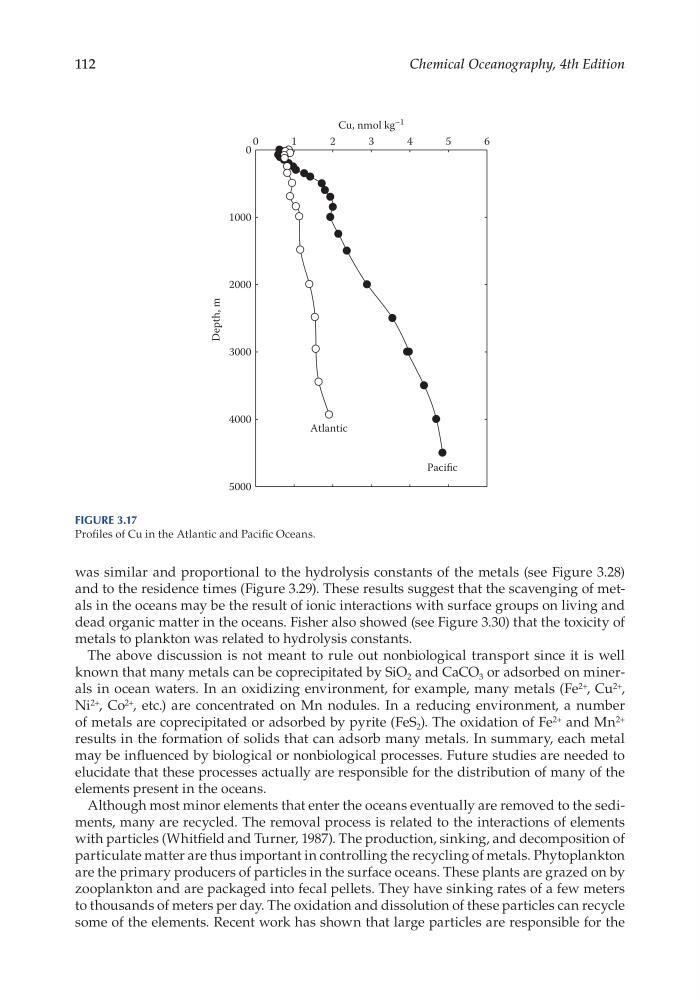
Figure 3.17
Profiles of Cu in the Atlantic and Pacific Oceans.
Chemical Oceanography, 4th Edition
was similar and proportional to the hydrolysis constants of the metals (see Figure 3.28)
and to the residence times (Figure 3.29). These results suggest that the scavenging of metals in the oceans may be the result of ionic interactions with surface groups on living and
dead organic matter in the oceans. Fisher also showed (see Figure 3.30) that the toxicity of
metals to plankton was related to hydrolysis constants.
The above discussion is not meant to rule out nonbiological transport since it is well
known that many metals can be coprecipitated by SiO 2 and CaCO 3 or adsorbed on minerals in ocean waters. In an oxidizing environment, for example, many metals (Fe 2+ , Cu 2+ ,
Ni 2+ , Co 2+ , etc.) are concentrated on Mn nodules. In a reducing environment, a number
of metals are coprecipitated or adsorbed by pyrite (FeS 2 ). The oxidation of Fe 2+ and Mn 2+
results in the formation of solids that can adsorb many metals. In summary, each metal
may be influenced by biological or nonbiological processes. Future studies are needed to
elucidate that these processes actually are responsible for the distribution of many of the
elements present in the oceans.
Although most minor elements that enter the oceans eventually are removed to the sediments, many are recycled. The removal process is related to the interactions of elements
with particles (Whitfield and Turner, 1987). The production, sinking, and decomposition of
particulate matter are thus important in controlling the recycling of metals. Phytoplankton
are the primary producers of particles in the surface oceans. These plants are grazed on by
zooplankton and are packaged into fecal pellets. They have sinking rates of a few meters
to thousands of meters per day. The oxidation and dissolution of these particles can recycle
some of the elements. Recent work has shown that large particles are responsible for the
Cu, nmol kg
–1
0
1
2
3
4
5
6
Depth, m
0
1000
2000
3000
4000
5000
Atlantic
Pacific
Figure 3.17
Profiles of Cu in the Atlantic and Pacific Oceans.