

111
Minor Elements in Seawater
These effects can account for the movement of elements from surface waters to the sediments. This movement can be caused by
1. Active uptake by organisms (Fe 2+ , Zn 2+ , Mn 2+ )
2. Passive uptake by organisms (heavy metals)
3. Adsorption on particulate matter (Pb 2+ , Cu 2+ )
4. Remobilization from sediments by oxidation (Mn 2+ )
5. Precipitation (Fe 3+ )
The active uptake of metals may be due to their use in enzyme systems (V, Cr, Mn, Fe, Co,
Ni, Cu, Zn, and Mo). Passive uptake may be due to the adsorption on organic particles
caused by interactions with surface groups (carboxylic, phenolic).
It is well known that a number of metals are concentrated in biological materials. This has
led to the suggestion that their source in the deep ocean comes from the death of marine
organisms with subsequent remineralization during oxidation. An alternate explanation
may be that metals may be carried to the deep ocean by adsorption on organic matter, both
living and dead. We have found, for example, that Cu 2+ is adsorbed on bacteria that are living or dead (see Figure 3.26). The absorption is quite fast (Figure 3.27), and the Cu 2+ can be
desorbed by acidifying the solutions. The adsorption increases with increasing pH, which
indicates that surface –OH and –COOH groups may be involved in the process. Fisher
(1986) has shown that adsorption of a number of metals to living and dead phytoplankton
Co, pmol kg
–1
0
20
40
60
80
100
120
Depth, m
0
1000
2000
3000
4000
5000
Atlantic
Pacific
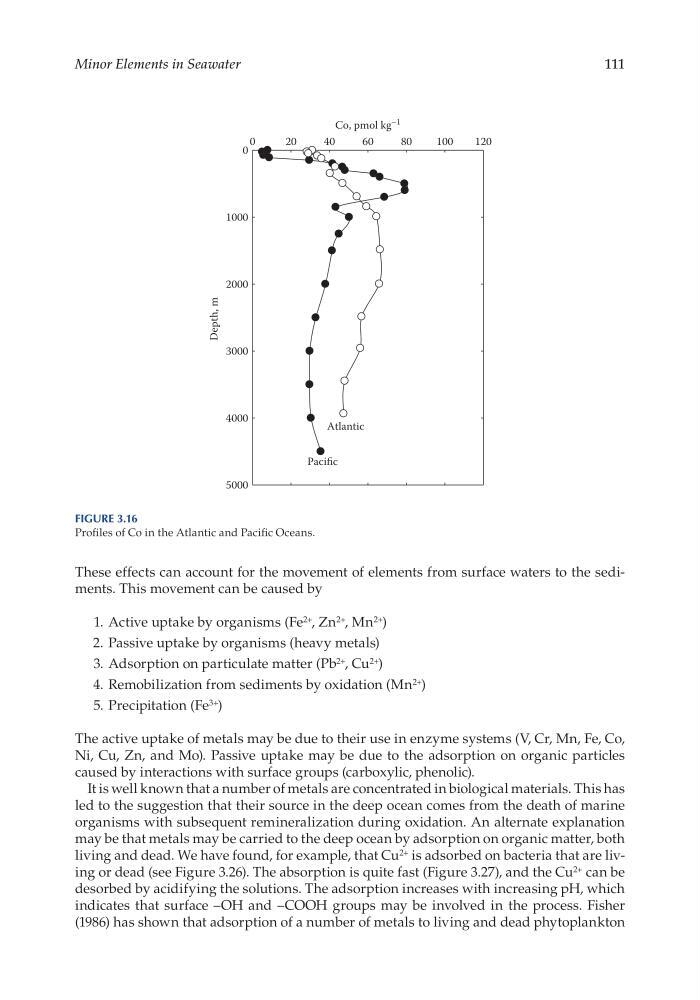
Figure 3.16
Profiles of Co in the Atlantic and Pacific Oceans.
Minor Elements in Seawater
These effects can account for the movement of elements from surface waters to the sediments. This movement can be caused by
1. Active uptake by organisms (Fe 2+ , Zn 2+ , Mn 2+ )
2. Passive uptake by organisms (heavy metals)
3. Adsorption on particulate matter (Pb 2+ , Cu 2+ )
4. Remobilization from sediments by oxidation (Mn 2+ )
5. Precipitation (Fe 3+ )
The active uptake of metals may be due to their use in enzyme systems (V, Cr, Mn, Fe, Co,
Ni, Cu, Zn, and Mo). Passive uptake may be due to the adsorption on organic particles
caused by interactions with surface groups (carboxylic, phenolic).
It is well known that a number of metals are concentrated in biological materials. This has
led to the suggestion that their source in the deep ocean comes from the death of marine
organisms with subsequent remineralization during oxidation. An alternate explanation
may be that metals may be carried to the deep ocean by adsorption on organic matter, both
living and dead. We have found, for example, that Cu 2+ is adsorbed on bacteria that are living or dead (see Figure 3.26). The absorption is quite fast (Figure 3.27), and the Cu 2+ can be
desorbed by acidifying the solutions. The adsorption increases with increasing pH, which
indicates that surface –OH and –COOH groups may be involved in the process. Fisher
(1986) has shown that adsorption of a number of metals to living and dead phytoplankton
Co, pmol kg
–1
0
20
40
60
80
100
120
Depth, m
0
1000
2000
3000
4000
5000
Atlantic
Pacific
Figure 3.16
Profiles of Co in the Atlantic and Pacific Oceans.