

99
Minor Elements in Seawater
sea salt (brines) that is transported to the land from the sea. As discussed in Chapter 10,
the input of elements from hydrothermal vents can change the residence times determined from inputs only from rivers. Estimates of the residence times from river inputs
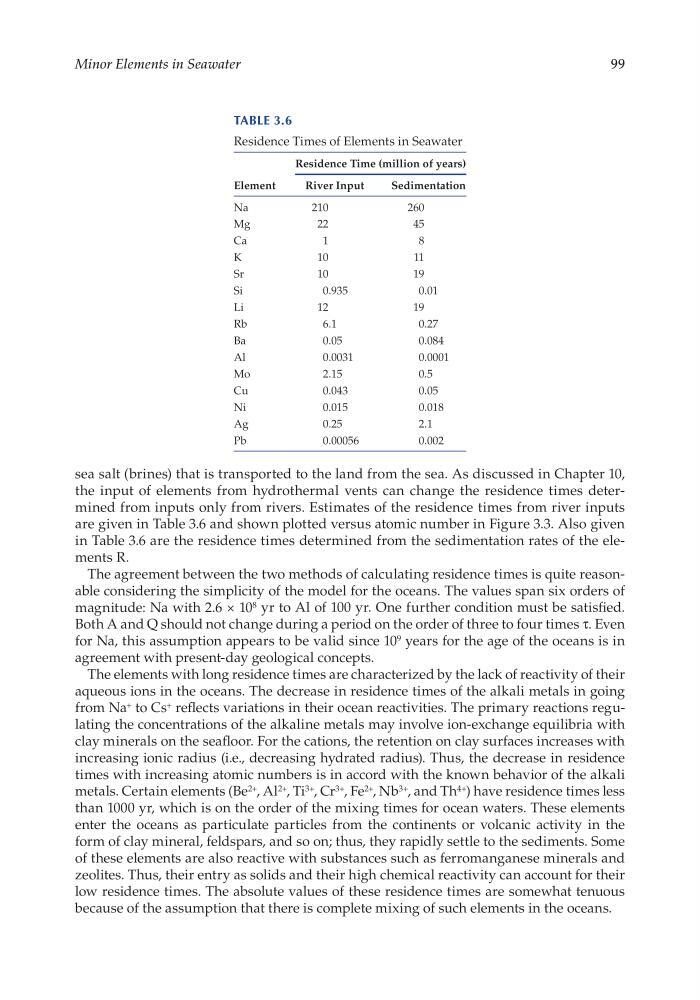
are given in Table 3.6 and shown plotted versus atomic number in Figure 3.3. Also given
in Table 3.6 are the residence times determined from the sedimentation rates of the elements R.
The agreement between the two methods of calculating residence times is quite reasonable considering the simplicity of the model for the oceans. The values span six orders of
magnitude: Na with 2.6 × 10 8 yr to Al of 100 yr. One further condition must be satisfied.
Both A and Q should not change during a period on the order of three to four times τ. Even
for Na, this assumption appears to be valid since 10 9 years for the age of the oceans is in
agreement with present- day geological concepts.
The elements with long residence times are characterized by the lack of reactivity of their
aqueous ions in the oceans. The decrease in residence times of the alkali metals in going
from Na + to Cs + reflects variations in their ocean reactivities. The primary reactions regulating the concentrations of the alkaline metals may involve ion- exchange equilibria with
clay minerals on the seafloor. For the cations, the retention on clay surfaces increases with
increasing ionic radius (i.e., decreasing hydrated radius). Thus, the decrease in residence
times with increasing atomic numbers is in accord with the known behavior of the alkali
metals. Certain elements (Be 2+ , Al 2+ , Ti 3+ , Cr 3+ , Fe 2+ , Nb 3+ , and Th 4+ ) have residence times less
than 1000 yr, which is on the order of the mixing times for ocean waters. These elements
enter the oceans as particulate particles from the continents or volcanic activity in the
form of clay mineral, feldspars, and so on; thus, they rapidly settle to the sediments. Some
of these elements are also reactive with substances such as ferromanganese minerals and
zeolites. Thus, their entry as solids and their high chemical reactivity can account for their
low residence times. The absolute values of these residence times are somewhat tenuous
because of the assumption that there is complete mixing of such elements in the oceans.
Table 3.6
Residence Times of Elements in Seawater
Element
Residence Time (million of years)
River Input
Sedimentation
Na
210
260
Mg
22
45
Ca
1
8
K
10
11
Sr
10
19
Si
0.935
0.01
Li
12
19
Rb
6.1
0.27
Ba
0.05
0.084
Al
0.0031
0.0001
Mo
2.15
0.5
Cu
0.043
0.05
Ni
0.015
0.018
Ag
0.25
2.1
Pb
0.00056
0.002
Minor Elements in Seawater
sea salt (brines) that is transported to the land from the sea. As discussed in Chapter 10,
the input of elements from hydrothermal vents can change the residence times determined from inputs only from rivers. Estimates of the residence times from river inputs
are given in Table 3.6 and shown plotted versus atomic number in Figure 3.3. Also given
in Table 3.6 are the residence times determined from the sedimentation rates of the elements R.
The agreement between the two methods of calculating residence times is quite reasonable considering the simplicity of the model for the oceans. The values span six orders of
magnitude: Na with 2.6 × 10 8 yr to Al of 100 yr. One further condition must be satisfied.
Both A and Q should not change during a period on the order of three to four times τ. Even
for Na, this assumption appears to be valid since 10 9 years for the age of the oceans is in
agreement with present- day geological concepts.
The elements with long residence times are characterized by the lack of reactivity of their
aqueous ions in the oceans. The decrease in residence times of the alkali metals in going
from Na + to Cs + reflects variations in their ocean reactivities. The primary reactions regulating the concentrations of the alkaline metals may involve ion- exchange equilibria with
clay minerals on the seafloor. For the cations, the retention on clay surfaces increases with
increasing ionic radius (i.e., decreasing hydrated radius). Thus, the decrease in residence
times with increasing atomic numbers is in accord with the known behavior of the alkali
metals. Certain elements (Be 2+ , Al 2+ , Ti 3+ , Cr 3+ , Fe 2+ , Nb 3+ , and Th 4+ ) have residence times less
than 1000 yr, which is on the order of the mixing times for ocean waters. These elements
enter the oceans as particulate particles from the continents or volcanic activity in the
form of clay mineral, feldspars, and so on; thus, they rapidly settle to the sediments. Some
of these elements are also reactive with substances such as ferromanganese minerals and
zeolites. Thus, their entry as solids and their high chemical reactivity can account for their
low residence times. The absolute values of these residence times are somewhat tenuous
because of the assumption that there is complete mixing of such elements in the oceans.
Table 3.6
Residence Times of Elements in Seawater
Element
Residence Time (million of years)
River Input
Sedimentation
Na
210
260
Mg
22
45
Ca
1
8
K
10
11
Sr
10
19
Si
0.935
0.01
Li
12
19
Rb
6.1
0.27
Ba
0.05
0.084
Al
0.0031
0.0001
Mo
2.15
0.5
Cu
0.043
0.05
Ni
0.015
0.018
Ag
0.25
2.1
Pb
0.00056
0.002