

98
Chemical Oceanography, 4th Edition
3.2 Residence Times
An element can have a low concentration in seawater for two reasons:
1. It may be very reactive and thus be rapidly removed to the sediments.
2. It may occur in very low concentrations in its source from crystalline rocks or
gaseous emanations from the interior of the earth.
For example, Al 3+ , although a minor element in seawater, is one of the most predominant
constituents of igneous rocks; its high reactivity in the marine environment reduces its
concentration. The element Cs + , on the other hand, has a low concentration in seawater
and in crystalline rocks. Insight into the comparative behavior of elements can thus be
gained by considering the relative reactivity of the elements based on the average time
they spend in seawater before removal to the sediments or the degree of undersaturation
of the element in seawater. These areas are discussed in the following sections.
Barth (1952) was the first to introduce the concept of the ocean as a simple reservoir for
the elements that are introduced into it during the major sediment cycle. He assumed a
steady- state system in which the amount of an element entering per unit time is equal to or
compensated by the settling out of an equivalent amount. The residence time τ can then be
defined as the average time that a substance remains in seawater before removal by some
precipitation or adsorption process and is given by
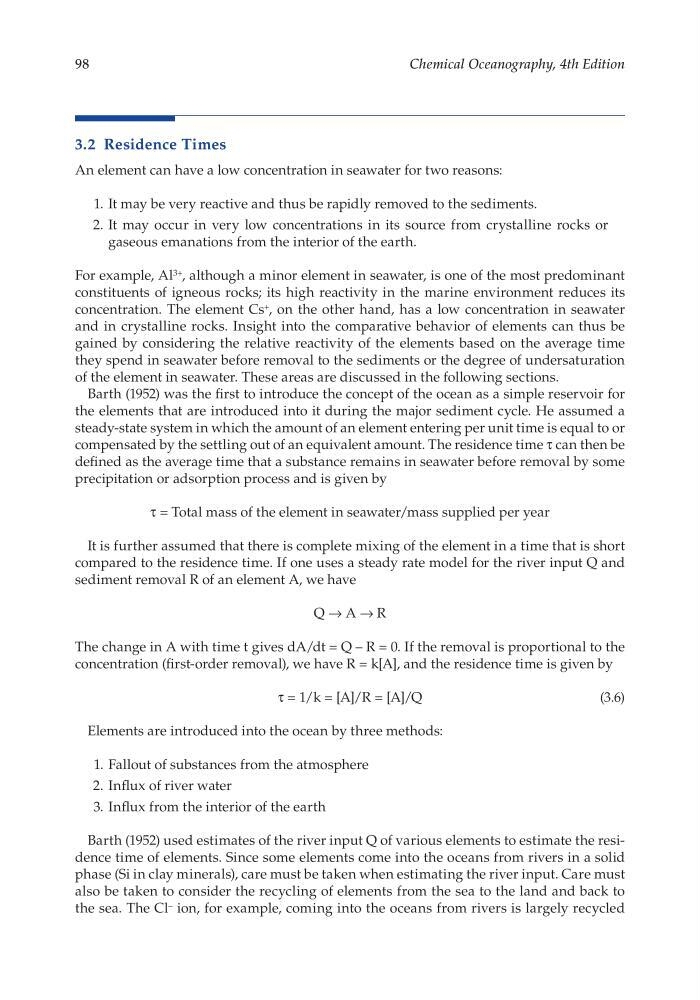
τ = Total mass of the element in seawater/ mass supplied per year
It is further assumed that there is complete mixing of the element in a time that is short
compared to the residence time. If one uses a steady rate model for the river input Q and
sediment removal R of an element A, we have
Q → A → R
The change in A with time t gives dA/ dt = Q – R = 0. If the removal is proportional to the
concentration (first- order removal), we have R = k[A], and the residence time is given by
τ = 1/k = [A]/R = [A]/Q
(3.6)
Elements are introduced into the ocean by three methods:
1. Fallout of substances from the atmosphere
2. Influx of river water
3. Influx from the interior of the earth
Barth (1952) used estimates of the river input Q of various elements to estimate the residence time of elements. Since some elements come into the oceans from rivers in a solid
phase (Si in clay minerals), care must be taken when estimating the river input. Care must
also be taken to consider the recycling of elements from the sea to the land and back to
the sea. The Cl – ion, for example, coming into the oceans from rivers is largely recycled
Chemical Oceanography, 4th Edition
3.2 Residence Times
An element can have a low concentration in seawater for two reasons:
1. It may be very reactive and thus be rapidly removed to the sediments.
2. It may occur in very low concentrations in its source from crystalline rocks or
gaseous emanations from the interior of the earth.
For example, Al 3+ , although a minor element in seawater, is one of the most predominant
constituents of igneous rocks; its high reactivity in the marine environment reduces its
concentration. The element Cs + , on the other hand, has a low concentration in seawater
and in crystalline rocks. Insight into the comparative behavior of elements can thus be
gained by considering the relative reactivity of the elements based on the average time
they spend in seawater before removal to the sediments or the degree of undersaturation
of the element in seawater. These areas are discussed in the following sections.
Barth (1952) was the first to introduce the concept of the ocean as a simple reservoir for
the elements that are introduced into it during the major sediment cycle. He assumed a
steady- state system in which the amount of an element entering per unit time is equal to or
compensated by the settling out of an equivalent amount. The residence time τ can then be
defined as the average time that a substance remains in seawater before removal by some
precipitation or adsorption process and is given by
τ = Total mass of the element in seawater/ mass supplied per year
It is further assumed that there is complete mixing of the element in a time that is short
compared to the residence time. If one uses a steady rate model for the river input Q and
sediment removal R of an element A, we have
Q → A → R
The change in A with time t gives dA/ dt = Q – R = 0. If the removal is proportional to the
concentration (first- order removal), we have R = k[A], and the residence time is given by
τ = 1/k = [A]/R = [A]/Q
(3.6)
Elements are introduced into the ocean by three methods:
1. Fallout of substances from the atmosphere
2. Influx of river water
3. Influx from the interior of the earth
Barth (1952) used estimates of the river input Q of various elements to estimate the residence time of elements. Since some elements come into the oceans from rivers in a solid
phase (Si in clay minerals), care must be taken when estimating the river input. Care must
also be taken to consider the recycling of elements from the sea to the land and back to
the sea. The Cl – ion, for example, coming into the oceans from rivers is largely recycled