

97
Minor Elements in Seawater
the formation of stronger Cl – complexes for many metals. For example, mercury can form
higher- order complexes with chloride.
Hg 2+ + Cl – → HgCl +
(3.1)
HgCl + + Cl – → HgCl 2
0
(3.2)
HgCl 2
0 + Cl – → HgCl 3
–
(3.3)
HgCl 3– + Cl – → HgCl 4
2–
(3.4)
HgCl 4
2– + Cl – → HgCl 5
3–
(3.5)
To evaluate the complete speciation or form of these heavy metals in seawater, it is necessary to consider the competition of all the ligands (Cl – , Br – , OH – , HCO 3
– , CO 3
2– , etc.) for a
given metal and the major divalent cations in seawater (Mg 2+ , Ca 2+ , and Sr 2+ ) for a given
anion. The speciation of the divalent heavy metals (Cd 2+ , Hg 2+ , Zn 2+ , Cu 2+ , and Pb 2+ ) in seawater and river waters is discussed further in the chapter.
3.1.3 Transition Metals between d 0 and d 10
The transition metal cations, in which the number of d electrons is greater than zero and
less than 10, represent this group. These include Mn 2+ , Fe 2+ , Co 2+ , Ni 2+ , Cu 2+ , and Zn 2+ ions.
These metals have been extensively studied and form strong complexes with organic molecules (ligands). From such work has evolved the so- called Irving- Williams order, which
states that for almost every ligand the stability of its complexes increases in the order
Mn 2+ < Fe 2+ < Co 2+ < Ni 2+ < Cu 2+ > Zn 2+
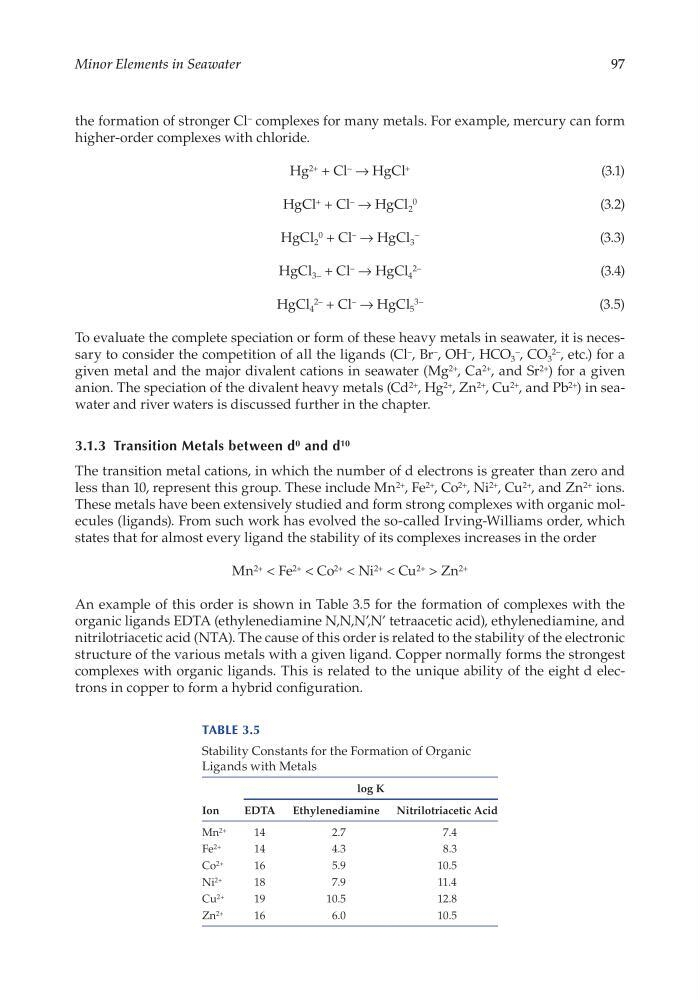
An example of this order is shown in Table 3.5 for the formation of complexes with the
organic ligands EDTA (ethylenediamine N,N,N’,N’ tetraacetic acid), ethylenediamine, and
nitrilotriacetic acid (NTA). The cause of this order is related to the stability of the electronic
structure of the various metals with a given ligand. Copper normally forms the strongest
complexes with organic ligands. This is related to the unique ability of the eight d electrons in copper to form a hybrid configuration.
Table 3.5
Stability Constants for the Formation of Organic
Ligands with Metals
Ion
log K
EDTA
Ethylenediamine
Nitrilotriacetic Acid
Mn 2+
14
2.7
7.4
Fe 2+
14
4.3
8.3
Co 2+
16
5.9
10.5
Ni 2+
18
7.9
11.4
Cu 2+
19
10.5
12.8
Zn 2+
16
6.0
10.5
Minor Elements in Seawater
the formation of stronger Cl – complexes for many metals. For example, mercury can form
higher- order complexes with chloride.
Hg 2+ + Cl – → HgCl +
(3.1)
HgCl + + Cl – → HgCl 2
0
(3.2)
HgCl 2
0 + Cl – → HgCl 3
–
(3.3)
HgCl 3– + Cl – → HgCl 4
2–
(3.4)
HgCl 4
2– + Cl – → HgCl 5
3–
(3.5)
To evaluate the complete speciation or form of these heavy metals in seawater, it is necessary to consider the competition of all the ligands (Cl – , Br – , OH – , HCO 3
– , CO 3
2– , etc.) for a
given metal and the major divalent cations in seawater (Mg 2+ , Ca 2+ , and Sr 2+ ) for a given
anion. The speciation of the divalent heavy metals (Cd 2+ , Hg 2+ , Zn 2+ , Cu 2+ , and Pb 2+ ) in seawater and river waters is discussed further in the chapter.
3.1.3 Transition Metals between d 0 and d 10
The transition metal cations, in which the number of d electrons is greater than zero and
less than 10, represent this group. These include Mn 2+ , Fe 2+ , Co 2+ , Ni 2+ , Cu 2+ , and Zn 2+ ions.
These metals have been extensively studied and form strong complexes with organic molecules (ligands). From such work has evolved the so- called Irving- Williams order, which
states that for almost every ligand the stability of its complexes increases in the order
Mn 2+ < Fe 2+ < Co 2+ < Ni 2+ < Cu 2+ > Zn 2+
An example of this order is shown in Table 3.5 for the formation of complexes with the
organic ligands EDTA (ethylenediamine N,N,N’,N’ tetraacetic acid), ethylenediamine, and
nitrilotriacetic acid (NTA). The cause of this order is related to the stability of the electronic
structure of the various metals with a given ligand. Copper normally forms the strongest
complexes with organic ligands. This is related to the unique ability of the eight d electrons in copper to form a hybrid configuration.
Table 3.5
Stability Constants for the Formation of Organic
Ligands with Metals
Ion
log K
EDTA
Ethylenediamine
Nitrilotriacetic Acid
Mn 2+
14
2.7
7.4
Fe 2+
14
4.3
8.3
Co 2+
16
5.9
10.5
Ni 2+
18
7.9
11.4
Cu 2+
19
10.5
12.8
Zn 2+
16
6.0
10.5