

100
Chemical Oceanography, 4th Edition
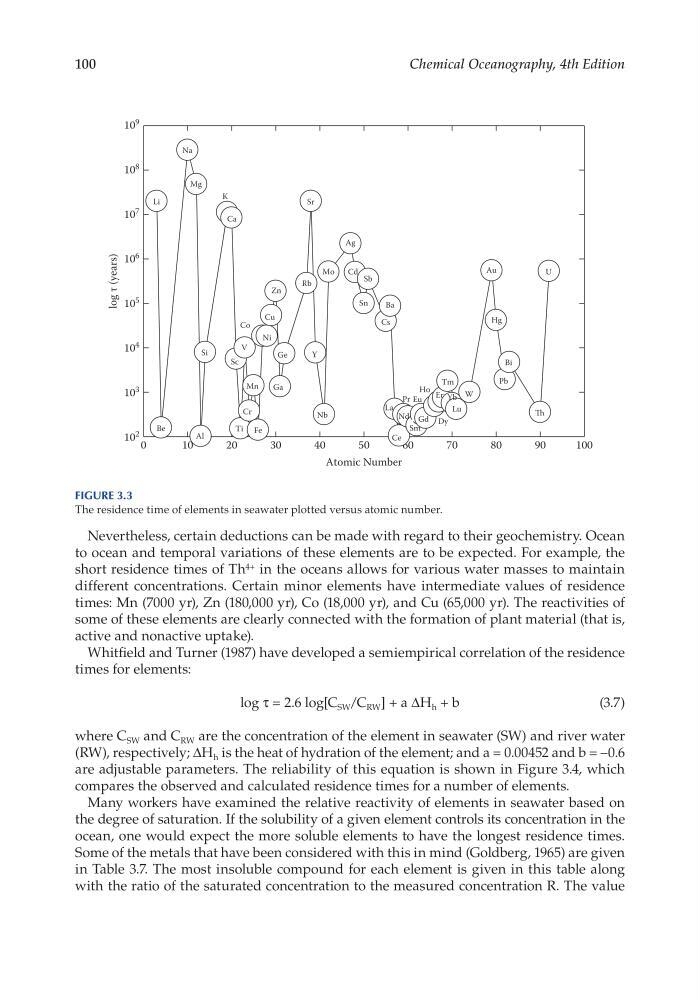
Nevertheless, certain deductions can be made with regard to their geochemistry. Ocean
to ocean and temporal variations of these elements are to be expected. For example, the
short residence times of Th 4+ in the oceans allows for various water masses to maintain
different concentrations. Certain minor elements have intermediate values of residence
times: Mn (7000 yr), Zn (180,000 yr), Co (18,000 yr), and Cu (65,000 yr). The reactivities of
some of these elements are clearly connected with the formation of plant material (that is,
active and nonactive uptake).
Whitfield and Turner (1987) have developed a semiempirical correlation of the residence
times for elements:
log τ = 2.6 log[C SW / C RW ] + a ΔH h + b
(3.7)
where C SW and C RW are the concentration of the element in seawater (SW) and river water
(RW), respectively; ΔH h is the heat of hydration of the element; and a = 0.00452 and b = –0.6
are adjustable parameters. The reliability of this equation is shown in Figure 3.4, which
compares the observed and calculated residence times for a number of elements.
Many workers have examined the relative reactivity of elements in seawater based on
the degree of saturation. If the solubility of a given element controls its concentration in the
ocean, one would expect the more soluble elements to have the longest residence times.
Some of the metals that have been considered with this in mind (Goldberg, 1965) are given
in Table 3.7. The most insoluble compound for each element is given in this table along
with the ratio of the saturated concentration to the measured concentration R. The value
Atomic Number
0
10
20
30
40
50
60
70
80
90
100
log τ (years)
10
9
10
8
10
7
10
6
10
5
10
4
10
3
10
2
Li
Na
Mg
K
Ca
Sr
Rb
Mo
Ag
Cd Sb
Be
Al
Ti Fe
Cr
Mn
V
Sc
Si
Co
Ni
Cu
Ga
Ge
Nb
Y
Cs
La
Ce
Pr
Zn
Sn
Ba
Au
Hg
Sm
Eu
Gd Dy
Ho Er
Tm
Yb
Lu
W
Pb
Bi
U
Nd
Figure 3.3
The residence time of elements in seawater plotted versus atomic number.
Chemical Oceanography, 4th Edition
Nevertheless, certain deductions can be made with regard to their geochemistry. Ocean
to ocean and temporal variations of these elements are to be expected. For example, the
short residence times of Th 4+ in the oceans allows for various water masses to maintain
different concentrations. Certain minor elements have intermediate values of residence
times: Mn (7000 yr), Zn (180,000 yr), Co (18,000 yr), and Cu (65,000 yr). The reactivities of
some of these elements are clearly connected with the formation of plant material (that is,
active and nonactive uptake).
Whitfield and Turner (1987) have developed a semiempirical correlation of the residence
times for elements:
log τ = 2.6 log[C SW / C RW ] + a ΔH h + b
(3.7)
where C SW and C RW are the concentration of the element in seawater (SW) and river water
(RW), respectively; ΔH h is the heat of hydration of the element; and a = 0.00452 and b = –0.6
are adjustable parameters. The reliability of this equation is shown in Figure 3.4, which
compares the observed and calculated residence times for a number of elements.
Many workers have examined the relative reactivity of elements in seawater based on
the degree of saturation. If the solubility of a given element controls its concentration in the
ocean, one would expect the more soluble elements to have the longest residence times.
Some of the metals that have been considered with this in mind (Goldberg, 1965) are given
in Table 3.7. The most insoluble compound for each element is given in this table along
with the ratio of the saturated concentration to the measured concentration R. The value
Atomic Number
0
10
20
30
40
50
60
70
80
90
100
log τ (years)
10
9
10
8
10
7
10
6
10
5
10
4
10
3
10
2
Li
Na
Mg
K
Ca
Sr
Rb
Mo
Ag
Cd Sb
Be
Al
Ti Fe
Cr
Mn
V
Sc
Si
Co
Ni
Cu
Ga
Ge
Nb
Y
Cs
La
Ce
Pr
Zn
Sn
Ba
Au
Hg
Sm
Eu
Gd Dy
Ho Er
Tm
Yb
Lu
W
Pb
Bi
U
Nd
Figure 3.3
The residence time of elements in seawater plotted versus atomic number.