

2.1.5 Where do we go from here?
History tells us that conflicting ideas about the
nature of a fluid flow can only be finally resolved by
observations. We already have adequate data to
demonstrate that we are dealing with a flow that
has powerful turbulent elements, and that the historical picture must be abandoned as an adequate
description. Something like it could conceivably
ultimately re-emerge as the result of multi-decadal
averaging, but such an outcome is far from assured.
The major issue for us concerns understanding
the ocean as it pertains to climate prediction. Only
an adequate observation base will permit us to
determine the present state of the ocean, to understand which elements are undergoing secular
shifts, the extent to which the ocean is predictable
beyond a year or two and, to the extent that we
find predictability, to actually make forecasts.
A rational observing system is inevitably a series
of compromises and tradeoffs. There is insufficient
space here to discuss all of the various issues, but a
few simple points are perhaps worthwhile. Our
only extant true global-scale observations come
from space. These, however, are currently restricted to surface properties; this restriction in turn
means that only a small number of the possible
measurements are really of interest, including
altimetry and roughness (for the wind field). It is
difficult to imagine any future ocean observations
not requiring spacecraft of these types. One also
needs global in-situ measurements. Here the tradeoffs tend to be of accuracy and precision versus
the need for large numbers of measurements.
SECTION 2 OBSERVATIONS AND MODELS
56
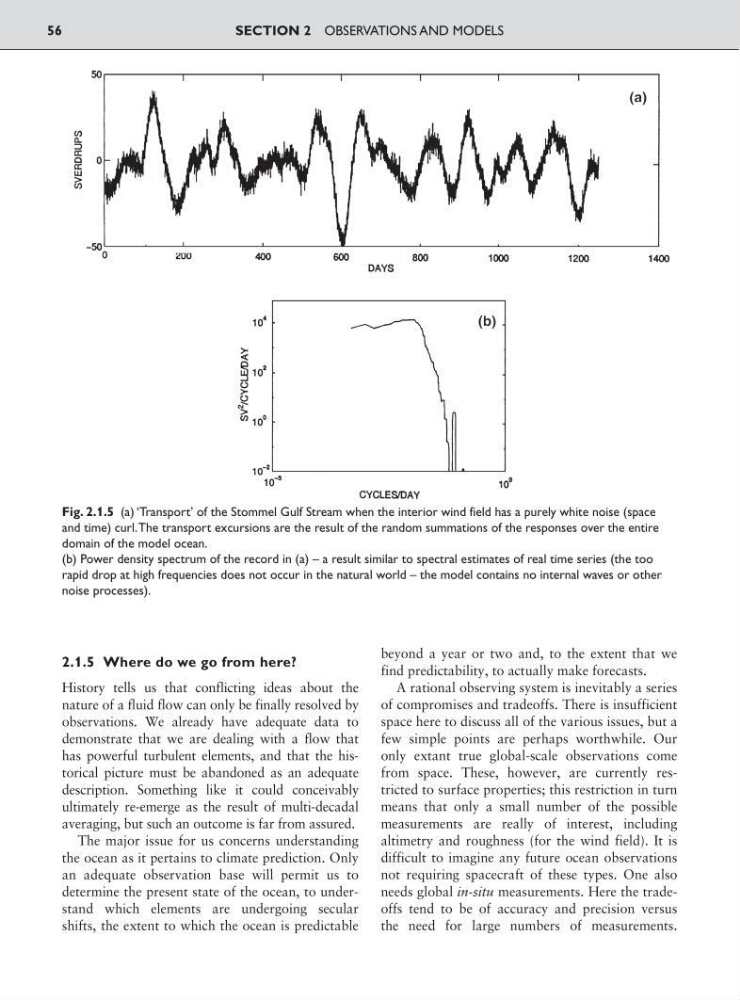
Fig. 2.1.5 (a) ‘Transport’ of the Stommel Gulf Stream when the interior wind field has a purely white noise (space
and time) curl.The transport excursions are the result of the random summations of the responses over the entire
domain of the model ocean.
(b) Power density spectrum of the record in (a) – a result similar to spectral estimates of real time series (the too
rapid drop at high frequencies does not occur in the natural world – the model contains no internal waves or other
noise processes).
History tells us that conflicting ideas about the
nature of a fluid flow can only be finally resolved by
observations. We already have adequate data to
demonstrate that we are dealing with a flow that
has powerful turbulent elements, and that the historical picture must be abandoned as an adequate
description. Something like it could conceivably
ultimately re-emerge as the result of multi-decadal
averaging, but such an outcome is far from assured.
The major issue for us concerns understanding
the ocean as it pertains to climate prediction. Only
an adequate observation base will permit us to
determine the present state of the ocean, to understand which elements are undergoing secular
shifts, the extent to which the ocean is predictable
beyond a year or two and, to the extent that we
find predictability, to actually make forecasts.
A rational observing system is inevitably a series
of compromises and tradeoffs. There is insufficient
space here to discuss all of the various issues, but a
few simple points are perhaps worthwhile. Our
only extant true global-scale observations come
from space. These, however, are currently restricted to surface properties; this restriction in turn
means that only a small number of the possible
measurements are really of interest, including
altimetry and roughness (for the wind field). It is
difficult to imagine any future ocean observations
not requiring spacecraft of these types. One also
needs global in-situ measurements. Here the tradeoffs tend to be of accuracy and precision versus
the need for large numbers of measurements.
SECTION 2 OBSERVATIONS AND MODELS
56
Fig. 2.1.5 (a) ‘Transport’ of the Stommel Gulf Stream when the interior wind field has a purely white noise (space
and time) curl.The transport excursions are the result of the random summations of the responses over the entire
domain of the model ocean.
(b) Power density spectrum of the record in (a) – a result similar to spectral estimates of real time series (the too
rapid drop at high frequencies does not occur in the natural world – the model contains no internal waves or other
noise processes).