

constitutes a major step toward the global observing system.
It is obvious that GODAE owes a great deal to
WOCE. Argo, for example, grew out of the innovative technical advances of the WOCE observational programme. GODAE is, however, not a
research programme and in no way should be considered a follow-on research programme. A comparison of the goals of GODAE with those of
WOCE makes evident the very distinct aims.
GODAE aims to deliver practical applications of
the advances made possible by WOCE observations and modelling and, in that way, build a lasting manifestation of the WOCE legacy.
GODAE outputs
The generation of globally consistent fields of
upper ocean temperature, salinity and velocity
from the synthesis of incomplete information provided by the multivariate in-situ and remote data
streams through models and assimilation is an
identifying characteristic of GODAE. GODAE
outputs will include coherent, organized data sets,
synoptic ocean analyses, short-range ocean forecasts, high-quality scientific re-analyses, and statistical attributes and errors of products.
GODAE is in the process of defining and
executing a range of Pilot Projects, work programmes and implementation tasks, including
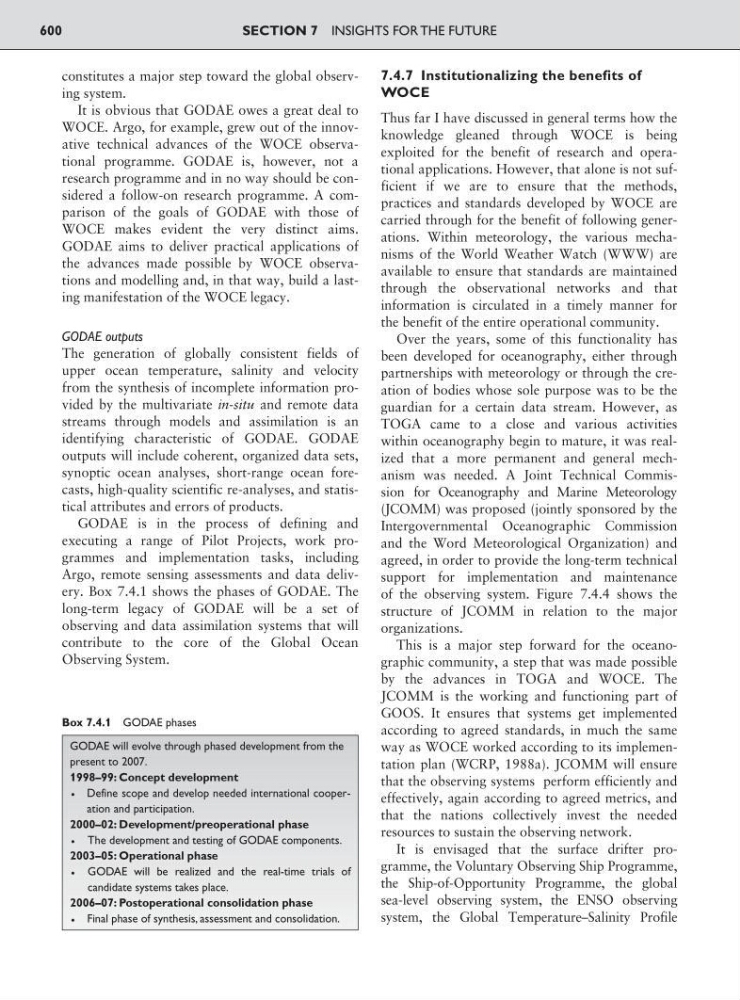
Argo, remote sensing assessments and data delivery. Box 7.4.1 shows the phases of GODAE. The
long-term legacy of GODAE will be a set of
observing and data assimilation systems that will
contribute to the core of the Global Ocean
Observing System.
7.4.7 Institutionalizing the benefits of
WOCE
Thus far I have discussed in general terms how the
knowledge gleaned through WOCE is being
exploited for the benefit of research and operational applications. However, that alone is not sufficient if we are to ensure that the methods,
practices and standards developed by WOCE are
carried through for the benefit of following generations. Within meteorology, the various mechanisms of the World Weather Watch (WWW) are
available to ensure that standards are maintained
through the observational networks and that
information is circulated in a timely manner for
the benefit of the entire operational community.
Over the years, some of this functionality has
been developed for oceanography, either through
partnerships with meteorology or through the creation of bodies whose sole purpose was to be the
guardian for a certain data stream. However, as
TOGA came to a close and various activities
within oceanography begin to mature, it was realized that a more permanent and general mechanism was needed. A Joint Technical Commission for Oceanography and Marine Meteorology
(JCOMM) was proposed (jointly sponsored by the
Intergovernmental Oceanographic Commission
and the Word Meteorological Organization) and
agreed, in order to provide the long-term technical
support for implementation and maintenance
of the observing system. Figure 7.4.4 shows the
structure of JCOMM in relation to the major
organizations.
This is a major step forward for the oceanographic community, a step that was made possible
by the advances in TOGA and WOCE. The
JCOMM is the working and functioning part of
GOOS. It ensures that systems get implemented
according to agreed standards, in much the same
way as WOCE worked according to its implementation plan (WCRP, 1988a). JCOMM will ensure
that the observing systems perform efficiently and
effectively, again according to agreed metrics, and
that the nations collectively invest the needed
resources to sustain the observing network.
It is envisaged that the surface drifter programme, the Voluntary Observing Ship Programme,
the Ship-of-Opportunity Programme, the global
sea-level observing system, the ENSO observing
system, the Global Temperature–Salinity Profile
SECTION 7 INSIGHTS FOR THE FUTURE
600
Box 7.4.1 GODAE phases
GODAE will evolve through phased development from the
present to 2007.
1998–99: Concept development
¥ Define scope and develop needed international cooperation and participation.
2000–02: Development/preoperational phase
¥ The development and testing of GODAE components.
2003–05: Operational phase
¥ GODAE will be realized and the real-time trials of
candidate systems takes place.
2006–07: Postoperational consolidation phase
¥ Final phase of synthesis, assessment and consolidation.