

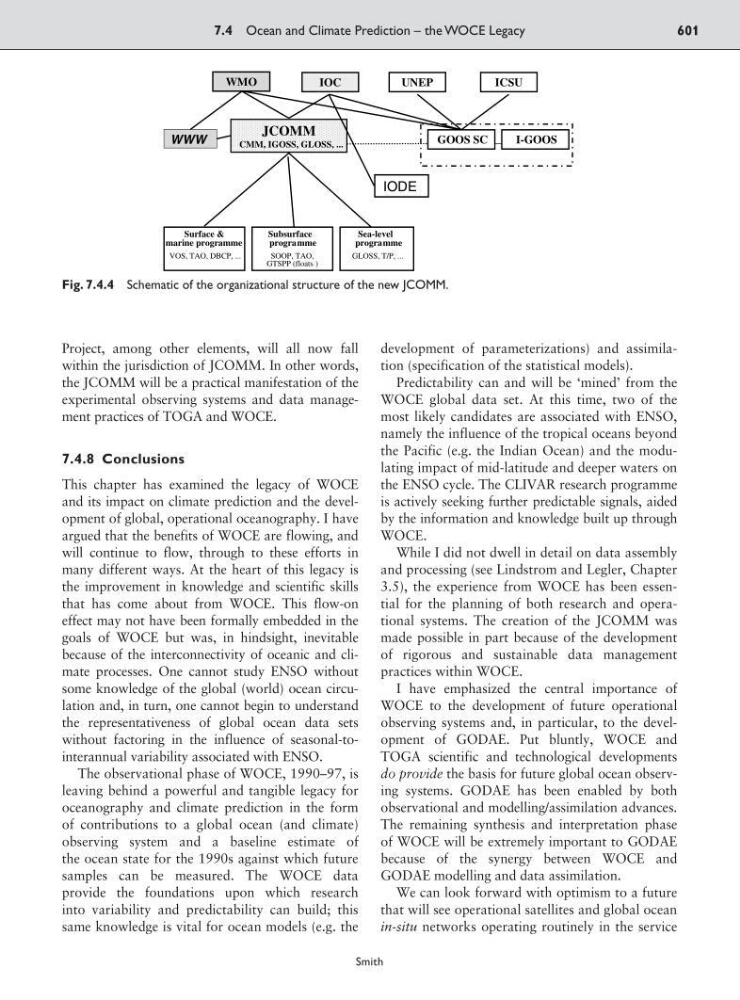
Project, among other elements, will all now fall
within the jurisdiction of JCOMM. In other words,
the JCOMM will be a practical manifestation of the
experimental observing systems and data management practices of TOGA and WOCE.
7.4.8 Conclusions
This chapter has examined the legacy of WOCE
and its impact on climate prediction and the development of global, operational oceanography. I have
argued that the benefits of WOCE are flowing, and
will continue to flow, through to these efforts in
many different ways. At the heart of this legacy is
the improvement in knowledge and scientific skills
that has come about from WOCE. This flow-on
effect may not have been formally embedded in the
goals of WOCE but was, in hindsight, inevitable
because of the interconnectivity of oceanic and climate processes. One cannot study ENSO without
some knowledge of the global (world) ocean circulation and, in turn, one cannot begin to understand
the representativeness of global ocean data sets
without factoring in the influence of seasonal-tointerannual variability associated with ENSO.
The observational phase of WOCE, 1990–97, is
leaving behind a powerful and tangible legacy for
oceanography and climate prediction in the form
of contributions to a global ocean (and climate)
observing system and a baseline estimate of
the ocean state for the 1990s against which future
samples can be measured. The WOCE data
provide the foundations upon which research
into variability and predictability can build; this
same knowledge is vital for ocean models (e.g. the
development of parameterizations) and assimilation (specification of the statistical models).
Predictability can and will be ‘mined’ from the
WOCE global data set. At this time, two of the
most likely candidates are associated with ENSO,
namely the influence of the tropical oceans beyond
the Pacific (e.g. the Indian Ocean) and the modulating impact of mid-latitude and deeper waters on
the ENSO cycle. The CLIVAR research programme
is actively seeking further predictable signals, aided
by the information and knowledge built up through
WOCE.
While I did not dwell in detail on data assembly
and processing (see Lindstrom and Legler, Chapter
3.5), the experience from WOCE has been essential for the planning of both research and operational systems. The creation of the JCOMM was
made possible in part because of the development
of rigorous and sustainable data management
practices within WOCE.
I have emphasized the central importance of
WOCE to the development of future operational
observing systems and, in particular, to the development of GODAE. Put bluntly, WOCE and
TOGA scientific and technological developments
do provide the basis for future global ocean observing systems. GODAE has been enabled by both
observational and modelling/assimilation advances.
The remaining synthesis and interpretation phase
of WOCE will be extremely important to GODAE
because of the synergy between WOCE and
GODAE modelling and data assimilation.
We can look forward with optimism to a future
that will see operational satellites and global ocean
in-situ networks operating routinely in the service
7.4 Ocean and Climate Prediction – the WOCE Legacy
601
Smith
WMO
IOC
UNEP
ICSU
GOOS SC
I-GOOS
JCOMM
CMM, IGOSS, GLOSS, ...
Surface &
marine programme
VOS, TAO, DBCP, ...
Subsurface
programme
SOOP, TAO,
GTSPP (floats )
Sea-level
programme
GLOSS, T/P, ...
WWW
IODE
Fig. 7.4.4 Schematic of the organizational structure of the new JCOMM.