

and sea surface salinity are as large as the seasonal
cycle and, due to the faster advection time scales in
the tropical ocean, are more likely to penetrate
below the mixed layer and alter the subsurface
salinity field. Thus tropical sections might be more
likely to suffer interannual biases than those at
higher latitudes.
The possibility that temporal fluctuations in the
velocity and salinity field rectify to produce a mean
flux must also be examined, as this flux has been
ignored in equation (6.2.5). In most of the ocean
the dominant velocity variability is at mesoscale
eddy time and space scales (Stammer, 1997b) and
in the seasonal cycle. Using estimates of lateral
mixing rates based on eddy length scales, energy
levels from satellite altimeter data and mean climatological salt gradients, Stammer (1998) estimates
that the eddy freshwater fluxes are small
(:0.05 Sv) except along western boundary currents extensions (ϳ40° of latitude).
SECTION 6 LARGE-SCALE OCEAN TRANSPORTS
482
60°S
40°
20°
0°
20°
40°
60°N
-0.1
-0.08
-0.06
-0.04
-0.02
0
0.02
0.04
0.06
0.08
0.1
Seasonal Ekman Freshwater Flux (Sv)
Pacific
Atlantic
Indian
(b)
0°
30°E
60°
90°
120°
150°
180°
150°
120°
90°
60°
30°W
0°
60°S
30°
0°
30°
60°N
10
8 Sv s
-1 m
-1
(a)
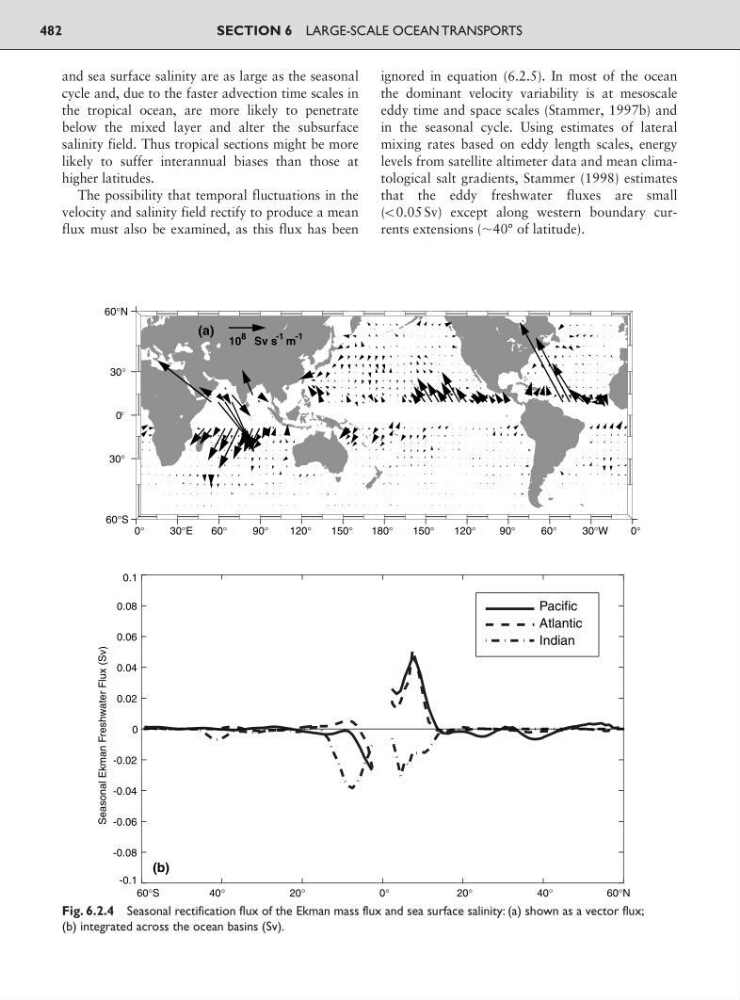
Fig. 6.2.4 Seasonal rectification flux of the Ekman mass flux and sea surface salinity: (a) shown as a vector flux;
(b) integrated across the ocean basins (Sv).
cycle and, due to the faster advection time scales in
the tropical ocean, are more likely to penetrate
below the mixed layer and alter the subsurface
salinity field. Thus tropical sections might be more
likely to suffer interannual biases than those at
higher latitudes.
The possibility that temporal fluctuations in the
velocity and salinity field rectify to produce a mean
flux must also be examined, as this flux has been
ignored in equation (6.2.5). In most of the ocean
the dominant velocity variability is at mesoscale
eddy time and space scales (Stammer, 1997b) and
in the seasonal cycle. Using estimates of lateral
mixing rates based on eddy length scales, energy
levels from satellite altimeter data and mean climatological salt gradients, Stammer (1998) estimates
that the eddy freshwater fluxes are small
(:0.05 Sv) except along western boundary currents extensions (ϳ40° of latitude).
SECTION 6 LARGE-SCALE OCEAN TRANSPORTS
482
60°S
40°
20°
0°
20°
40°
60°N
-0.1
-0.08
-0.06
-0.04
-0.02
0
0.02
0.04
0.06
0.08
0.1
Seasonal Ekman Freshwater Flux (Sv)
Pacific
Atlantic
Indian
(b)
0°
30°E
60°
90°
120°
150°
180°
150°
120°
90°
60°
30°W
0°
60°S
30°
0°
30°
60°N
10
8 Sv s
-1 m
-1
(a)
Fig. 6.2.4 Seasonal rectification flux of the Ekman mass flux and sea surface salinity: (a) shown as a vector flux;
(b) integrated across the ocean basins (Sv).