

and Pressure), several orders of magnitude higher
than the background
3
He in seawater (Ϸ6
10
914 cm
3 STP g
91
) (Butterfield et al., 1990). The
injection of these
3 He-rich fluids into the deep
ocean produces hydrothermal plumes that can
easily be detected against the oceanic background
of dissolved atmospheric helium using precise
3
He/
4
He measurements (e.g. Lupton, 1998). The
largest fraction of this mantle helium is injected at
the crest of the Mid-Ocean Ridges at depths of
2000–2500 m. The
3
He/
4 He ratio of the ‘pure’
injected fluid is Ϸ110
95
, or about 8 times the
atmospheric value. Because helium is a stable, conservative tracer that is lost from the ocean only
by gas exchange with the atmosphere, the deep
and intermediate waters of all major deep ocean
basins have accumulated excess
3 He of mantle origin. To a large degree, the amount of this excess
hydrothermal helium is controlled by the relative
5.8 Transformation and Age of Water Masses
441
Schlosser et al.
CFC-11 ( 1992)
in pure AAIW
-20
1
3
7
20
40
60
80
100
120
140
160
180
200
220
240
260
(pptV)
0
10°
20°
30°
40°
60°
50°
40°
30°
20°
10°
0°
10°
20°E
70°W
50°S
(a)
CF C-11
concentration a ge
in pure AAIW
(years)
2
5
7
9
11
13
15
17
19
21
23
25
27
29
31
33
37
41
0
10°
20°
30°
40°
60°
50°
40°
30°
20°
10°
0°
10°
20°E
70°W
50°S
(b)
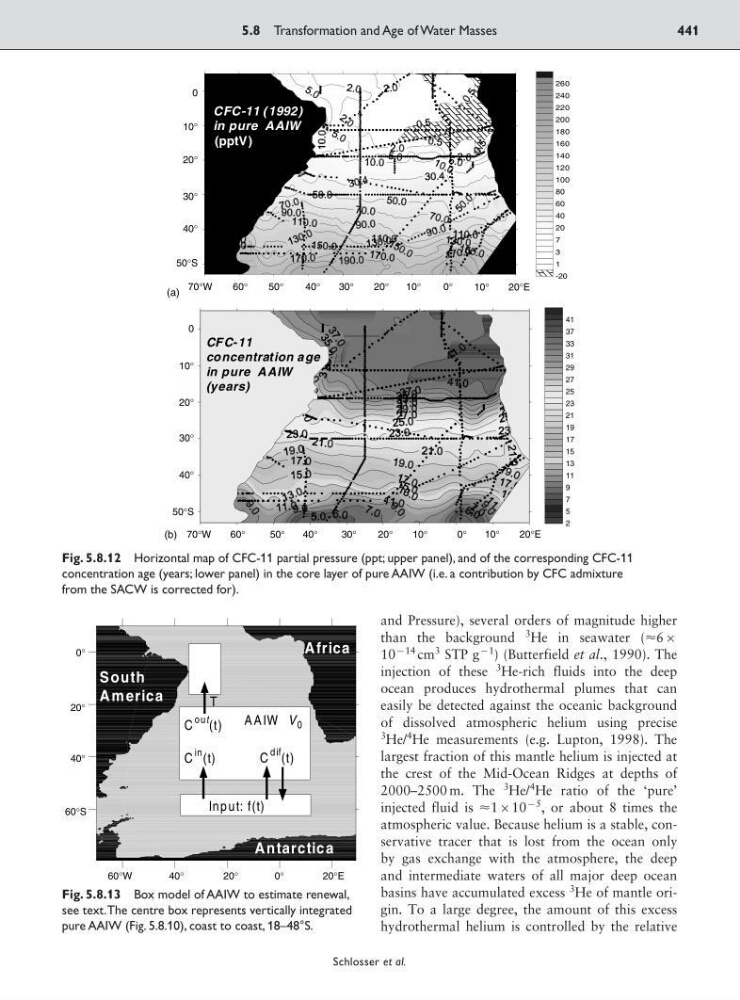
Fig. 5.8.12 Horizontal map of CFC-11 partial pressure (ppt; upper panel), and of the corresponding CFC-11
concentration age (years; lower panel) in the core layer of pure AAIW (i.e. a contribution by CFC admixture
from the SACW is corrected for).
South
A m erica
A frica
A ntarctica
Input: f(t)
A A IW V 0
C
in (t)
C
out (t)
C
dif (t)
T
0°
20°
40°
60°S
60°W
4 0 °
20°
0°
20°E
Fig. 5.8.13 Box model of AAIW to estimate renewal,
see text.The centre box represents vertically integrated
pure AAIW (Fig. 5.8.10), coast to coast, 18–48°S.
than the background
3
He in seawater (Ϸ6
10
914 cm
3 STP g
91
) (Butterfield et al., 1990). The
injection of these
3 He-rich fluids into the deep
ocean produces hydrothermal plumes that can
easily be detected against the oceanic background
of dissolved atmospheric helium using precise
3
He/
4
He measurements (e.g. Lupton, 1998). The
largest fraction of this mantle helium is injected at
the crest of the Mid-Ocean Ridges at depths of
2000–2500 m. The
3
He/
4 He ratio of the ‘pure’
injected fluid is Ϸ110
95
, or about 8 times the
atmospheric value. Because helium is a stable, conservative tracer that is lost from the ocean only
by gas exchange with the atmosphere, the deep
and intermediate waters of all major deep ocean
basins have accumulated excess
3 He of mantle origin. To a large degree, the amount of this excess
hydrothermal helium is controlled by the relative
5.8 Transformation and Age of Water Masses
441
Schlosser et al.
CFC-11 ( 1992)
in pure AAIW
-20
1
3
7
20
40
60
80
100
120
140
160
180
200
220
240
260
(pptV)
0
10°
20°
30°
40°
60°
50°
40°
30°
20°
10°
0°
10°
20°E
70°W
50°S
(a)
CF C-11
concentration a ge
in pure AAIW
(years)
2
5
7
9
11
13
15
17
19
21
23
25
27
29
31
33
37
41
0
10°
20°
30°
40°
60°
50°
40°
30°
20°
10°
0°
10°
20°E
70°W
50°S
(b)
Fig. 5.8.12 Horizontal map of CFC-11 partial pressure (ppt; upper panel), and of the corresponding CFC-11
concentration age (years; lower panel) in the core layer of pure AAIW (i.e. a contribution by CFC admixture
from the SACW is corrected for).
South
A m erica
A frica
A ntarctica
Input: f(t)
A A IW V 0
C
in (t)
C
out (t)
C
dif (t)
T
0°
20°
40°
60°S
60°W
4 0 °
20°
0°
20°E
Fig. 5.8.13 Box model of AAIW to estimate renewal,
see text.The centre box represents vertically integrated
pure AAIW (Fig. 5.8.10), coast to coast, 18–48°S.