

signature in sea surface height. Diabatic surface
forcing, on the other hand, tends to produce a
forced response that changes sign with depth once
within the lower thermocline, and thus has a
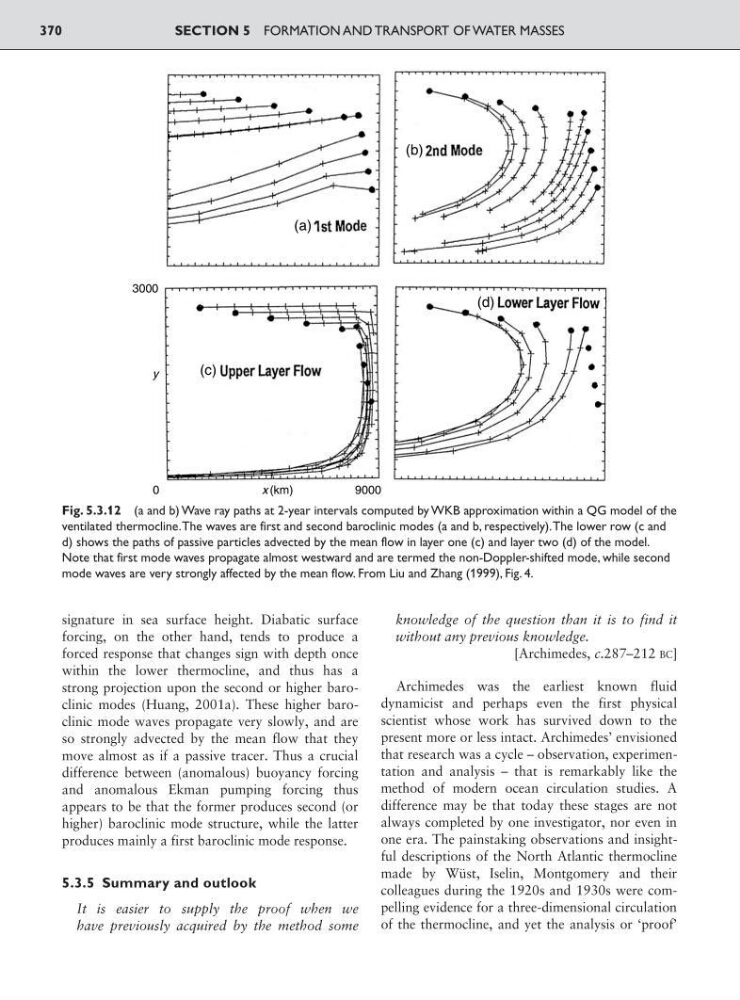
strong projection upon the second or higher baroclinic modes (Huang, 2001a). These higher baroclinic mode waves propagate very slowly, and are
so strongly advected by the mean flow that they
move almost as if a passive tracer. Thus a crucial
difference between (anomalous) buoyancy forcing
and anomalous Ekman pumping forcing thus
appears to be that the former produces second (or
higher) baroclinic mode structure, while the latter
produces mainly a first baroclinic mode response.
5.3.5 Summary and outlook
It is easier to supply the proof when we
have previously acquired by the method some
knowledge of the question than it is to find it
without any previous knowledge.
[Archimedes, c.287–212 BC]
Archimedes was the earliest known fluid
dynamicist and perhaps even the first physical
scientist whose work has survived down to the
present more or less intact. Archimedes’ envisioned
that research was a cycle – observation, experimentation and analysis – that is remarkably like the
method of modern ocean circulation studies. A
difference may be that today these stages are not
always completed by one investigator, nor even in
one era. The painstaking observations and insightful descriptions of the North Atlantic thermocline
made by Wüst, Iselin, Montgomery and their
colleagues during the 1920s and 1930s were compelling evidence for a three-dimensional circulation
of the thermocline, and yet the analysis or ‘proof’
SECTION 5 FORMATION AND TRANSPORT OF WATER MASSES
370
3000
y
0
x (km)
9000
(b)
(d)
(c)
(a)
Fig. 5.3.12 (a and b) Wave ray paths at 2-year intervals computed by WKB approximation within a QG model of the
ventilated thermocline.The waves are first and second baroclinic modes (a and b, respectively).The lower row (c and
d) shows the paths of passive particles advected by the mean flow in layer one (c) and layer two (d) of the model.
Note that first mode waves propagate almost westward and are termed the non-Doppler-shifted mode, while second
mode waves are very strongly affected by the mean flow. From Liu and Zhang (1999), Fig. 4.
forcing, on the other hand, tends to produce a
forced response that changes sign with depth once
within the lower thermocline, and thus has a
strong projection upon the second or higher baroclinic modes (Huang, 2001a). These higher baroclinic mode waves propagate very slowly, and are
so strongly advected by the mean flow that they
move almost as if a passive tracer. Thus a crucial
difference between (anomalous) buoyancy forcing
and anomalous Ekman pumping forcing thus
appears to be that the former produces second (or
higher) baroclinic mode structure, while the latter
produces mainly a first baroclinic mode response.
5.3.5 Summary and outlook
It is easier to supply the proof when we
have previously acquired by the method some
knowledge of the question than it is to find it
without any previous knowledge.
[Archimedes, c.287–212 BC]
Archimedes was the earliest known fluid
dynamicist and perhaps even the first physical
scientist whose work has survived down to the
present more or less intact. Archimedes’ envisioned
that research was a cycle – observation, experimentation and analysis – that is remarkably like the
method of modern ocean circulation studies. A
difference may be that today these stages are not
always completed by one investigator, nor even in
one era. The painstaking observations and insightful descriptions of the North Atlantic thermocline
made by Wüst, Iselin, Montgomery and their
colleagues during the 1920s and 1930s were compelling evidence for a three-dimensional circulation
of the thermocline, and yet the analysis or ‘proof’
SECTION 5 FORMATION AND TRANSPORT OF WATER MASSES
370
3000
y
0
x (km)
9000
(b)
(d)
(c)
(a)
Fig. 5.3.12 (a and b) Wave ray paths at 2-year intervals computed by WKB approximation within a QG model of the
ventilated thermocline.The waves are first and second baroclinic modes (a and b, respectively).The lower row (c and
d) shows the paths of passive particles advected by the mean flow in layer one (c) and layer two (d) of the model.
Note that first mode waves propagate almost westward and are termed the non-Doppler-shifted mode, while second
mode waves are very strongly affected by the mean flow. From Liu and Zhang (1999), Fig. 4.