

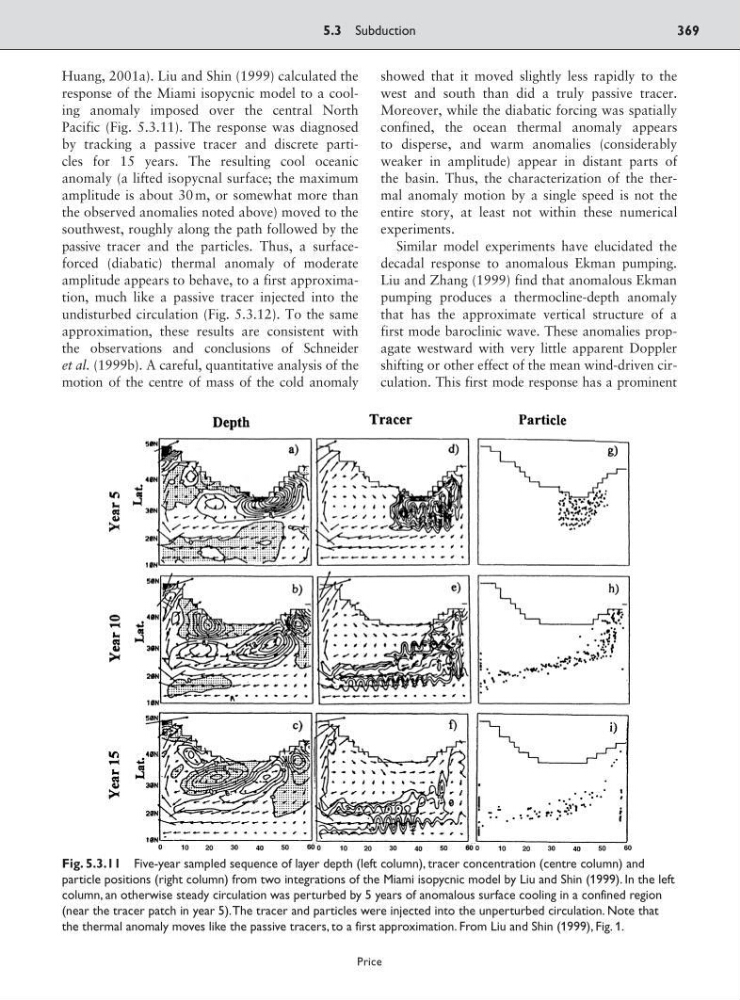
Huang, 2001a). Liu and Shin (1999) calculated the
response of the Miami isopycnic model to a cooling anomaly imposed over the central North
Pacific (Fig. 5.3.11). The response was diagnosed
by tracking a passive tracer and discrete particles for 15 years. The resulting cool oceanic
anomaly (a lifted isopycnal surface; the maximum
amplitude is about 30 m, or somewhat more than
the observed anomalies noted above) moved to the
southwest, roughly along the path followed by the
passive tracer and the particles. Thus, a surfaceforced (diabatic) thermal anomaly of moderate
amplitude appears to behave, to a first approximation, much like a passive tracer injected into the
undisturbed circulation (Fig. 5.3.12). To the same
approximation, these results are consistent with
the observations and conclusions of Schneider
et al. (1999b). A careful, quantitative analysis of the
motion of the centre of mass of the cold anomaly
showed that it moved slightly less rapidly to the
west and south than did a truly passive tracer.
Moreover, while the diabatic forcing was spatially
confined, the ocean thermal anomaly appears
to disperse, and warm anomalies (considerably
weaker in amplitude) appear in distant parts of
the basin. Thus, the characterization of the thermal anomaly motion by a single speed is not the
entire story, at least not within these numerical
experiments.
Similar model experiments have elucidated the
decadal response to anomalous Ekman pumping.
Liu and Zhang (1999) find that anomalous Ekman
pumping produces a thermocline-depth anomaly
that has the approximate vertical structure of a
first mode baroclinic wave. These anomalies propagate westward with very little apparent Doppler
shifting or other effect of the mean wind-driven circulation. This first mode response has a prominent
5.3 Subduction
369
Price
Fig. 5.3.11 Five-year sampled sequence of layer depth (left column), tracer concentration (centre column) and
particle positions (right column) from two integrations of the Miami isopycnic model by Liu and Shin (1999). In the left
column, an otherwise steady circulation was perturbed by 5 years of anomalous surface cooling in a confined region
(near the tracer patch in year 5).The tracer and particles were injected into the unperturbed circulation. Note that
the thermal anomaly moves like the passive tracers, to a first approximation. From Liu and Shin (1999), Fig. 1.
response of the Miami isopycnic model to a cooling anomaly imposed over the central North
Pacific (Fig. 5.3.11). The response was diagnosed
by tracking a passive tracer and discrete particles for 15 years. The resulting cool oceanic
anomaly (a lifted isopycnal surface; the maximum
amplitude is about 30 m, or somewhat more than
the observed anomalies noted above) moved to the
southwest, roughly along the path followed by the
passive tracer and the particles. Thus, a surfaceforced (diabatic) thermal anomaly of moderate
amplitude appears to behave, to a first approximation, much like a passive tracer injected into the
undisturbed circulation (Fig. 5.3.12). To the same
approximation, these results are consistent with
the observations and conclusions of Schneider
et al. (1999b). A careful, quantitative analysis of the
motion of the centre of mass of the cold anomaly
showed that it moved slightly less rapidly to the
west and south than did a truly passive tracer.
Moreover, while the diabatic forcing was spatially
confined, the ocean thermal anomaly appears
to disperse, and warm anomalies (considerably
weaker in amplitude) appear in distant parts of
the basin. Thus, the characterization of the thermal anomaly motion by a single speed is not the
entire story, at least not within these numerical
experiments.
Similar model experiments have elucidated the
decadal response to anomalous Ekman pumping.
Liu and Zhang (1999) find that anomalous Ekman
pumping produces a thermocline-depth anomaly
that has the approximate vertical structure of a
first mode baroclinic wave. These anomalies propagate westward with very little apparent Doppler
shifting or other effect of the mean wind-driven circulation. This first mode response has a prominent
5.3 Subduction
369
Price
Fig. 5.3.11 Five-year sampled sequence of layer depth (left column), tracer concentration (centre column) and
particle positions (right column) from two integrations of the Miami isopycnic model by Liu and Shin (1999). In the left
column, an otherwise steady circulation was perturbed by 5 years of anomalous surface cooling in a confined region
(near the tracer patch in year 5).The tracer and particles were injected into the unperturbed circulation. Note that
the thermal anomaly moves like the passive tracers, to a first approximation. From Liu and Shin (1999), Fig. 1.