

not dramatically altered by eddy variability. Nevertheless, in the former case the subduction process,
especially within the western basin, occurred
mainly by a divergence of the eddy thickness flux,
and thus could be termed eddy subduction. In
some localized regions this eddy subduction
reached amplitudes of 100 m yr
91
. Spall (1995)
and Follows and Marshall (1994) examined subduction processes near oceanic fronts. There, too,
the subduction process occurs mainly in conjunction with eddy formation (baroclinic instability),
and thus could be said to be eddy subduction.
Another view of eddy effects and subduction
has been developed by Robbins and Jenkins
(1998), and Jenkins (1998), who have analysed 15
years of tritium and
3 He observations from the
eastern subtropical North Atlantic with the aim
of characterizing the circulation and ventilation
rates. Within shallow layers of the thermocline
(:26.5), the tritium–
3
He-inferred age was found
to be nearly steady and consistent with the notion
of direct advective flux from surface outcrops
within the gyre. At deeper levels in the thermocline, the tracer-inferred age has shown a significant increase over the period analysed, and has
only recently begun to approach a steady state. A
time-changing tracer-inferred age could perhaps
result from a time-changing circulation, or, on the
balance of evidence (Robbins et al., 2000), more
likely from a transient tracer balance due to horizontal diffusion (which is ignored in straightforward age estimates). Robbins et al. (2000) showed
that horizontal diffusion into the lower thermocline from a convective ventilation region north
of the gyre boundary would yield the observed
horizontal structure of the tracer fields; it also
yielded roughly the observed temporal increase of
tritium–
3
He ages, all assuming a steady circulation. For the tritium–
3 He tracer pair, diffusion is
thus of great importance, especially within the
SECTION 5 FORMATION AND TRANSPORT OF WATER MASSES
364
(a)
(b)
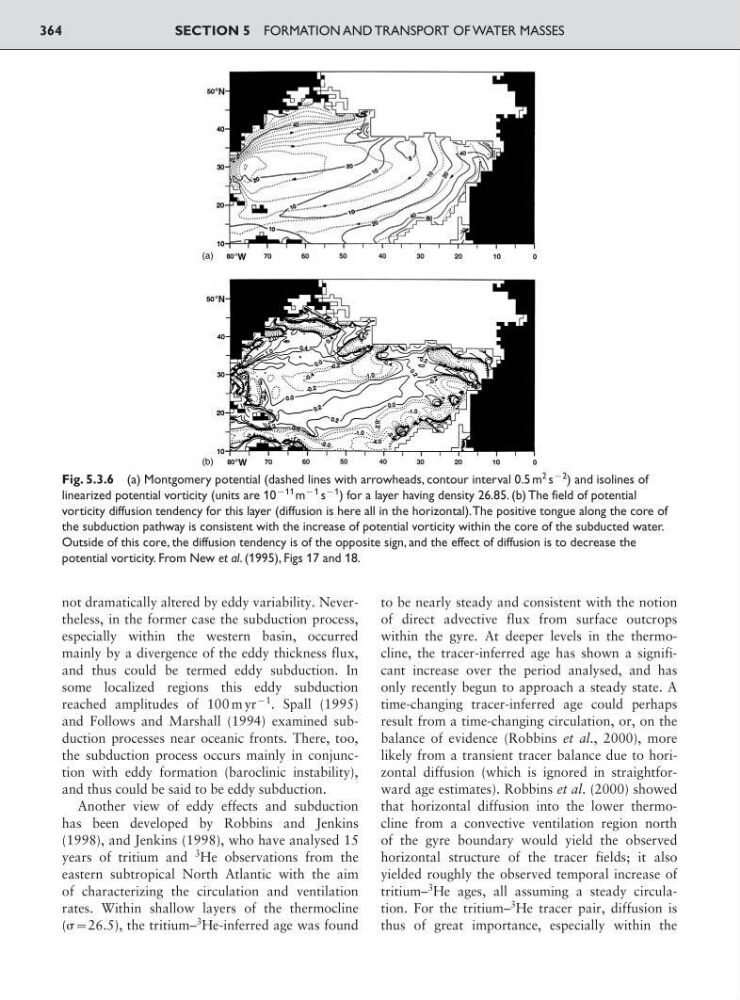
Fig. 5.3.6 (a) Montgomery potential (dashed lines with arrowheads, contour interval 0.5 m
2 s
92 ) and isolines of
linearized potential vorticity (units are 10
911 m
91 s
91 ) for a layer having density 26.85. (b) The field of potential
vorticity diffusion tendency for this layer (diffusion is here all in the horizontal).The positive tongue along the core of
the subduction pathway is consistent with the increase of potential vorticity within the core of the subducted water.
Outside of this core, the diffusion tendency is of the opposite sign, and the effect of diffusion is to decrease the
potential vorticity. From New et al. (1995), Figs 17 and 18.
especially within the western basin, occurred
mainly by a divergence of the eddy thickness flux,
and thus could be termed eddy subduction. In
some localized regions this eddy subduction
reached amplitudes of 100 m yr
91
. Spall (1995)
and Follows and Marshall (1994) examined subduction processes near oceanic fronts. There, too,
the subduction process occurs mainly in conjunction with eddy formation (baroclinic instability),
and thus could be said to be eddy subduction.
Another view of eddy effects and subduction
has been developed by Robbins and Jenkins
(1998), and Jenkins (1998), who have analysed 15
years of tritium and
3 He observations from the
eastern subtropical North Atlantic with the aim
of characterizing the circulation and ventilation
rates. Within shallow layers of the thermocline
(:26.5), the tritium–
3
He-inferred age was found
to be nearly steady and consistent with the notion
of direct advective flux from surface outcrops
within the gyre. At deeper levels in the thermocline, the tracer-inferred age has shown a significant increase over the period analysed, and has
only recently begun to approach a steady state. A
time-changing tracer-inferred age could perhaps
result from a time-changing circulation, or, on the
balance of evidence (Robbins et al., 2000), more
likely from a transient tracer balance due to horizontal diffusion (which is ignored in straightforward age estimates). Robbins et al. (2000) showed
that horizontal diffusion into the lower thermocline from a convective ventilation region north
of the gyre boundary would yield the observed
horizontal structure of the tracer fields; it also
yielded roughly the observed temporal increase of
tritium–
3
He ages, all assuming a steady circulation. For the tritium–
3 He tracer pair, diffusion is
thus of great importance, especially within the
SECTION 5 FORMATION AND TRANSPORT OF WATER MASSES
364
(a)
(b)
Fig. 5.3.6 (a) Montgomery potential (dashed lines with arrowheads, contour interval 0.5 m
2 s
92 ) and isolines of
linearized potential vorticity (units are 10
911 m
91 s
91 ) for a layer having density 26.85. (b) The field of potential
vorticity diffusion tendency for this layer (diffusion is here all in the horizontal).The positive tongue along the core of
the subduction pathway is consistent with the increase of potential vorticity within the core of the subducted water.
Outside of this core, the diffusion tendency is of the opposite sign, and the effect of diffusion is to decrease the
potential vorticity. From New et al. (1995), Figs 17 and 18.