

many of the consequences of subduction expected
from the LPS theory. Fluid on the :26.7 layer is
drawn southwards and westwards into the main
thermocline as a part of the Sverdrup flow. Along
its northern extent the :26.7 layer has a fairly
large thickness compared with other layers above
and below having the same density difference, and
in that regard is like a mode water (McCartney,
1982; Siedler et al., 1987; Hazeleger and Drijfhout,
1998; Schmid et al., 2000; and see also Hanawa
and Talley, Chapter 5.4) having low potential
vorticity (Fig. 5.3.6). For a substantial distance
downstream of the subduction region this low
Potential Vorticity (PV) forms a tongue that serves
to mark the subducted water mass. (In the real
North Atlantic there is no strictly comparable
mode water formed at this density and general
location.) An interesting question is whether the
water within this layer conserves potential vorticity, as assumed in the idealized LPS theory. Since
the low PV tongue is surrounded by higher PV
waters on all sides, there is bound to be some
diffusion of (higher) PV into the subducted water
mass. This significantly erodes the low PV tongue,
which, 5–10 years after subduction, begins to lose
its identity. The low potential vorticity is spread
by diffusion into the surrounding waters, which
thus have a negative potential vorticity diffusion
tendency (balanced in this near steady state by horizontal advection). The change of PV within the subducted water is not small, and horizontal diffusion
clearly influences the basin-scale distribution of PV
(see Toole and McDougall, Chapter 5.2 for a review
of mixing in the ocean). Nevertheless, the overall
pattern of thermocline circulation in the numerical
model solution is qualitatively as expected from the
purely advective (adiabatic) theory of LPS.
In numerical models that admit mesoscale eddy
variability, the subduction rate is liable to be
affected by eddy variability (Marshall, 1997), especially in high eddy energy regions, e.g. the formation site of western subtropical model water near
the Gulf Stream. Hazeleger and Drijfhout (2000)
showed comparable eddy-resolving and non-eddyresolving simulations of the Gulf Stream region to
illustrate this process. The net subduction rate was
5.3 Subduction
363
Price
(a)
(b)
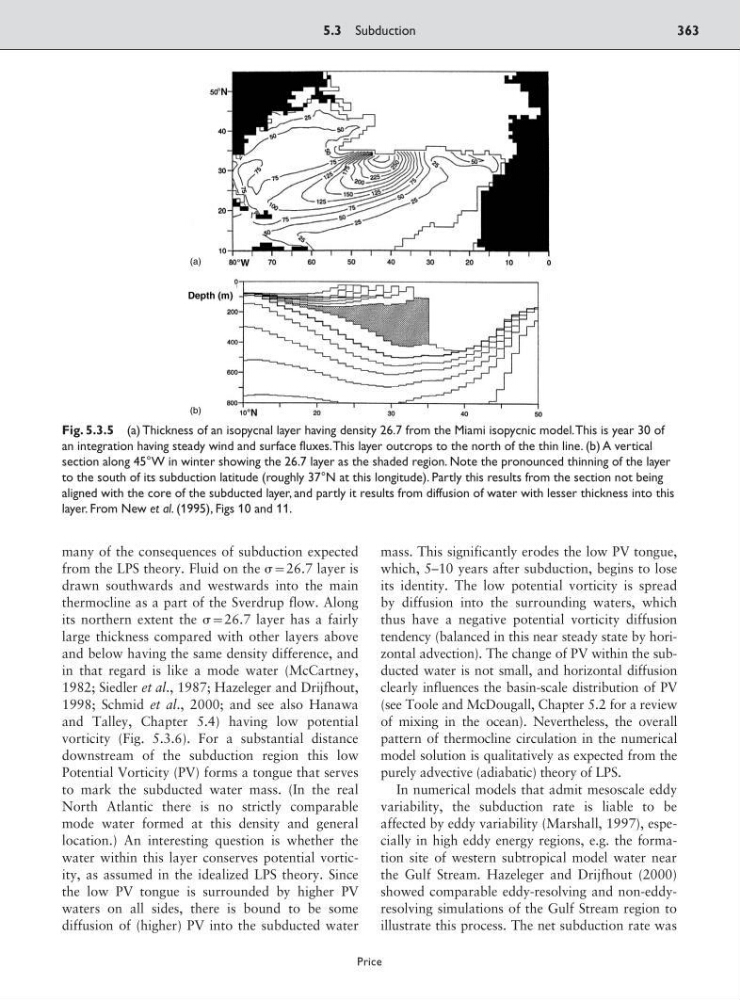
Fig. 5.3.5 (a) Thickness of an isopycnal layer having density 26.7 from the Miami isopycnic model.This is year 30 of
an integration having steady wind and surface fluxes.This layer outcrops to the north of the thin line. (b) A vertical
section along 45°W in winter showing the 26.7 layer as the shaded region. Note the pronounced thinning of the layer
to the south of its subduction latitude (roughly 37°N at this longitude). Partly this results from the section not being
aligned with the core of the subducted layer, and partly it results from diffusion of water with lesser thickness into this
layer. From New et al. (1995), Figs 10 and 11.
from the LPS theory. Fluid on the :26.7 layer is
drawn southwards and westwards into the main
thermocline as a part of the Sverdrup flow. Along
its northern extent the :26.7 layer has a fairly
large thickness compared with other layers above
and below having the same density difference, and
in that regard is like a mode water (McCartney,
1982; Siedler et al., 1987; Hazeleger and Drijfhout,
1998; Schmid et al., 2000; and see also Hanawa
and Talley, Chapter 5.4) having low potential
vorticity (Fig. 5.3.6). For a substantial distance
downstream of the subduction region this low
Potential Vorticity (PV) forms a tongue that serves
to mark the subducted water mass. (In the real
North Atlantic there is no strictly comparable
mode water formed at this density and general
location.) An interesting question is whether the
water within this layer conserves potential vorticity, as assumed in the idealized LPS theory. Since
the low PV tongue is surrounded by higher PV
waters on all sides, there is bound to be some
diffusion of (higher) PV into the subducted water
mass. This significantly erodes the low PV tongue,
which, 5–10 years after subduction, begins to lose
its identity. The low potential vorticity is spread
by diffusion into the surrounding waters, which
thus have a negative potential vorticity diffusion
tendency (balanced in this near steady state by horizontal advection). The change of PV within the subducted water is not small, and horizontal diffusion
clearly influences the basin-scale distribution of PV
(see Toole and McDougall, Chapter 5.2 for a review
of mixing in the ocean). Nevertheless, the overall
pattern of thermocline circulation in the numerical
model solution is qualitatively as expected from the
purely advective (adiabatic) theory of LPS.
In numerical models that admit mesoscale eddy
variability, the subduction rate is liable to be
affected by eddy variability (Marshall, 1997), especially in high eddy energy regions, e.g. the formation site of western subtropical model water near
the Gulf Stream. Hazeleger and Drijfhout (2000)
showed comparable eddy-resolving and non-eddyresolving simulations of the Gulf Stream region to
illustrate this process. The net subduction rate was
5.3 Subduction
363
Price
(a)
(b)
Fig. 5.3.5 (a) Thickness of an isopycnal layer having density 26.7 from the Miami isopycnic model.This is year 30 of
an integration having steady wind and surface fluxes.This layer outcrops to the north of the thin line. (b) A vertical
section along 45°W in winter showing the 26.7 layer as the shaded region. Note the pronounced thinning of the layer
to the south of its subduction latitude (roughly 37°N at this longitude). Partly this results from the section not being
aligned with the core of the subducted layer, and partly it results from diffusion of water with lesser thickness into this
layer. From New et al. (1995), Figs 10 and 11.