

the thermocline, and unventilated thermocline
waters (the pool region of Section 5.3.1) were presumed to have horizontally uniform potential vorticity equal to that of the adjacent streamline
within the ventilated region. Surface-layer data
included the surface density and the Ekman pumping rate. With this, and a few other detailed
assumptions, the problem reduces to solving a free
boundary value problem for the Bernoulli function
in density coordinates. The resulting solutions
hold a rather remarkable resemblance to the
North Pacific thermocline (Fig. 5.3.2) and can be
used to diagnose several interesting properties.
First, the depth of the wind-driven subtropical
gyre of the North Pacific is found to be no more
than about 1.4 km (and is typically much less),
compared with about 1.7 km in the North
Atlantic. Huang and Russell (1995) attributed the
difference to the comparatively strong thermohaline forcing and circulation of the North Atlantic,
and the shallow and strong halocline found over
much of the North Pacific (see also Talley, 1985,
for an analysis of salinity over the North Pacific).
Second, the renewal time for subtropical thermocline water masses can be estimated from their
volume and advective ventilation rate, and is
found to be about 3 years for the lightest density
classes (:24.1–24.7), and about 10–15 years
for the subtropical mode waters (:25.3–25.7).
The mass flux from the ventilated thermocline
is exported mainly to the tropics, where it must,
on average, have a significant influence on the
thermocline properties of the tropics (Gu and
Philander, 1997; Kleeman et al., 1999). Whether
interannual anomalies produced over the subtropics are important for the tropics is less clear.
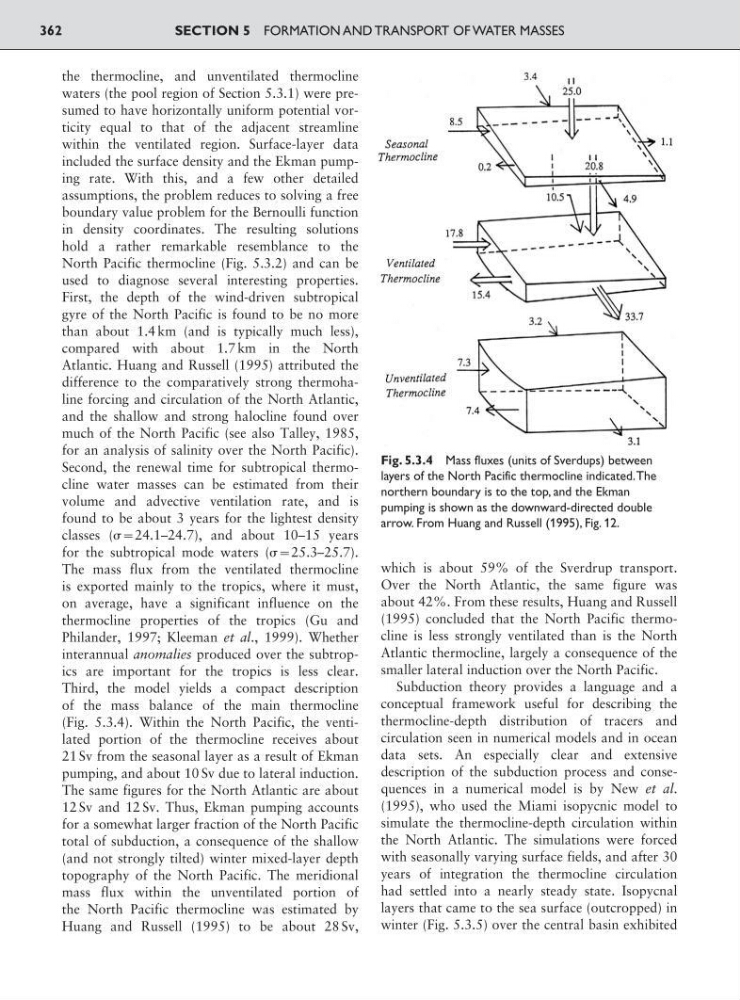
Third, the model yields a compact description
of the mass balance of the main thermocline
(Fig. 5.3.4). Within the North Pacific, the ventilated portion of the thermocline receives about
21 Sv from the seasonal layer as a result of Ekman
pumping, and about 10 Sv due to lateral induction.
The same figures for the North Atlantic are about
12 Sv and 12 Sv. Thus, Ekman pumping accounts
for a somewhat larger fraction of the North Pacific
total of subduction, a consequence of the shallow
(and not strongly tilted) winter mixed-layer depth
topography of the North Pacific. The meridional
mass flux within the unventilated portion of
the North Pacific thermocline was estimated by
Huang and Russell (1995) to be about 28 Sv,
which is about 59% of the Sverdrup transport.
Over the North Atlantic, the same figure was
about 42%. From these results, Huang and Russell
(1995) concluded that the North Pacific thermocline is less strongly ventilated than is the North
Atlantic thermocline, largely a consequence of the
smaller lateral induction over the North Pacific.
Subduction theory provides a language and a
conceptual framework useful for describing the
thermocline-depth distribution of tracers and
circulation seen in numerical models and in ocean
data sets. An especially clear and extensive
description of the subduction process and consequences in a numerical model is by New et al.
(1995), who used the Miami isopycnic model to
simulate the thermocline-depth circulation within
the North Atlantic. The simulations were forced
with seasonally varying surface fields, and after 30
years of integration the thermocline circulation
had settled into a nearly steady state. Isopycnal
layers that came to the sea surface (outcropped) in
winter (Fig. 5.3.5) over the central basin exhibited
SECTION 5 FORMATION AND TRANSPORT OF WATER MASSES
362
Fig. 5.3.4 Mass fluxes (units of Sverdups) between
layers of the North Pacific thermocline indicated.The
northern boundary is to the top, and the Ekman
pumping is shown as the downward-directed double
arrow. From Huang and Russell (1995), Fig. 12.
waters (the pool region of Section 5.3.1) were presumed to have horizontally uniform potential vorticity equal to that of the adjacent streamline
within the ventilated region. Surface-layer data
included the surface density and the Ekman pumping rate. With this, and a few other detailed
assumptions, the problem reduces to solving a free
boundary value problem for the Bernoulli function
in density coordinates. The resulting solutions
hold a rather remarkable resemblance to the
North Pacific thermocline (Fig. 5.3.2) and can be
used to diagnose several interesting properties.
First, the depth of the wind-driven subtropical
gyre of the North Pacific is found to be no more
than about 1.4 km (and is typically much less),
compared with about 1.7 km in the North
Atlantic. Huang and Russell (1995) attributed the
difference to the comparatively strong thermohaline forcing and circulation of the North Atlantic,
and the shallow and strong halocline found over
much of the North Pacific (see also Talley, 1985,
for an analysis of salinity over the North Pacific).
Second, the renewal time for subtropical thermocline water masses can be estimated from their
volume and advective ventilation rate, and is
found to be about 3 years for the lightest density
classes (:24.1–24.7), and about 10–15 years
for the subtropical mode waters (:25.3–25.7).
The mass flux from the ventilated thermocline
is exported mainly to the tropics, where it must,
on average, have a significant influence on the
thermocline properties of the tropics (Gu and
Philander, 1997; Kleeman et al., 1999). Whether
interannual anomalies produced over the subtropics are important for the tropics is less clear.
Third, the model yields a compact description
of the mass balance of the main thermocline
(Fig. 5.3.4). Within the North Pacific, the ventilated portion of the thermocline receives about
21 Sv from the seasonal layer as a result of Ekman
pumping, and about 10 Sv due to lateral induction.
The same figures for the North Atlantic are about
12 Sv and 12 Sv. Thus, Ekman pumping accounts
for a somewhat larger fraction of the North Pacific
total of subduction, a consequence of the shallow
(and not strongly tilted) winter mixed-layer depth
topography of the North Pacific. The meridional
mass flux within the unventilated portion of
the North Pacific thermocline was estimated by
Huang and Russell (1995) to be about 28 Sv,
which is about 59% of the Sverdrup transport.
Over the North Atlantic, the same figure was
about 42%. From these results, Huang and Russell
(1995) concluded that the North Pacific thermocline is less strongly ventilated than is the North
Atlantic thermocline, largely a consequence of the
smaller lateral induction over the North Pacific.
Subduction theory provides a language and a
conceptual framework useful for describing the
thermocline-depth distribution of tracers and
circulation seen in numerical models and in ocean
data sets. An especially clear and extensive
description of the subduction process and consequences in a numerical model is by New et al.
(1995), who used the Miami isopycnic model to
simulate the thermocline-depth circulation within
the North Atlantic. The simulations were forced
with seasonally varying surface fields, and after 30
years of integration the thermocline circulation
had settled into a nearly steady state. Isopycnal
layers that came to the sea surface (outcropped) in
winter (Fig. 5.3.5) over the central basin exhibited
SECTION 5 FORMATION AND TRANSPORT OF WATER MASSES
362
Fig. 5.3.4 Mass fluxes (units of Sverdups) between
layers of the North Pacific thermocline indicated.The
northern boundary is to the top, and the Ekman
pumping is shown as the downward-directed double
arrow. From Huang and Russell (1995), Fig. 12.