

subduction as does Ekman pumping alone
(Huang, 1990). Lateral induction is slightly less
important over the North Pacific because the slope
of the winter mixed-layer depth is less than that in
the North Atlantic, but nevertheless makes a significant contribution (Huang and Russell, 1995).
The basin-scale tilt of the late winter mixedlayer depth must itself be a reflection of the pattern of heat (or buoyancy) exchange between the
ocean and atmosphere combined with the largescale circulation. For example, imagine a water
column circulating in a subtropical gyre. In regions
where the column receives annual-average surface
heating (say in the generally southward flow in the
eastern subtropical gyres of the North Atlantic or
North Pacific), then the late winter mixed-layer
depth will tend to shoal from year-to-year as
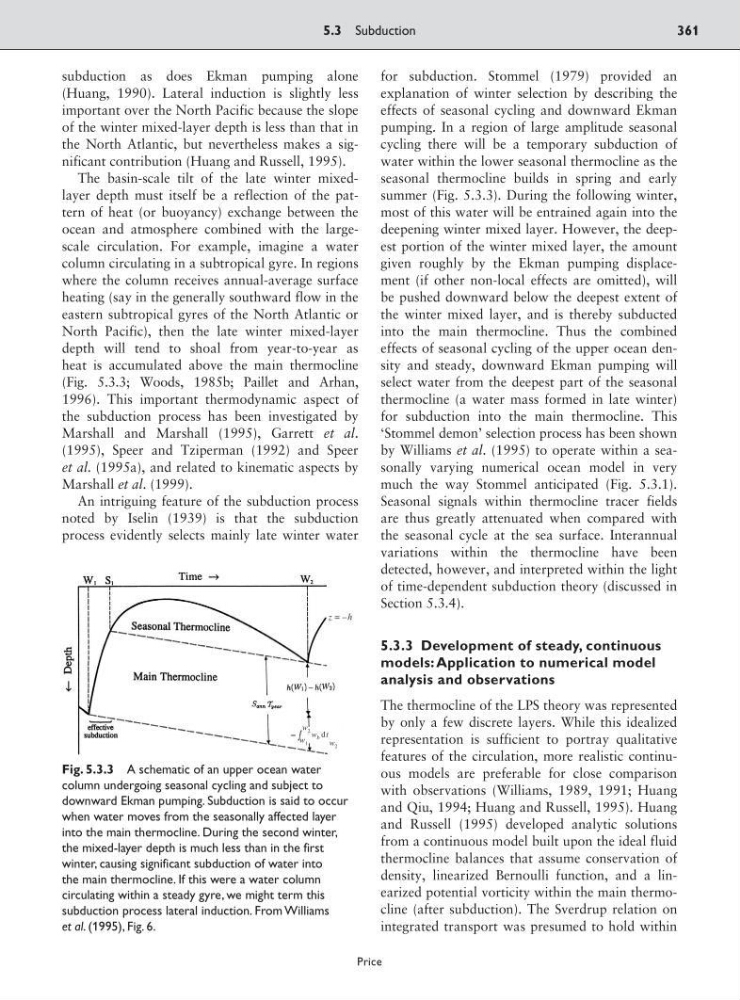
heat is accumulated above the main thermocline
(Fig. 5.3.3; Woods, 1985b; Paillet and Arhan,
1996). This important thermodynamic aspect of
the subduction process has been investigated by
Marshall and Marshall (1995), Garrett et al.
(1995), Speer and Tziperman (1992) and Speer
et al. (1995a), and related to kinematic aspects by
Marshall et al. (1999).
An intriguing feature of the subduction process
noted by Iselin (1939) is that the subduction
process evidently selects mainly late winter water
for subduction. Stommel (1979) provided an
explanation of winter selection by describing the
effects of seasonal cycling and downward Ekman
pumping. In a region of large amplitude seasonal
cycling there will be a temporary subduction of
water within the lower seasonal thermocline as the
seasonal thermocline builds in spring and early
summer (Fig. 5.3.3). During the following winter,
most of this water will be entrained again into the
deepening winter mixed layer. However, the deepest portion of the winter mixed layer, the amount
given roughly by the Ekman pumping displacement (if other non-local effects are omitted), will
be pushed downward below the deepest extent of
the winter mixed layer, and is thereby subducted
into the main thermocline. Thus the combined
effects of seasonal cycling of the upper ocean density and steady, downward Ekman pumping will
select water from the deepest part of the seasonal
thermocline (a water mass formed in late winter)
for subduction into the main thermocline. This
‘Stommel demon’ selection process has been shown
by Williams et al. (1995) to operate within a seasonally varying numerical ocean model in very
much the way Stommel anticipated (Fig. 5.3.1).
Seasonal signals within thermocline tracer fields
are thus greatly attenuated when compared with
the seasonal cycle at the sea surface. Interannual
variations within the thermocline have been
detected, however, and interpreted within the light
of time-dependent subduction theory (discussed in
Section 5.3.4).
5.3.3 Development of steady, continuous
models: Application to numerical model
analysis and observations
The thermocline of the LPS theory was represented
by only a few discrete layers. While this idealized
representation is sufficient to portray qualitative
features of the circulation, more realistic continuous models are preferable for close comparison
with observations (Williams, 1989, 1991; Huang
and Qiu, 1994; Huang and Russell, 1995). Huang
and Russell (1995) developed analytic solutions
from a continuous model built upon the ideal fluid
thermocline balances that assume conservation of
density, linearized Bernoulli function, and a linearized potential vorticity within the main thermocline (after subduction). The Sverdrup relation on
integrated transport was presumed to hold within
5.3 Subduction
361
Price
z = –h
d t
w b
w 2
w 2
w 1
Fig. 5.3.3 A schematic of an upper ocean water
column undergoing seasonal cycling and subject to
downward Ekman pumping. Subduction is said to occur
when water moves from the seasonally affected layer
into the main thermocline. During the second winter,
the mixed-layer depth is much less than in the first
winter, causing significant subduction of water into
the main thermocline. If this were a water column
circulating within a steady gyre, we might term this
subduction process lateral induction. From Williams
et al. (1995), Fig. 6.
(Huang, 1990). Lateral induction is slightly less
important over the North Pacific because the slope
of the winter mixed-layer depth is less than that in
the North Atlantic, but nevertheless makes a significant contribution (Huang and Russell, 1995).
The basin-scale tilt of the late winter mixedlayer depth must itself be a reflection of the pattern of heat (or buoyancy) exchange between the
ocean and atmosphere combined with the largescale circulation. For example, imagine a water
column circulating in a subtropical gyre. In regions
where the column receives annual-average surface
heating (say in the generally southward flow in the
eastern subtropical gyres of the North Atlantic or
North Pacific), then the late winter mixed-layer
depth will tend to shoal from year-to-year as
heat is accumulated above the main thermocline
(Fig. 5.3.3; Woods, 1985b; Paillet and Arhan,
1996). This important thermodynamic aspect of
the subduction process has been investigated by
Marshall and Marshall (1995), Garrett et al.
(1995), Speer and Tziperman (1992) and Speer
et al. (1995a), and related to kinematic aspects by
Marshall et al. (1999).
An intriguing feature of the subduction process
noted by Iselin (1939) is that the subduction
process evidently selects mainly late winter water
for subduction. Stommel (1979) provided an
explanation of winter selection by describing the
effects of seasonal cycling and downward Ekman
pumping. In a region of large amplitude seasonal
cycling there will be a temporary subduction of
water within the lower seasonal thermocline as the
seasonal thermocline builds in spring and early
summer (Fig. 5.3.3). During the following winter,
most of this water will be entrained again into the
deepening winter mixed layer. However, the deepest portion of the winter mixed layer, the amount
given roughly by the Ekman pumping displacement (if other non-local effects are omitted), will
be pushed downward below the deepest extent of
the winter mixed layer, and is thereby subducted
into the main thermocline. Thus the combined
effects of seasonal cycling of the upper ocean density and steady, downward Ekman pumping will
select water from the deepest part of the seasonal
thermocline (a water mass formed in late winter)
for subduction into the main thermocline. This
‘Stommel demon’ selection process has been shown
by Williams et al. (1995) to operate within a seasonally varying numerical ocean model in very
much the way Stommel anticipated (Fig. 5.3.1).
Seasonal signals within thermocline tracer fields
are thus greatly attenuated when compared with
the seasonal cycle at the sea surface. Interannual
variations within the thermocline have been
detected, however, and interpreted within the light
of time-dependent subduction theory (discussed in
Section 5.3.4).
5.3.3 Development of steady, continuous
models: Application to numerical model
analysis and observations
The thermocline of the LPS theory was represented
by only a few discrete layers. While this idealized
representation is sufficient to portray qualitative
features of the circulation, more realistic continuous models are preferable for close comparison
with observations (Williams, 1989, 1991; Huang
and Qiu, 1994; Huang and Russell, 1995). Huang
and Russell (1995) developed analytic solutions
from a continuous model built upon the ideal fluid
thermocline balances that assume conservation of
density, linearized Bernoulli function, and a linearized potential vorticity within the main thermocline (after subduction). The Sverdrup relation on
integrated transport was presumed to hold within
5.3 Subduction
361
Price
z = –h
d t
w b
w 2
w 2
w 1
Fig. 5.3.3 A schematic of an upper ocean water
column undergoing seasonal cycling and subject to
downward Ekman pumping. Subduction is said to occur
when water moves from the seasonally affected layer
into the main thermocline. During the second winter,
the mixed-layer depth is much less than in the first
winter, causing significant subduction of water into
the main thermocline. If this were a water column
circulating within a steady gyre, we might term this
subduction process lateral induction. From Williams
et al. (1995), Fig. 6.