

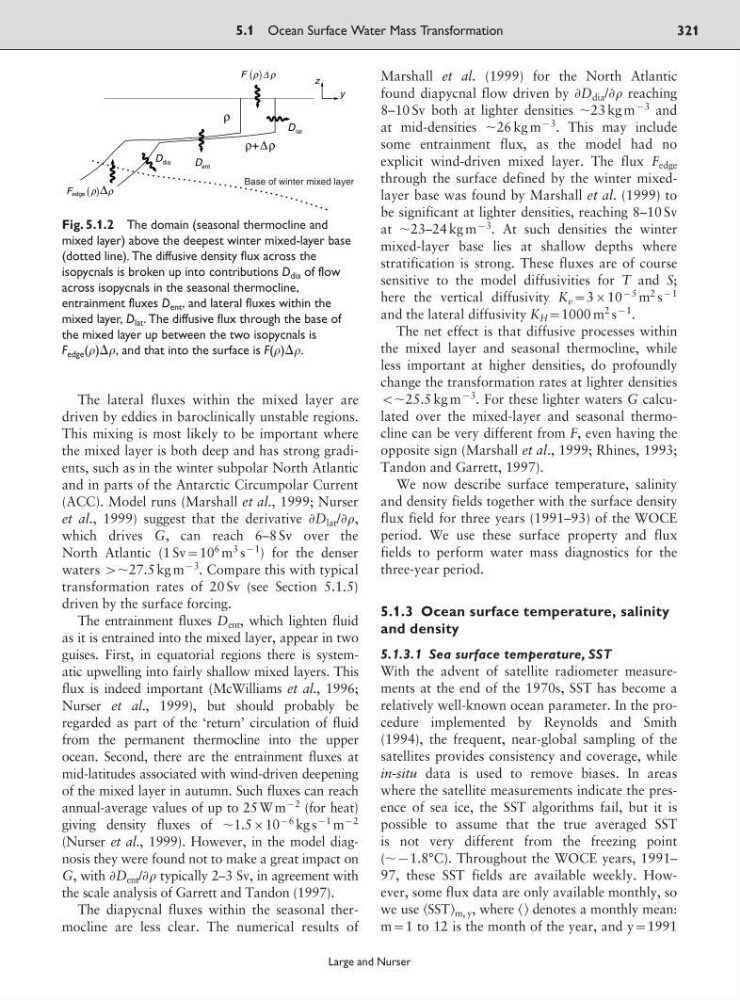
The lateral fluxes within the mixed layer are
driven by eddies in baroclinically unstable regions.
This mixing is most likely to be important where
the mixed layer is both deep and has strong gradients, such as in the winter subpolar North Atlantic
and in parts of the Antarctic Circumpolar Current
(ACC). Model runs (Marshall et al., 1999; Nurser
et al., 1999) suggest that the derivative ѨD lat /Ѩ,
which drives G, can reach 6–8 Sv over the
North Atlantic (1 Sv:10
6 m
3 s
91 ) for the denser
waters 9ϳ27.5 kg m
93 . Compare this with typical
transformation rates of 20 Sv (see Section 5.1.5)
driven by the surface forcing.
The entrainment fluxes D ent , which lighten fluid
as it is entrained into the mixed layer, appear in two
guises. First, in equatorial regions there is systematic upwelling into fairly shallow mixed layers. This
flux is indeed important (McWilliams et al., 1996;
Nurser et al., 1999), but should probably be
regarded as part of the ‘return’ circulation of fluid
from the permanent thermocline into the upper
ocean. Second, there are the entrainment fluxes at
mid-latitudes associated with wind-driven deepening
of the mixed layer in autumn. Such fluxes can reach
annual-average values of up to 25 W m
92 (for heat)
giving density fluxes of ϳ1.510
96 kg s
91 m
92
(Nurser et al., 1999). However, in the model diagnosis they were found not to make a great impact on
G, with ѨD ent /Ѩ typically 2–3 Sv, in agreement with
the scale analysis of Garrett and Tandon (1997).
The diapycnal fluxes within the seasonal thermocline are less clear. The numerical results of
Marshall et al. (1999) for the North Atlantic
found diapycnal flow driven by ѨD dia /Ѩ reaching
8–10 Sv both at lighter densities ϳ23 kg m
93 and
at mid-densities ϳ26 kg m
93
. This may include
some entrainment flux, as the model had no
explicit wind-driven mixed layer. The flux F edge
through the surface defined by the winter mixedlayer base was found by Marshall et al. (1999) to
be significant at lighter densities, reaching 8–10 Sv
at ϳ23–24 kg m
93 . At such densities the winter
mixed-layer base lies at shallow depths where
stratification is strong. These fluxes are of course
sensitive to the model diffusivities for T and S;
here the vertical diffusivity K v :310
95 m
2 s
91
and the lateral diffusivity K H :1000 m
2 s
91
.
The net effect is that diffusive processes within
the mixed layer and seasonal thermocline, while
less important at higher densities, do profoundly
change the transformation rates at lighter densities
:ϳ25.5 kg m
93
. For these lighter waters G calculated over the mixed-layer and seasonal thermocline can be very different from F, even having the
opposite sign (Marshall et al., 1999; Rhines, 1993;
Tandon and Garrett, 1997).
We now describe surface temperature, salinity
and density fields together with the surface density
flux field for three years (1991–93) of the WOCE
period. We use these surface property and flux
fields to perform water mass diagnostics for the
three-year period.
5.1.3 Ocean surface temperature, salinity
and density
5.1.3.1 Sea surface temperature, SST
With the advent of satellite radiometer measurements at the end of the 1970s, SST has become a
relatively well-known ocean parameter. In the procedure implemented by Reynolds and Smith
(1994), the frequent, near-global sampling of the
satellites provides consistency and coverage, while
in-situ data is used to remove biases. In areas
where the satellite measurements indicate the presence of sea ice, the SST algorithms fail, but it is
possible to assume that the true averaged SST
is not very different from the freezing point
(ϳ91.8°C). Throughout the WOCE years, 1991–
97, these SST fields are available weekly. However, some flux data are only available monthly, so
we use ͗SST͘ m, y , where ͗ ͘ denotes a monthly mean:
m:1 to 12 is the month of the year, and y:1991
5.1 Ocean Surface Water Mass Transformation
321
Large and Nurser
y
z
D ent
D dia
D lat
Base of winter mixed layer
ρ
ρ+Δρ
F edge ρ ρ
( )
F ρ ρ
( )Δ
Δ
Fig. 5.1.2 The domain (seasonal thermocline and
mixed layer) above the deepest winter mixed-layer base
(dotted line). The diffusive density flux across the
isopycnals is broken up into contributions D dia of flow
across isopycnals in the seasonal thermocline,
entrainment fluxes D ent , and lateral fluxes within the
mixed layer, D lat . The diffusive flux through the base of
the mixed layer up between the two isopycnals is
F edge ()⌬, and that into the surface is F()⌬.
driven by eddies in baroclinically unstable regions.
This mixing is most likely to be important where
the mixed layer is both deep and has strong gradients, such as in the winter subpolar North Atlantic
and in parts of the Antarctic Circumpolar Current
(ACC). Model runs (Marshall et al., 1999; Nurser
et al., 1999) suggest that the derivative ѨD lat /Ѩ,
which drives G, can reach 6–8 Sv over the
North Atlantic (1 Sv:10
6 m
3 s
91 ) for the denser
waters 9ϳ27.5 kg m
93 . Compare this with typical
transformation rates of 20 Sv (see Section 5.1.5)
driven by the surface forcing.
The entrainment fluxes D ent , which lighten fluid
as it is entrained into the mixed layer, appear in two
guises. First, in equatorial regions there is systematic upwelling into fairly shallow mixed layers. This
flux is indeed important (McWilliams et al., 1996;
Nurser et al., 1999), but should probably be
regarded as part of the ‘return’ circulation of fluid
from the permanent thermocline into the upper
ocean. Second, there are the entrainment fluxes at
mid-latitudes associated with wind-driven deepening
of the mixed layer in autumn. Such fluxes can reach
annual-average values of up to 25 W m
92 (for heat)
giving density fluxes of ϳ1.510
96 kg s
91 m
92
(Nurser et al., 1999). However, in the model diagnosis they were found not to make a great impact on
G, with ѨD ent /Ѩ typically 2–3 Sv, in agreement with
the scale analysis of Garrett and Tandon (1997).
The diapycnal fluxes within the seasonal thermocline are less clear. The numerical results of
Marshall et al. (1999) for the North Atlantic
found diapycnal flow driven by ѨD dia /Ѩ reaching
8–10 Sv both at lighter densities ϳ23 kg m
93 and
at mid-densities ϳ26 kg m
93
. This may include
some entrainment flux, as the model had no
explicit wind-driven mixed layer. The flux F edge
through the surface defined by the winter mixedlayer base was found by Marshall et al. (1999) to
be significant at lighter densities, reaching 8–10 Sv
at ϳ23–24 kg m
93 . At such densities the winter
mixed-layer base lies at shallow depths where
stratification is strong. These fluxes are of course
sensitive to the model diffusivities for T and S;
here the vertical diffusivity K v :310
95 m
2 s
91
and the lateral diffusivity K H :1000 m
2 s
91
.
The net effect is that diffusive processes within
the mixed layer and seasonal thermocline, while
less important at higher densities, do profoundly
change the transformation rates at lighter densities
:ϳ25.5 kg m
93
. For these lighter waters G calculated over the mixed-layer and seasonal thermocline can be very different from F, even having the
opposite sign (Marshall et al., 1999; Rhines, 1993;
Tandon and Garrett, 1997).
We now describe surface temperature, salinity
and density fields together with the surface density
flux field for three years (1991–93) of the WOCE
period. We use these surface property and flux
fields to perform water mass diagnostics for the
three-year period.
5.1.3 Ocean surface temperature, salinity
and density
5.1.3.1 Sea surface temperature, SST
With the advent of satellite radiometer measurements at the end of the 1970s, SST has become a
relatively well-known ocean parameter. In the procedure implemented by Reynolds and Smith
(1994), the frequent, near-global sampling of the
satellites provides consistency and coverage, while
in-situ data is used to remove biases. In areas
where the satellite measurements indicate the presence of sea ice, the SST algorithms fail, but it is
possible to assume that the true averaged SST
is not very different from the freezing point
(ϳ91.8°C). Throughout the WOCE years, 1991–
97, these SST fields are available weekly. However, some flux data are only available monthly, so
we use ͗SST͘ m, y , where ͗ ͘ denotes a monthly mean:
m:1 to 12 is the month of the year, and y:1991
5.1 Ocean Surface Water Mass Transformation
321
Large and Nurser
y
z
D ent
D dia
D lat
Base of winter mixed layer
ρ
ρ+Δρ
F edge ρ ρ
( )
F ρ ρ
( )Δ
Δ
Fig. 5.1.2 The domain (seasonal thermocline and
mixed layer) above the deepest winter mixed-layer base
(dotted line). The diffusive density flux across the
isopycnals is broken up into contributions D dia of flow
across isopycnals in the seasonal thermocline,
entrainment fluxes D ent , and lateral fluxes within the
mixed layer, D lat . The diffusive flux through the base of
the mixed layer up between the two isopycnals is
F edge ()⌬, and that into the surface is F()⌬.