

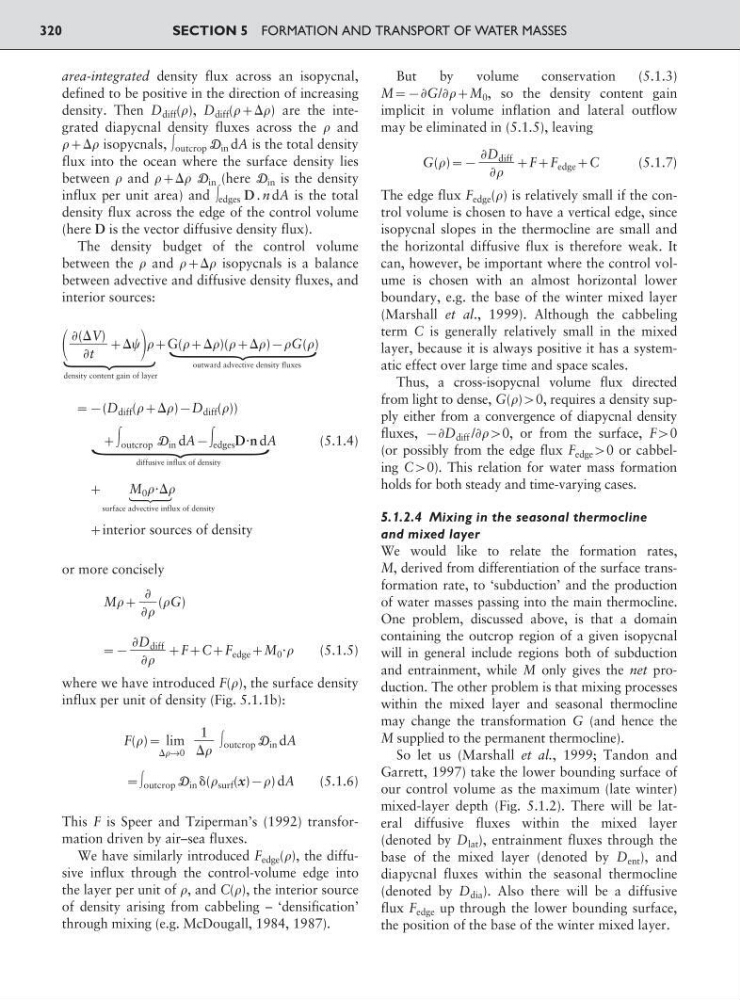
area-integrated density flux across an isopycnal,
defined to be positive in the direction of increasing
density. Then D diff (), D diff (;⌬) are the integrated diapycnal density fluxes across the and
;⌬ isopycnals, ͵ outcrop D in dA is the total density
flux into the ocean where the surface density lies
between and ;⌬ D in (here D in is the density
influx per unit area) and ͵ edges D . n dA is the total
density flux across the edge of the control volume
(here D is the vector diffusive density flux).
The density budget of the control volume
between the and ;⌬ isopycnals is a balance
between advective and diffusive density fluxes, and
interior sources:
or more concisely
M;
(G)
:9
;F;C;F edge ;M 0 и
(5.1.5)
where we have introduced F(), the surface density
influx per unit of density (Fig. 5.1.1b):
F(): lim
⌬→0
͵ outcrop D in dA
: ͵ outcrop D in ␦( surf (x)9) dA (5.1.6)
This F is Speer and Tziperman’s (1992) transformation driven by air–sea fluxes.
We have similarly introduced F edge (), the diffusive influx through the control-volume edge into
the layer per unit of , and C(), the interior source
of density arising from cabbeling – ‘densification’
through mixing (e.g. McDougall, 1984, 1987).
But
by
volume
conservation
(5.1.3)
M:9ѨG/Ѩ;M 0 , so the density content gain
implicit in volume inflation and lateral outflow
may be eliminated in (5.1.5), leaving
G():9
;F;F edge ;C
(5.1.7)
The edge flux F edge () is relatively small if the control volume is chosen to have a vertical edge, since
isopycnal slopes in the thermocline are small and
the horizontal diffusive flux is therefore weak. It
can, however, be important where the control volume is chosen with an almost horizontal lower
boundary, e.g. the base of the winter mixed layer
(Marshall et al., 1999). Although the cabbeling
term C is generally relatively small in the mixed
layer, because it is always positive it has a systematic effect over large time and space scales.
Thus, a cross-isopycnal volume flux directed
from light to dense, G()90, requires a density supply either from a convergence of diapycnal density
fluxes, 9ѨD diff /Ѩ90, or from the surface, F90
(or possibly from the edge flux F edge 90 or cabbeling C90). This relation for water mass formation
holds for both steady and time-varying cases.
5.1.2.4 Mixing in the seasonal thermocline
and mixed layer
We would like to relate the formation rates,
M, derived from differentiation of the surface transformation rate, to ‘subduction’ and the production
of water masses passing into the main thermocline.
One problem, discussed above, is that a domain
containing the outcrop region of a given isopycnal
will in general include regions both of subduction
and entrainment, while M only gives the net production. The other problem is that mixing processes
within the mixed layer and seasonal thermocline
may change the transformation G (and hence the
M supplied to the permanent thermocline).
So let us (Marshall et al., 1999; Tandon and
Garrett, 1997) take the lower bounding surface of
our control volume as the maximum (late winter)
mixed-layer depth (Fig. 5.1.2). There will be lateral diffusive fluxes within the mixed layer
(denoted by D lat ), entrainment fluxes through the
base of the mixed layer (denoted by D ent ), and
diapycnal fluxes within the seasonal thermocline
(denoted by D dia ). Also there will be a diffusive
flux F edge up through the lower bounding surface,
the position of the base of the winter mixed layer.
ѨD diff
ᎏ
Ѩ
1
ᎏ
⌬
ѨD diff
ᎏ
Ѩ
Ѩ
ᎏ
Ѩ
SECTION 5 FORMATION AND TRANSPORT OF WATER MASSES
320
;⌬ ;G(;⌬)(;⌬)9G()
:9(D diff (;⌬)9D diff ())
; ͵ outcrop D in dA9 ͵ edges Dиn dA
(5.1.4)
;
M 0 и⌬
;interior sources of density
Ѩ(⌬V)
ᎏ
Ѩt
outward advective density fluxes
·
density content gain of layer
·
diffusive influx of density
·
surface advective influx of density
·
defined to be positive in the direction of increasing
density. Then D diff (), D diff (;⌬) are the integrated diapycnal density fluxes across the and
;⌬ isopycnals, ͵ outcrop D in dA is the total density
flux into the ocean where the surface density lies
between and ;⌬ D in (here D in is the density
influx per unit area) and ͵ edges D . n dA is the total
density flux across the edge of the control volume
(here D is the vector diffusive density flux).
The density budget of the control volume
between the and ;⌬ isopycnals is a balance
between advective and diffusive density fluxes, and
interior sources:
or more concisely
M;
(G)
:9
;F;C;F edge ;M 0 и
(5.1.5)
where we have introduced F(), the surface density
influx per unit of density (Fig. 5.1.1b):
F(): lim
⌬→0
͵ outcrop D in dA
: ͵ outcrop D in ␦( surf (x)9) dA (5.1.6)
This F is Speer and Tziperman’s (1992) transformation driven by air–sea fluxes.
We have similarly introduced F edge (), the diffusive influx through the control-volume edge into
the layer per unit of , and C(), the interior source
of density arising from cabbeling – ‘densification’
through mixing (e.g. McDougall, 1984, 1987).
But
by
volume
conservation
(5.1.3)
M:9ѨG/Ѩ;M 0 , so the density content gain
implicit in volume inflation and lateral outflow
may be eliminated in (5.1.5), leaving
G():9
;F;F edge ;C
(5.1.7)
The edge flux F edge () is relatively small if the control volume is chosen to have a vertical edge, since
isopycnal slopes in the thermocline are small and
the horizontal diffusive flux is therefore weak. It
can, however, be important where the control volume is chosen with an almost horizontal lower
boundary, e.g. the base of the winter mixed layer
(Marshall et al., 1999). Although the cabbeling
term C is generally relatively small in the mixed
layer, because it is always positive it has a systematic effect over large time and space scales.
Thus, a cross-isopycnal volume flux directed
from light to dense, G()90, requires a density supply either from a convergence of diapycnal density
fluxes, 9ѨD diff /Ѩ90, or from the surface, F90
(or possibly from the edge flux F edge 90 or cabbeling C90). This relation for water mass formation
holds for both steady and time-varying cases.
5.1.2.4 Mixing in the seasonal thermocline
and mixed layer
We would like to relate the formation rates,
M, derived from differentiation of the surface transformation rate, to ‘subduction’ and the production
of water masses passing into the main thermocline.
One problem, discussed above, is that a domain
containing the outcrop region of a given isopycnal
will in general include regions both of subduction
and entrainment, while M only gives the net production. The other problem is that mixing processes
within the mixed layer and seasonal thermocline
may change the transformation G (and hence the
M supplied to the permanent thermocline).
So let us (Marshall et al., 1999; Tandon and
Garrett, 1997) take the lower bounding surface of
our control volume as the maximum (late winter)
mixed-layer depth (Fig. 5.1.2). There will be lateral diffusive fluxes within the mixed layer
(denoted by D lat ), entrainment fluxes through the
base of the mixed layer (denoted by D ent ), and
diapycnal fluxes within the seasonal thermocline
(denoted by D dia ). Also there will be a diffusive
flux F edge up through the lower bounding surface,
the position of the base of the winter mixed layer.
ѨD diff
ᎏ
Ѩ
1
ᎏ
⌬
ѨD diff
ᎏ
Ѩ
Ѩ
ᎏ
Ѩ
SECTION 5 FORMATION AND TRANSPORT OF WATER MASSES
320
;⌬ ;G(;⌬)(;⌬)9G()
:9(D diff (;⌬)9D diff ())
; ͵ outcrop D in dA9 ͵ edges Dиn dA
(5.1.4)
;
M 0 и⌬
;interior sources of density
Ѩ(⌬V)
ᎏ
Ѩt
outward advective density fluxes
·
density content gain of layer
·
diffusive influx of density
·
surface advective influx of density
·