

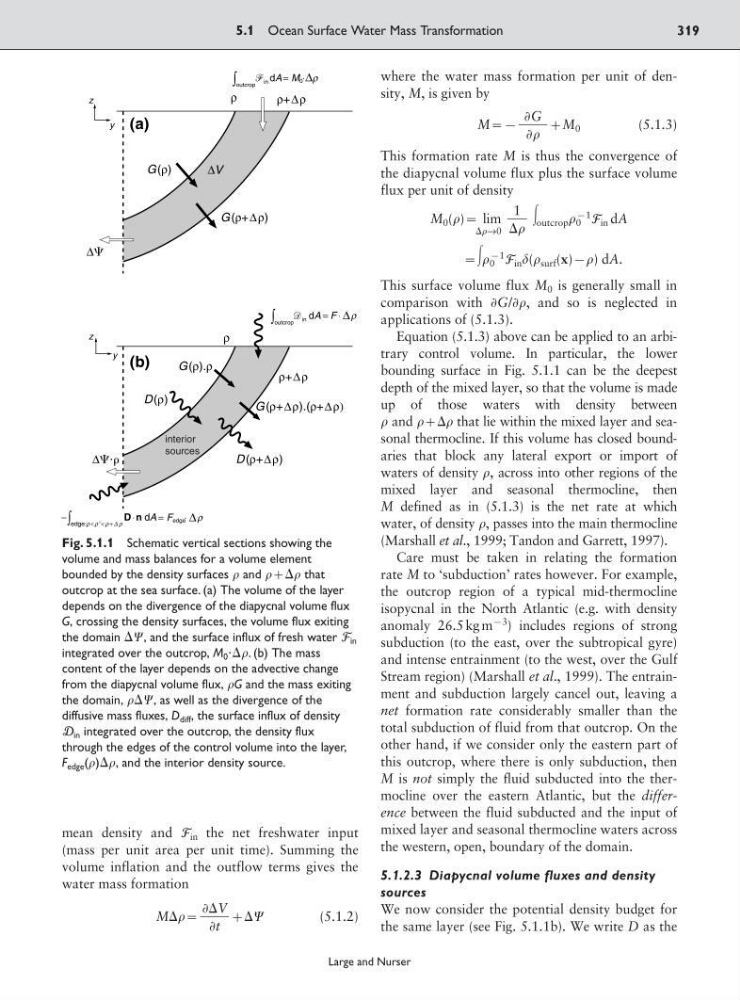
mean density and F in the net freshwater input
(mass per unit area per unit time). Summing the
volume inflation and the outflow terms gives the
water mass formation
M⌬:
;⌬
(5.1.2)
where the water mass formation per unit of density, M, is given by
M:9
;M 0
(5.1.3)
This formation rate M is thus the convergence of
the diapycnal volume flux plus the surface volume
flux per unit of density
M 0 (): lim
⌬→0
͵ outcrop 0
91
F in dA
: ͵ 0
91
F in ( surf (x)9) dA.
This surface volume flux M 0 is generally small in
comparison with ѨG/Ѩ, and so is neglected in
applications of (5.1.3).
Equation (5.1.3) above can be applied to an arbitrary control volume. In particular, the lower
bounding surface in Fig. 5.1.1 can be the deepest
depth of the mixed layer, so that the volume is made
up of those waters with density between
and ;⌬ that lie within the mixed layer and seasonal thermocline. If this volume has closed boundaries that block any lateral export or import of
waters of density , across into other regions of the
mixed layer and seasonal thermocline, then
M defined as in (5.1.3) is the net rate at which
water, of density , passes into the main thermocline
(Marshall et al., 1999; Tandon and Garrett, 1997).
Care must be taken in relating the formation
rate M to ‘subduction’ rates however. For example,
the outcrop region of a typical mid-thermocline
isopycnal in the North Atlantic (e.g. with density
anomaly 26.5 kg m
93
) includes regions of strong
subduction (to the east, over the subtropical gyre)
and intense entrainment (to the west, over the Gulf
Stream region) (Marshall et al., 1999). The entrainment and subduction largely cancel out, leaving a
net formation rate considerably smaller than the
total subduction of fluid from that outcrop. On the
other hand, if we consider only the eastern part of
this outcrop, where there is only subduction, then
M is not simply the fluid subducted into the thermocline over the eastern Atlantic, but the difference between the fluid subducted and the input of
mixed layer and seasonal thermocline waters across
the western, open, boundary of the domain.
5.1.2.3 Diapycnal volume fluxes and density
sources
We now consider the potential density budget for
the same layer (see Fig. 5.1.1b). We write D as the
1
ᎏ
⌬
ѨG
ᎏ
Ѩ
Ѩ⌬V
ᎏ
Ѩt
5.1 Ocean Surface Water Mass Transformation
319
Large and Nurser
ρ+Δρ
ρ
G(ρ+Δρ)
G(ρ)
ΔV
ρ+Δρ
ρ
G(ρ).ρ
D(ρ)
D(ρ+Δρ)
y
y
z
G(ρ+Δρ).(ρ+Δρ)
z
(a)
(b)
in
outcrop
dA F
∫
= ⋅ ρ
−
⋅
< ′ < +
∫
D n dA
edge:ρ ρ ρ
ρ
Δ
interior
sources
in
outcrop
dA M 0
∫
= ⋅ ρ
F edge
=
⋅ ρ
Δ
Δ
Δ
Fig. 5.1.1 Schematic vertical sections showing the
volume and mass balances for a volume element
bounded by the density surfaces and ;⌬ that
outcrop at the sea surface. (a) The volume of the layer
depends on the divergence of the diapycnal volume flux
G, crossing the density surfaces, the volume flux exiting
the domain ⌬, and the surface influx of fresh water F in
integrated over the outcrop, M 0 и⌬. (b) The mass
content of the layer depends on the advective change
from the diapycnal volume flux, G and the mass exiting
the domain, ⌬, as well as the divergence of the
diffusive mass fluxes, D diff , the surface influx of density
D in integrated over the outcrop, the density flux
through the edges of the control volume into the layer,
F edge ()⌬, and the interior density source.
(mass per unit area per unit time). Summing the
volume inflation and the outflow terms gives the
water mass formation
M⌬:
;⌬
(5.1.2)
where the water mass formation per unit of density, M, is given by
M:9
;M 0
(5.1.3)
This formation rate M is thus the convergence of
the diapycnal volume flux plus the surface volume
flux per unit of density
M 0 (): lim
⌬→0
͵ outcrop 0
91
F in dA
: ͵ 0
91
F in ( surf (x)9) dA.
This surface volume flux M 0 is generally small in
comparison with ѨG/Ѩ, and so is neglected in
applications of (5.1.3).
Equation (5.1.3) above can be applied to an arbitrary control volume. In particular, the lower
bounding surface in Fig. 5.1.1 can be the deepest
depth of the mixed layer, so that the volume is made
up of those waters with density between
and ;⌬ that lie within the mixed layer and seasonal thermocline. If this volume has closed boundaries that block any lateral export or import of
waters of density , across into other regions of the
mixed layer and seasonal thermocline, then
M defined as in (5.1.3) is the net rate at which
water, of density , passes into the main thermocline
(Marshall et al., 1999; Tandon and Garrett, 1997).
Care must be taken in relating the formation
rate M to ‘subduction’ rates however. For example,
the outcrop region of a typical mid-thermocline
isopycnal in the North Atlantic (e.g. with density
anomaly 26.5 kg m
93
) includes regions of strong
subduction (to the east, over the subtropical gyre)
and intense entrainment (to the west, over the Gulf
Stream region) (Marshall et al., 1999). The entrainment and subduction largely cancel out, leaving a
net formation rate considerably smaller than the
total subduction of fluid from that outcrop. On the
other hand, if we consider only the eastern part of
this outcrop, where there is only subduction, then
M is not simply the fluid subducted into the thermocline over the eastern Atlantic, but the difference between the fluid subducted and the input of
mixed layer and seasonal thermocline waters across
the western, open, boundary of the domain.
5.1.2.3 Diapycnal volume fluxes and density
sources
We now consider the potential density budget for
the same layer (see Fig. 5.1.1b). We write D as the
1
ᎏ
⌬
ѨG
ᎏ
Ѩ
Ѩ⌬V
ᎏ
Ѩt
5.1 Ocean Surface Water Mass Transformation
319
Large and Nurser
ρ+Δρ
ρ
G(ρ+Δρ)
G(ρ)
ΔV
ρ+Δρ
ρ
G(ρ).ρ
D(ρ)
D(ρ+Δρ)
y
y
z
G(ρ+Δρ).(ρ+Δρ)
z
(a)
(b)
in
outcrop
dA F
∫
= ⋅ ρ
−
⋅
< ′ < +
∫
D n dA
edge:ρ ρ ρ
ρ
Δ
interior
sources
in
outcrop
dA M 0
∫
= ⋅ ρ
F edge
=
⋅ ρ
Δ
Δ
Δ
Fig. 5.1.1 Schematic vertical sections showing the
volume and mass balances for a volume element
bounded by the density surfaces and ;⌬ that
outcrop at the sea surface. (a) The volume of the layer
depends on the divergence of the diapycnal volume flux
G, crossing the density surfaces, the volume flux exiting
the domain ⌬, and the surface influx of fresh water F in
integrated over the outcrop, M 0 и⌬. (b) The mass
content of the layer depends on the advective change
from the diapycnal volume flux, G and the mass exiting
the domain, ⌬, as well as the divergence of the
diffusive mass fluxes, D diff , the surface influx of density
D in integrated over the outcrop, the density flux
through the edges of the control volume into the layer,
F edge ()⌬, and the interior density source.