

somewhat relieved when partial barriers are introduced representing continents and leaving smaller
gaps (Drake Passage) for the current to pass
through (Gill, 1968).
The flat-bottom case gives unrealistic results
because it does not allow for the bottom form
stress to work in the overall momentum balance
(4.6.3), repeated here as
x
9
x
b 9H ෆp ෆ b ෆ x ෆ:0
(4.6.17)
This balance has been shown to hold in all more
or less realistic numerical models (
x
b is the frictional bottom stress, put to the linear from 0 RHu
below). The relevance of equation (4.6.17) to the
transport becomes clear when the relation of the
bottom form stress to the physical mechanisms
responsible for establishment of the bottom pressure field are considered.
The simplest of such models are barotropic with
simple topography. For Charney and DeVore’s
(1979) barotropic model of QG flow over sinusoidal terrain (with wavelength 2/k), the bottom
form stress is evaluated as
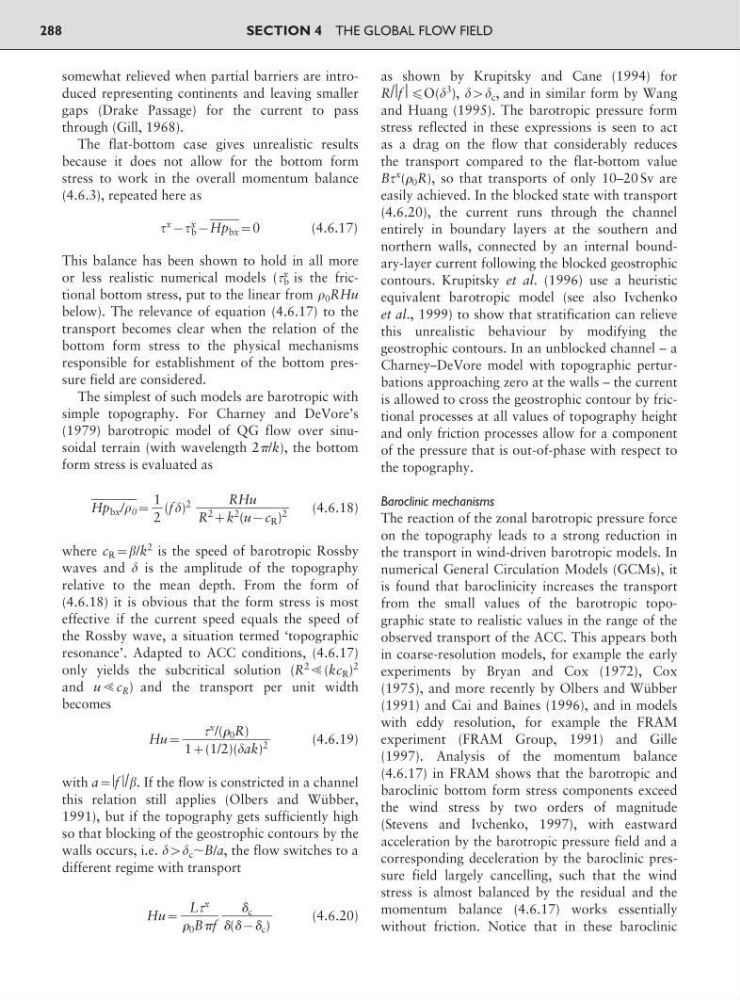
H ෆp ෆ b ෆ x ෆ/ ෆ ෆ 0
ෆ: (f)
2
(4.6.18)
where c R :/k
2 is the speed of barotropic Rossby
waves and is the amplitude of the topography
relative to the mean depth. From the form of
(4.6.18) it is obvious that the form stress is most
effective if the current speed equals the speed of
the Rossby wave, a situation termed ‘topographic
resonance’. Adapted to ACC conditions, (4.6.17)
only yields the subcritical solution (R
2
Ӷ (kc R )
2
and u Ӷ c R ) and the transport per unit width
becomes
Hu:
(4.6.19)
with a:|f |/. If the flow is constricted in a channel
this relation still applies (Olbers and Wübber,
1991), but if the topography gets sufficiently high
so that blocking of the geostrophic contours by the
walls occurs, i.e. 9 c ϳB/a, the flow switches to a
different regime with transport
Hu:
(4.6.20)
as shown by Krupitsky and Cane (1994) for
R/|f | -O(
3 ), 9 c , and in similar form by Wang
and Huang (1995). The barotropic pressure form
stress reflected in these expressions is seen to act
as a drag on the flow that considerably reduces
the transport compared to the flat-bottom value
B
x
( 0 R), so that transports of only 10–20 Sv are
easily achieved. In the blocked state with transport
(4.6.20), the current runs through the channel
entirely in boundary layers at the southern and
northern walls, connected by an internal boundary-layer current following the blocked geostrophic
contours. Krupitsky et al. (1996) use a heuristic
equivalent barotropic model (see also Ivchenko
et al., 1999) to show that stratification can relieve
this unrealistic behaviour by modifying the
geostrophic contours. In an unblocked channel – a
Charney–DeVore model with topographic perturbations approaching zero at the walls – the current
is allowed to cross the geostrophic contour by frictional processes at all values of topography height
and only friction processes allow for a component
of the pressure that is out-of-phase with respect to
the topography.
Baroclinic mechanisms
The reaction of the zonal barotropic pressure force
on the topography leads to a strong reduction in
the transport in wind-driven barotropic models. In
numerical General Circulation Models (GCMs), it
is found that baroclinicity increases the transport
from the small values of the barotropic topographic state to realistic values in the range of the
observed transport of the ACC. This appears both
in coarse-resolution models, for example the early
experiments by Bryan and Cox (1972), Cox
(1975), and more recently by Olbers and Wübber
(1991) and Cai and Baines (1996), and in models
with eddy resolution, for example the FRAM
experiment (FRAM Group, 1991) and Gille
(1997). Analysis of the momentum balance
(4.6.17) in FRAM shows that the barotropic and
baroclinic bottom form stress components exceed
the wind stress by two orders of magnitude
(Stevens and Ivchenko, 1997), with eastward
acceleration by the barotropic pressure field and a
corresponding deceleration by the baroclinic pressure field largely cancelling, such that the wind
stress is almost balanced by the residual and the
momentum balance (4.6.17) works essentially
without friction. Notice that in these baroclinic
␦ c
ᎏ
␦(␦9␦ c )
L
x
ᎏ
0 Bf
x /( 0 R)
ᎏᎏ
1;(1/2)(ak)
2
RHu
ᎏᎏ
R
2
;k
2
(u9c R )
2
1
ᎏ
2
SECTION 4 THE GLOBAL FLOW FIELD
288
gaps (Drake Passage) for the current to pass
through (Gill, 1968).
The flat-bottom case gives unrealistic results
because it does not allow for the bottom form
stress to work in the overall momentum balance
(4.6.3), repeated here as
x
9
x
b 9H ෆp ෆ b ෆ x ෆ:0
(4.6.17)
This balance has been shown to hold in all more
or less realistic numerical models (
x
b is the frictional bottom stress, put to the linear from 0 RHu
below). The relevance of equation (4.6.17) to the
transport becomes clear when the relation of the
bottom form stress to the physical mechanisms
responsible for establishment of the bottom pressure field are considered.
The simplest of such models are barotropic with
simple topography. For Charney and DeVore’s
(1979) barotropic model of QG flow over sinusoidal terrain (with wavelength 2/k), the bottom
form stress is evaluated as
H ෆp ෆ b ෆ x ෆ/ ෆ ෆ 0
ෆ: (f)
2
(4.6.18)
where c R :/k
2 is the speed of barotropic Rossby
waves and is the amplitude of the topography
relative to the mean depth. From the form of
(4.6.18) it is obvious that the form stress is most
effective if the current speed equals the speed of
the Rossby wave, a situation termed ‘topographic
resonance’. Adapted to ACC conditions, (4.6.17)
only yields the subcritical solution (R
2
Ӷ (kc R )
2
and u Ӷ c R ) and the transport per unit width
becomes
Hu:
(4.6.19)
with a:|f |/. If the flow is constricted in a channel
this relation still applies (Olbers and Wübber,
1991), but if the topography gets sufficiently high
so that blocking of the geostrophic contours by the
walls occurs, i.e. 9 c ϳB/a, the flow switches to a
different regime with transport
Hu:
(4.6.20)
as shown by Krupitsky and Cane (1994) for
R/|f | -O(
3 ), 9 c , and in similar form by Wang
and Huang (1995). The barotropic pressure form
stress reflected in these expressions is seen to act
as a drag on the flow that considerably reduces
the transport compared to the flat-bottom value
B
x
( 0 R), so that transports of only 10–20 Sv are
easily achieved. In the blocked state with transport
(4.6.20), the current runs through the channel
entirely in boundary layers at the southern and
northern walls, connected by an internal boundary-layer current following the blocked geostrophic
contours. Krupitsky et al. (1996) use a heuristic
equivalent barotropic model (see also Ivchenko
et al., 1999) to show that stratification can relieve
this unrealistic behaviour by modifying the
geostrophic contours. In an unblocked channel – a
Charney–DeVore model with topographic perturbations approaching zero at the walls – the current
is allowed to cross the geostrophic contour by frictional processes at all values of topography height
and only friction processes allow for a component
of the pressure that is out-of-phase with respect to
the topography.
Baroclinic mechanisms
The reaction of the zonal barotropic pressure force
on the topography leads to a strong reduction in
the transport in wind-driven barotropic models. In
numerical General Circulation Models (GCMs), it
is found that baroclinicity increases the transport
from the small values of the barotropic topographic state to realistic values in the range of the
observed transport of the ACC. This appears both
in coarse-resolution models, for example the early
experiments by Bryan and Cox (1972), Cox
(1975), and more recently by Olbers and Wübber
(1991) and Cai and Baines (1996), and in models
with eddy resolution, for example the FRAM
experiment (FRAM Group, 1991) and Gille
(1997). Analysis of the momentum balance
(4.6.17) in FRAM shows that the barotropic and
baroclinic bottom form stress components exceed
the wind stress by two orders of magnitude
(Stevens and Ivchenko, 1997), with eastward
acceleration by the barotropic pressure field and a
corresponding deceleration by the baroclinic pressure field largely cancelling, such that the wind
stress is almost balanced by the residual and the
momentum balance (4.6.17) works essentially
without friction. Notice that in these baroclinic
␦ c
ᎏ
␦(␦9␦ c )
L
x
ᎏ
0 Bf
x /( 0 R)
ᎏᎏ
1;(1/2)(ak)
2
RHu
ᎏᎏ
R
2
;k
2
(u9c R )
2
1
ᎏ
2
SECTION 4 THE GLOBAL FLOW FIELD
288