

conditions the barotropic pressure does not act as
a drag as in homogeneous models. Coarse models
have an equally strong effect of the baroclinic
pressure field but an unrealistically large contribution from lateral friction.
Baroclinic pressure gradients are established
either by thermohaline forcing changing the stratification by water mass conversion, or simply by
adiabatic rearrangement of a prescribed layering
of stratified mass being lifted over the topography.
The latter mechanism is operating in baroclinic
adiabatic models (case I in the terminology of
Section 4.6.3.2). As shown in Olbers and Völker
(1996) and Völker (1999), the waves that produce
the topographic resonance of Charney and DeVore
(1979) are now baroclinic. These are generated in
resonance with the topography and become stationary when the barotropic current speed equals
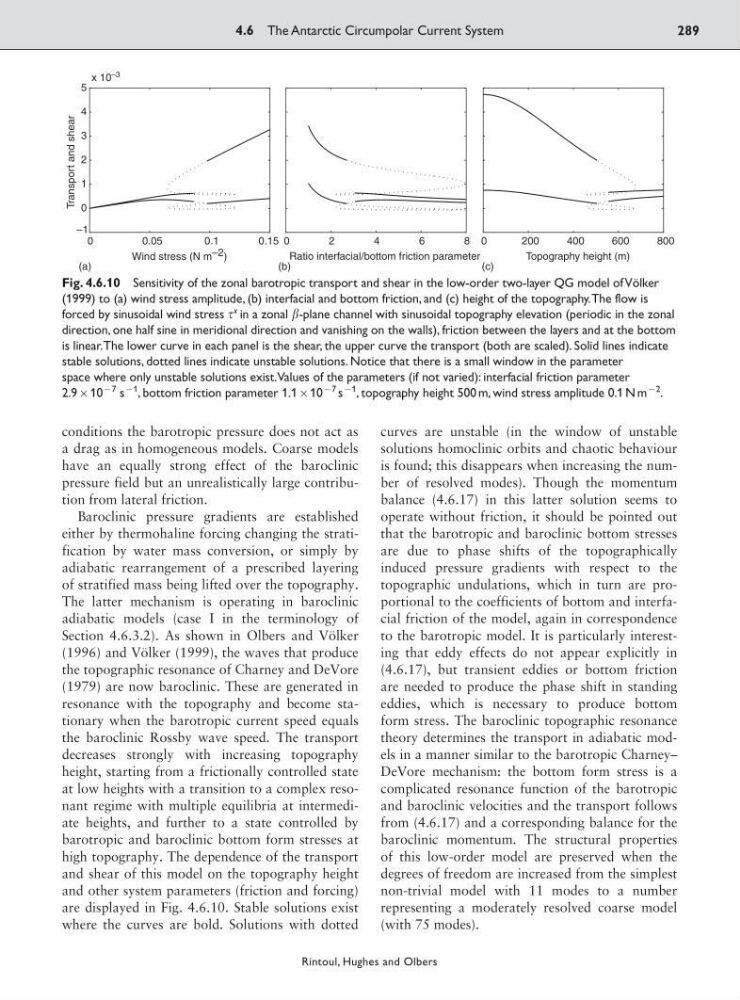
the baroclinic Rossby wave speed. The transport
decreases strongly with increasing topography
height, starting from a frictionally controlled state
at low heights with a transition to a complex resonant regime with multiple equilibria at intermediate heights, and further to a state controlled by
barotropic and baroclinic bottom form stresses at
high topography. The dependence of the transport
and shear of this model on the topography height
and other system parameters (friction and forcing)
are displayed in Fig. 4.6.10. Stable solutions exist
where the curves are bold. Solutions with dotted
curves are unstable (in the window of unstable
solutions homoclinic orbits and chaotic behaviour
is found; this disappears when increasing the number of resolved modes). Though the momentum
balance (4.6.17) in this latter solution seems to
operate without friction, it should be pointed out
that the barotropic and baroclinic bottom stresses
are due to phase shifts of the topographically
induced pressure gradients with respect to the
topographic undulations, which in turn are proportional to the coefficients of bottom and interfacial friction of the model, again in correspondence
to the barotropic model. It is particularly interesting that eddy effects do not appear explicitly in
(4.6.17), but transient eddies or bottom friction
are needed to produce the phase shift in standing
eddies, which is necessary to produce bottom
form stress. The baroclinic topographic resonance
theory determines the transport in adiabatic models in a manner similar to the barotropic Charney–
DeVore mechanism: the bottom form stress is a
complicated resonance function of the barotropic
and baroclinic velocities and the transport follows
from (4.6.17) and a corresponding balance for the
baroclinic momentum. The structural properties
of this low-order model are preserved when the
degrees of freedom are increased from the simplest
non-trivial model with 11 modes to a number
representing a moderately resolved coarse model
(with 75 modes).
4.6 The Antarctic Circumpolar Current System
289
Rintoul, Hughes and Olbers
0
0.05
0.1
0.15
–1
0
1
2
3
4
5
x 10 –3
Wind stress (N m –2 )
Transport and shear
0
2
4
6
8
Ratio interfacial/bottom friction parameter
0
200
400
600
800
Topography height (m)
(a)
(b)
(c)
Fig. 4.6.10 Sensitivity of the zonal barotropic transport and shear in the low-order two-layer QG model of Völker
(1999) to (a) wind stress amplitude, (b) interfacial and bottom friction, and (c) height of the topography.The flow is
forced by sinusoidal wind stress
x in a zonal -plane channel with sinusoidal topography elevation (periodic in the zonal
direction, one half sine in meridional direction and vanishing on the walls), friction between the layers and at the bottom
is linear.The lower curve in each panel is the shear, the upper curve the transport (both are scaled). Solid lines indicate
stable solutions, dotted lines indicate unstable solutions. Notice that there is a small window in the parameter
space where only unstable solutions exist.Values of the parameters (if not varied): interfacial friction parameter
2.910
97 s
91
, bottom friction parameter 1.110
97 s
91
, topography height 500 m, wind stress amplitude 0.1 N m
92
.
a drag as in homogeneous models. Coarse models
have an equally strong effect of the baroclinic
pressure field but an unrealistically large contribution from lateral friction.
Baroclinic pressure gradients are established
either by thermohaline forcing changing the stratification by water mass conversion, or simply by
adiabatic rearrangement of a prescribed layering
of stratified mass being lifted over the topography.
The latter mechanism is operating in baroclinic
adiabatic models (case I in the terminology of
Section 4.6.3.2). As shown in Olbers and Völker
(1996) and Völker (1999), the waves that produce
the topographic resonance of Charney and DeVore
(1979) are now baroclinic. These are generated in
resonance with the topography and become stationary when the barotropic current speed equals
the baroclinic Rossby wave speed. The transport
decreases strongly with increasing topography
height, starting from a frictionally controlled state
at low heights with a transition to a complex resonant regime with multiple equilibria at intermediate heights, and further to a state controlled by
barotropic and baroclinic bottom form stresses at
high topography. The dependence of the transport
and shear of this model on the topography height
and other system parameters (friction and forcing)
are displayed in Fig. 4.6.10. Stable solutions exist
where the curves are bold. Solutions with dotted
curves are unstable (in the window of unstable
solutions homoclinic orbits and chaotic behaviour
is found; this disappears when increasing the number of resolved modes). Though the momentum
balance (4.6.17) in this latter solution seems to
operate without friction, it should be pointed out
that the barotropic and baroclinic bottom stresses
are due to phase shifts of the topographically
induced pressure gradients with respect to the
topographic undulations, which in turn are proportional to the coefficients of bottom and interfacial friction of the model, again in correspondence
to the barotropic model. It is particularly interesting that eddy effects do not appear explicitly in
(4.6.17), but transient eddies or bottom friction
are needed to produce the phase shift in standing
eddies, which is necessary to produce bottom
form stress. The baroclinic topographic resonance
theory determines the transport in adiabatic models in a manner similar to the barotropic Charney–
DeVore mechanism: the bottom form stress is a
complicated resonance function of the barotropic
and baroclinic velocities and the transport follows
from (4.6.17) and a corresponding balance for the
baroclinic momentum. The structural properties
of this low-order model are preserved when the
degrees of freedom are increased from the simplest
non-trivial model with 11 modes to a number
representing a moderately resolved coarse model
(with 75 modes).
4.6 The Antarctic Circumpolar Current System
289
Rintoul, Hughes and Olbers
0
0.05
0.1
0.15
–1
0
1
2
3
4
5
x 10 –3
Wind stress (N m –2 )
Transport and shear
0
2
4
6
8
Ratio interfacial/bottom friction parameter
0
200
400
600
800
Topography height (m)
(a)
(b)
(c)
Fig. 4.6.10 Sensitivity of the zonal barotropic transport and shear in the low-order two-layer QG model of Völker
(1999) to (a) wind stress amplitude, (b) interfacial and bottom friction, and (c) height of the topography.The flow is
forced by sinusoidal wind stress
x in a zonal -plane channel with sinusoidal topography elevation (periodic in the zonal
direction, one half sine in meridional direction and vanishing on the walls), friction between the layers and at the bottom
is linear.The lower curve in each panel is the shear, the upper curve the transport (both are scaled). Solid lines indicate
stable solutions, dotted lines indicate unstable solutions. Notice that there is a small window in the parameter
space where only unstable solutions exist.Values of the parameters (if not varied): interfacial friction parameter
2.910
97 s
91
, bottom friction parameter 1.110
97 s
91
, topography height 500 m, wind stress amplitude 0.1 N m
92
.